
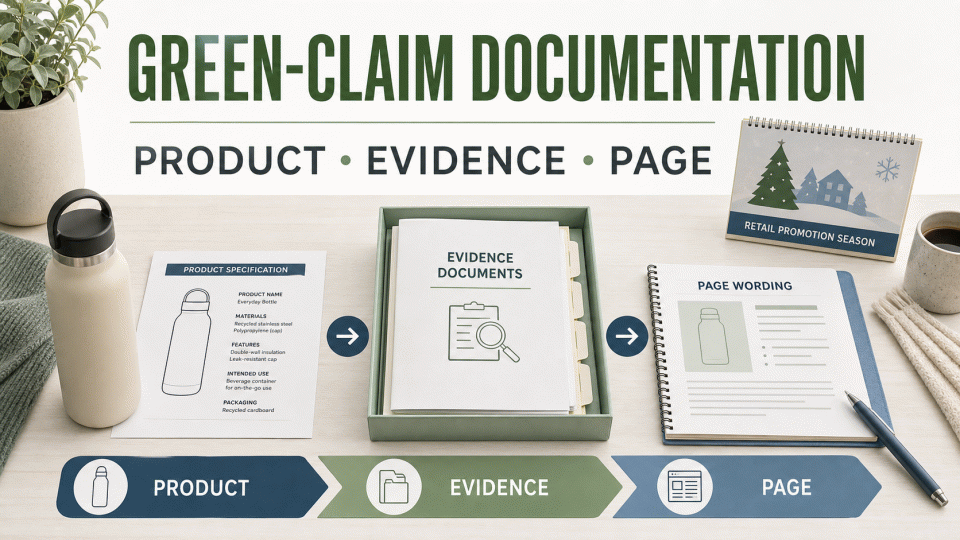
As a promotion period approaches, environmental labels, product attributes, and supply-chain records may be reviewed together. A defensible preparation method starts by defining the claim, then linking each claim to the actual product, supporting evidence, and page wording.
1. Define the claim object and scope
Separate the intended wording into a specific subject: recycled content, recyclability, compostability, renewable material, a product carbon footprint, a certification, or a platform program. The same offer may involve the product, its packaging, the legal entity, and supply-chain operations, but those objects are not interchangeable.
Create a scope card for every claim: product and SKU, formulation or version, packaging components, market, claim object, comparison basis if any, applicable program or standard, and evidence review date. Broad words such as “green,” “eco-friendly,” or “sustainable” should not be treated as proven conclusions without a defined basis. The U.S. Federal Trade Commission’s Green Guides caution that broad general environmental-benefit claims are difficult to substantiate and should be qualified with clear, specific benefits.
2. Link product facts to evidence
Use a product–evidence matrix rather than a generic certificate list. Check the issuing body, certificate holder, product or model, materials and formulation, facility or supply-chain scope, test method or standard version, issue date, current status, original-file location, and whether each field matches the SKU being sold.
A certification, laboratory report, supplier declaration, and purchase or batch record answer different questions. A supplier document may be part of the evidence, but its title alone does not establish eligibility for a platform program. For seals and certifications, verify scope, usage conditions, and current issuer rules; the FTC’s summary on environmental claims discusses certifications and seals here.
3. Build a reviewable peak-season schedule
Work in dependency order: identify the SKUs and packaging versions actually planned for the promotion; obtain the current rules for the relevant program; collect product, entity, supply-chain, and page records; review each claim against its evidence; then freeze the reviewed page version and assign ownership.
Record missing fields and review triggers such as a formulation, factory, packaging, evidence scope, standard, or market change. Do not replace a program-specific requirement with a universal number of weeks or months. Any expiry or renewal interval should come from the current rule or document for that particular program.
4. Keep page wording within the evidence
Review each sentence by asking: does it describe the product, packaging, company, or program status? Does the evidence cover the full meaning? Could the wording, graphic, or layout imply a broader environmental benefit? For example, a recycled-content statement should identify the relevant product or package component and use a reliable basis for any percentage; a recyclability statement should identify the applicable part and conditions rather than implying universal recyclability.
Present a certification or program name with its actual scope. Do not turn “submitted” or “under review” into “approved,” or turn an entity-level credential into a product-level conclusion. Any checking work by 绿色方舟(深圳)认证有限公司 should be based on the client’s actual products, documents, and target markets; it does not replace a platform, certification body, or authority’s decision.
5. Final pre-promotion checklist
Retain: (1) current SKUs, images, and packaging versions; (2) claim objects and target markets; (3) indexes for certificates, reports, supplier declarations, and batch records; (4) checks for entity, model, scope, date, and version; (5) final page wording mapped to evidence; and (6) unresolved rule questions with an owner. If a critical field is missing, narrow the wording to a factual description or pause the claim until the evidence is complete.
The purpose of a documentation schedule is to bring every environmental statement back to a specific product and an original record, not to suggest that one certificate settles every requirement. Recheck when products, supply chains, markets, or program rules change.


