
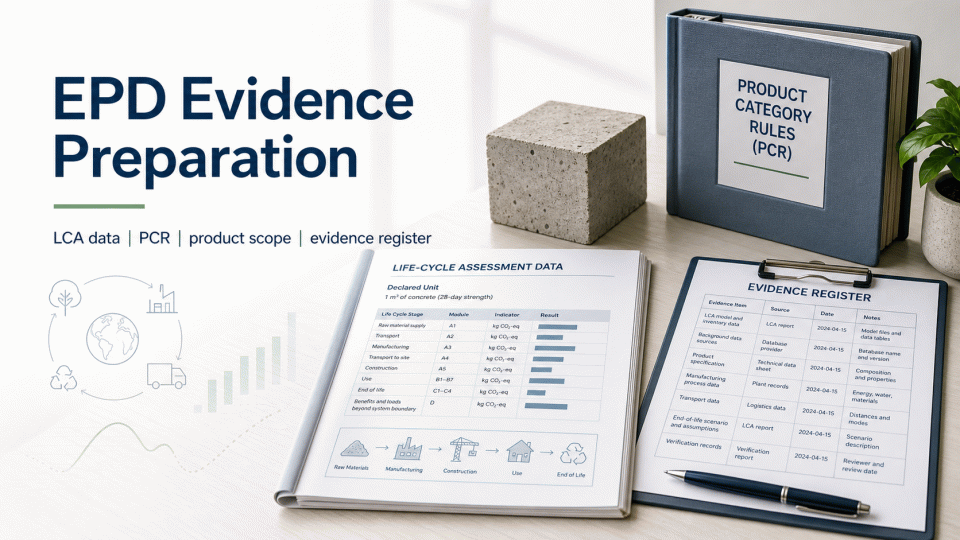
An Environmental Product Declaration (EPD) communicates quantified environmental information for a defined product, scope and method. A credible preparation file is not a stack of generic certificates. It connects the product definition, life cycle assessment (LCA), Product Category Rules (PCR), data sources, verification records and the wording used on the final page.
1. Define the EPD object and governing rules
Record the product name, model or SKU, function, composition, manufacturing location, declared unit and system boundary. Then identify the applicable PCR, EPD programme instructions and document versions. PCRs provide category-specific rules and guidance for LCA studies and EPD development; a similar-looking template should not be used when its scope does not fit the product.
An EPD is not a general green certificate for a company, brand or factory. It relates to a defined product and method. A change in formulation, process, location, declared unit or system boundary may affect the applicability of the underlying assessment.
2. Make LCA data traceable to the product
The data register should identify, as relevant, raw materials and energy inputs, manufacturing, transport assumptions, use, end-of-life scenarios, data years, sources, allocation choices and uncertainty treatment. Each material data point should be traceable to a product specification, bill of materials, meter record, supplier record or specific node in the LCA model.
A test report, ISO 14001 certificate, supplier statement or carbon-credit record is not automatically an EPD. Such documents may support the file, but their use in the LCA must follow the applicable PCR, system boundary and data-quality rules.
3. Build a product–data–declaration evidence register
Create one master record for each product and capture:
Product scope: model/SKU, composition, function, manufacturing location, declared unit and system boundary;
Rules: PCR title, version, applicability, EPD programme instructions and methodology documents;
LCA data: data item, source, year, allocation assumption, calculation-file version and owner;
Verification record: submitted version, comments, revisions and publication or verification status, only as supported by the project record;
Page wording: published values, boundaries, comparison conditions and source links, without turning a partial indicator into a universal conclusion about the product or company.
4. Keep verification and communication boundaries clear
An EPD project may include rule review, LCA modelling, document submission and independent verification. The exact steps depend on the programme, PCR and verification arrangement. Use wording such as “verified” or “published” only when the relevant project record supports it; preparing evidence is not the same as obtaining an EPD.
Product or sales pages should state the product scope, declared unit, life-cycle boundary, method and data version. An EPD should not be presented as a substitute for a market’s mandatory product rules, a buyer’s procurement conditions or a platform review, and it should not be used to promise customs clearance, listing access, certification results or a fixed completion date.
5. Pre-submission checklist
① Do the product, declared unit and system boundary match the PCR? ② Are BOM, production, energy, transport and end-of-life assumptions sourced and versioned? ③ Can the calculation file, assumptions, allocation choices and values be reviewed? ④ Are programme rules, verification records and publication status described accurately? ⑤ Can every environmental statement on the page be traced to a value, boundary and source? ⑥ Do changes to the product, formulation, plant, data or PCR trigger a reassessment? 绿色方舟(深圳)认证有限公司 can help organise an evidence index during preparation, but the applicable EPD programme, PCR and verification record govern the project outcome.
Sources and further reading
ISO 14025:2026 on EPD programme and declaration principles and requirements; ISO/TS 14027:2017 on developing, reviewing, registering and updating PCRs; EPD International: What is PCR?; and the EPD International resources library. This page is a preparation reference and does not replace applicable law, PCRs, programme instructions or an independent verification opinion.


