
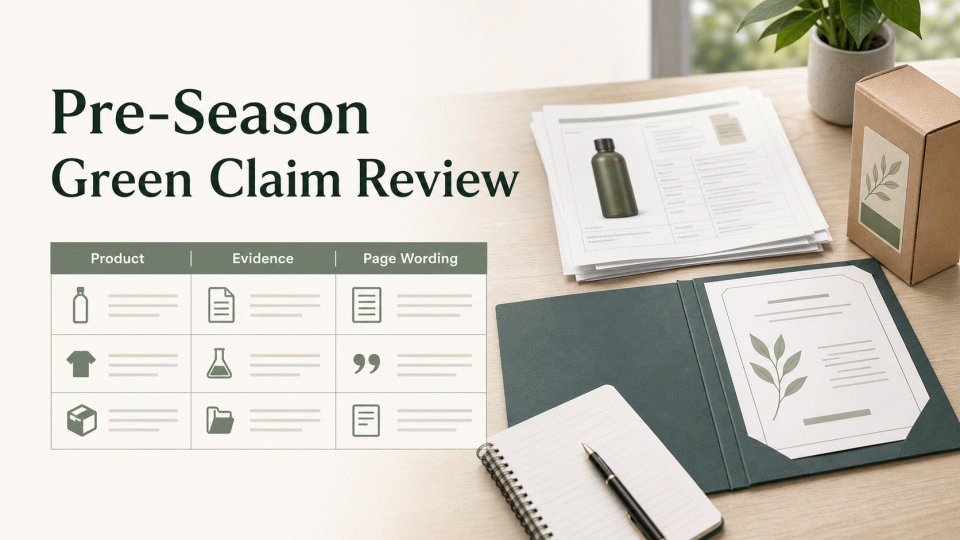
Before refreshing a listing for a peak sales period, break each environmental statement into a checkable claim object, then confirm the product scope, evidence and current wording. This is a documentation and page-review reference; it is not a promise of platform acceptance or a certification outcome.
For terms such as “green,” “eco-friendly,” “recyclable,” recycled content, or a named certification, record the meaning, market, source and final wording separately. The U.S. Federal Trade Commission’s Green Guides emphasize evidence that is competent and reliable for environmental marketing claims, and caution against broad unqualified claims: FTC Environmental Claims: Summary of the Green Guides.
1. Define the claim object and scope
Start with a list of live SKUs, models, variants, packaging components and target markets. Separate the object of the claim: the product, a component or material, packaging, a business activity, or a certification or label program. These objects cannot automatically share evidence merely because they belong to one brand.
For each SKU, record the material or formula version, production entity, supplier, market, page location and variant relationship. A certificate or test report should map to the same product scope. If it covers only a model, material or batch, state that boundary in the evidence register rather than extending it to an entire range.
2. Turn each claim into an evidence record
Create one record for each proposed statement. At minimum, capture the exact wording, claim object, market, product or packaging scope, supporting file, issuing party, document number, date, covered model or batch, limitations and archive location.
Certificates or labels: Check the holder, scheme name, status, scope, covered products and any public registry entry. Do not turn an enterprise-level qualification into a product attribute for every SKU.
Test or technical files: Check the sample identity, version, methods, test items, results and stated scope. A test report is not an automatic substitute for every market requirement.
Supply-chain records: For recycled, organic, responsible-sourcing or mass-balance claims, retain records linked to the relevant material, transaction, batch or processing step and state what they cover.
Page snapshots: Archive the title, bullets, A+ content, packaging or advertising version before release so the wording can be traced back to the evidence.
3. Review page wording and qualifications
Prefer a specific environmental attribute over an unsupported overall conclusion. If the record supports recycled material in one component, name the component and scope. If it supports recyclability, state relevant conditions, components or local-facility limitations where material. Avoid expanding the evidence into “zero impact,” “fully green,” “guaranteed,” or similar conclusions.
Keep platform programs, legal obligations, buyer-specific standards and third-party certifications in separate columns. Eligibility for a platform program is not the same as a regulatory conclusion, and a buyer audit is not a universal product certification. Retain the source, submitted version and communication record for each channel.
4. Pre-season review checklist
Check each item: (1) the title, cover text and body refer to the same product or packaging object; (2) Chinese and English state the same scope without adding a stronger outcome in one language; (3) the legal entity, model, material, batch and listing SKU align; (4) the file remains applicable and its version or scope has not changed; (5) cited standards, schemes and platform requirements are checked against primary sources; (6) every environmental phrase is specific and supportable; and (7) changes to variants, packaging or suppliers trigger a new review where relevant.
Use four statuses in the review log: checked, file needed, not applicable and do not use. When a claim cannot be confirmed, remove it or replace it with a factual description until the supporting record is available.
5. Maintenance boundaries and sources
The purpose of a pre-season review is traceability between the product, records and page wording. One general certificate cannot replace every market or platform requirement. Recheck the relevant record when the formula, material, supplier, packaging, certification scope or page version changes.
For evidence mapping or page-wording review, 绿色方舟(深圳)认证有限公司 can assess the available records against the stated product and market scope. This article is not legal advice, a certification decision or a platform-outcome promise.
Sources: FTC Environmental Marketing; 16 CFR Part 260 Green Guides. Requirements for a particular market, platform or certification scheme should be checked in its current official materials.


