
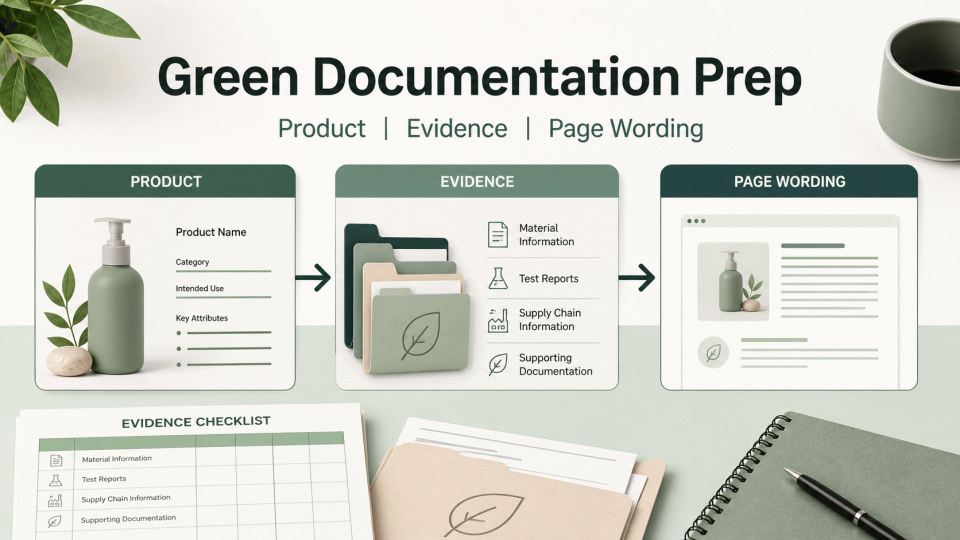
When preparing documentation for a green certification or an environmental claim, define the claim and market first. Then map the product scope, supporting records and customer-facing wording item by item. This is a documentation reference, not a certification scheme, legal opinion or platform application requirement, and it does not indicate an approval or certification outcome.
A useful record asks what is being claimed, which product or package it covers, which document supports it, who issued that document, what limitations apply and which words will appear on the page.
1. Separate the Three Types of Requirement
Law and market-access requirements concern obligations that apply in a particular market. Platform-program requirements concern a platform's own product data or application rules. Buyer or company standards may come from procurement, supply-chain or brand policies. Their responsible parties, evidence formats, scope and update cycles can differ; one “green certificate” should not be treated as a universal substitute.
At minimum, record the target market, product or SKU, materials and formulation, packaging, manufacturing entity, brand or importer, claim type, applicable version, evidence owner and review date. Confirm classification codes, destination rules and scheme-specific requirements against the current documents of the relevant authority or program.
2. Build a Product–Evidence–Page Record
The product section can capture model, version, materials, formulation, packaging components, intended use and sales market. The evidence section can capture specifications, BOMs, test or assessment records, supply-chain records and certification documents where applicable. The page section should capture the proposed title, benefit statement, label, graphic and qualifying language. Each record should return to a specific product and a specific claim; a supplier name, brand name and certificate holder should not be assumed to be the same legal entity.
For terms such as “recyclable,” “made with recycled content,” “compostable,” “low carbon” or “green,” define the comparison, material or process scope, conditions and evidence source. The U.S. Federal Trade Commission's Green Guides caution against broad, unqualified environmental benefit claims. They also explain that certifications and seals should make their basis clear, while certification does not replace substantiation for express or implied claims.
3. Documentation Checklist
Entity and scope: Do the product, brand, manufacturer, importer or claim owner match the documents? Does a document cover one SKU, a series, a facility, a material or the package?
Technical composition: Can specifications, BOMs, formulas, packaging structure, labels and version records support the attribute shown on the page? Does a change trigger a new assessment?
Evidence and provenance: Are the document number, issuer, date, method, applicable standard and limitations traceable? Do not replace a scheme- or market-specific review with a universal “valid for” period.
Page and graphics: Do the title, image, icon, certification name and footnote stay within the evidence-supported scope? Check graphic marks against authorization and usage rules; avoid seal-like visuals whose basis cannot be explained.
4. Keep Special Regulations in Separate Records
If a product or package also touches packaging rules, carbon reporting, supply-chain due diligence or another specialized regime, create a separate record for the regulation, product scope, responsible role, reporting or retention fields, official version and application date. These are independent regulatory checks; they should not be rewritten as “a green certification satisfies everything.” The European Commission's packaging page, for example, describes rules covering packaging and packaging waste; applicability still depends on the product, package, market and current law.
A clearly marked “to be confirmed” is more useful than an unsupported conclusion. For an unverified code, percentage, claim, authorization or date, retain the source link, open question and owner, then update the page after verification.
5. Final Page Review
Ask four questions: Is the object and scope clear? Does the evidence support both express and reasonably implied claims? Do the Chinese and English versions share the same boundary while reading naturally for their audiences? Do product, material, packaging, facility or market changes trigger a review? These checks turn a document list into a traceable record for page wording.
Sources: U.S. FTC Green Guides (16 CFR Part 260); FTC Environmental Claims Summary; European Commission packaging and packaging waste page.


