
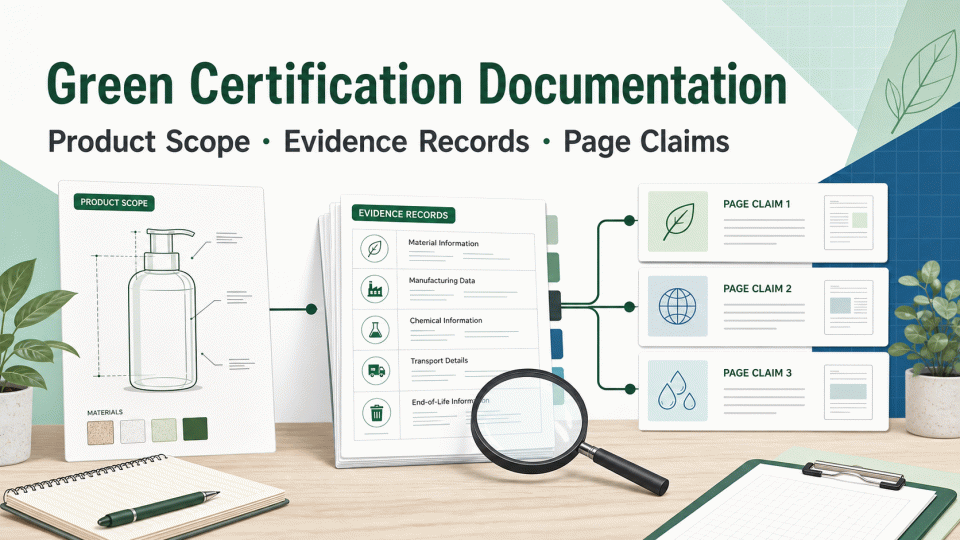
Green certifications, environmental claims, and marketplace sustainability programs are different things. Start by defining the claim object, product scope, market, and use context; then connect each piece of page copy to an evidence record. This is a documentation framework, not a substitute for a specific certification scheme, legal advice, or a marketplace’s current requirements.
1. Define the certification or claim object
“Green certification” may refer to product certification, material or chain-of-custody certification, an enterprise or factory system, an environmental product declaration, a carbon footprint, or another environmental attribute claim. Each has a different evaluation object and evidence set. Record whether the object is a product, package, material, facility, company, or supply chain, and whether the intended statement describes a certification fact, a specific attribute, or marketplace program information.
Create a scope register covering brand, model, SKU/ASIN, variants, materials or formulation, production site, packaging, target country, and intended page location. If a certificate covers one model, site, material batch, or supply-chain step, do not expand it into a whole-series or whole-brand conclusion.
2. Build an evidence register
Entity and authorization: certificate holder, brand owner, manufacturer, importer, or page operator; relevant authorization; certificate or declaration number; issuer; scheme name; version; and issue date.
Product and technical records: specifications, BOM, formulation, key material sources, packaging construction, labels, and manual versions. Use a change log to identify what must be rechecked after a model, formulation, supplier, factory, or package change.
Testing and environmental data: reports, sampling information, methods and versions, laboratory details, measurement scope, and the link between sample and product. Environmental claims may also require life-cycle boundaries, a functional unit, data sources, assumptions, and calculation records, depending on the scheme.
Supply-chain and traceability: purchasing, batch, transaction, chain-of-custody, material declarations, and supplier confirmations. Label each record with its scope, source, date, version, owner, and storage location rather than keeping an untraceable scan alone.
3. Map evidence to page wording
Use a five-column table: page sentence, claim object, evidence, scope, and review date. A statement that a model contains recycled material should be supported by the relevant material scope, calculation basis, model coverage, and data source. A statement that a product is certified should be checked against the certificate holder, scope, status, and mark-use permission. A test result, a certificate, a marketplace program record, and a legal requirement should not be presented as the same conclusion.
For broad terms such as “green,” “sustainable,” or “environmentally friendly,” prefer a specific, checkable benefit and place important qualifications where consumers can see them. The Green Guides also address certification and seal claims; a mark or certificate should not imply a broad environmental benefit without clear support.
4. Review boundaries and maintenance triggers
Before submission, review the certification scheme, mandatory requirements in the target market, and marketplace or buyer program requirements separately. Before a page goes live, check the title, bullets, image text, attributes, and detail copy for statements beyond the certificate or data scope.
Reassess the evidence after a factory, material, formulation, packaging, model, supplier, scheme version, certificate status, or page change. Do not assume one universal validity period or renewal lead time; use the actual rule of the certificate, scheme, test body, marketplace, and target market, and record the reviewer and date.
5. Pre-submission checklist
□ The claim object, model, materials, site, and target market are defined; □ holder, scope, number, version, and status are traceable; □ samples, data boundaries, and assumptions match the page object; □ supply-chain records reach the relevant batch or transaction; □ page copy does not expand a limited attribute into an overall environmental conclusion; □ marks and marketplace names are used under the relevant permission or program rule; □ Chinese and English scope and qualifications match; □ the review date, owner, and change triggers are recorded.
Sources: U.S. Federal Trade Commission Green Guides; ISO/IEC 17065:2012, conformity assessment requirements for bodies certifying products, processes and services. Specific schemes, market rules, and marketplace programs should be checked against their current official documents. 绿色方舟(深圳)认证有限公司 can help organize a review framework from customer-provided product, supply-chain, and market information, but does not promise an unverified certification result, marketplace decision, or market outcome.


