
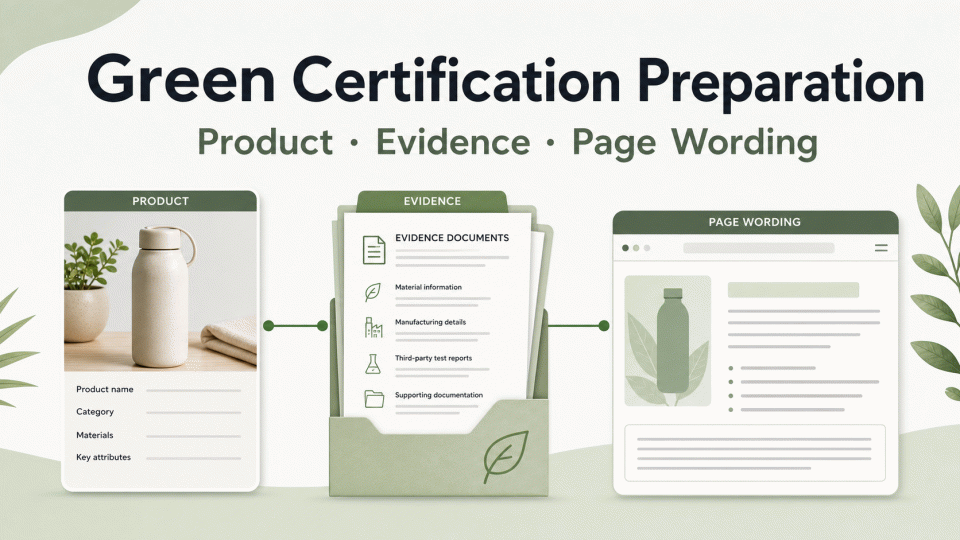
Preparing a green certification file is not simply a matter of storing one certificate. The product, the claimed attribute, the supporting records, and the wording on the page must point to the same scope. This reference page provides an organizing framework; the applicable requirements still need to be checked against the destination market, product category, scheme, and current official materials.
1. Define the certified object and scope
Start with a product–claim–market record: product name and model, materials or formulation, packaging components, manufacturing entity, brand or claim owner, destination market, and the intended certification scheme or environmental attribute. Do not assume that different SKUs, formulations, factories, or packages under the same brand share one conclusion.
Track four requirement types separately: legal requirements, scheme rules, platform or retailer submission requirements, and buyer-specific audit requirements. Their responsible parties, scopes, evidence formats, and source updates may differ. A certificate by itself does not establish that every market or platform requirement has been met.
2. Map each product claim to its evidence
Give each claim a unique index and record at least: the proposed wording, claim object, applicable SKU or batch, material and supplier, production or transaction step, evidence file number, issuing party, document date, applicable standard or scheme, limitations, verification link, and owner. For test reports, also check the sample description, model, key parameters, methods, and coverage.
Corporate files may include registration and authorization records; technical files may include specifications, BOMs, formulations, labels, and instructions; verification files may include applicable tests, assessments, or certification records; supply-chain files may include purchasing, batch, transaction, and origin records. Keep only categories relevant to the product instead of copying a checklist from another category.
3. Review environmental claims separately from certification marks
An environmental claim should identify its benefit and boundaries rather than relying on broad wording such as “green” or “eco-friendly.” The U.S. Federal Trade Commission’s Green Guides explain that environmental marketing claims need competent and reliable scientific evidence; general environmental benefit claims should be supported by clear, prominent, specific qualifications. Review whether the page keeps product, packaging, company, and supply-chain attributes distinct.
Check certification names, marks, certificate status, and permitted use separately. A certificate, a mark license, and page copy are different records. The existence of one document does not establish that every product, batch, or market can use the same statement. For certification-body requirements, ISO/IEC 17065 can be a useful reference point, but the specific scheme and the certifier’s current rules control.
4. Conduct a line-by-line page review
Check four points sentence by sentence: whether the wording matches the object and scope in the evidence; whether qualifications are adjacent and understandable; whether the Chinese and English versions describe the same scope; and whether certification, law, platform, or buyer requirements have been presented as interchangeable. Remove unsupported conclusions such as guaranteed approval, universal market coverage, or permanent validity.
For each standard, regulatory guide, or platform rule cited, archive the source title, official link, access date, and applicable version. Changes to rules, formulations, materials, suppliers, factories, packaging, or labels should trigger a new review. Whether retesting, recertification, or a wording update is needed depends on the applicable scheme and official requirements.
5. Submission checklist and boundaries
Before submission, check in this order: product and entity scope are confirmed; the claim object and qualifications are explicit; each evidence index resolves to the source file; samples, models, batches, and supply-chain records correspond; certification names and mark permissions have been checked separately; market, platform, and buyer-specific requirements are listed independently; the Chinese and English pages have been compared manually; and sources and versions are archived.
This framework organizes records and exposes gaps; it does not replace legal advice, a certification-body decision, a platform review, or import requirements. 绿色方舟(深圳)认证有限公司 can organize materials into traceable product–evidence–page records, while the responsible party must confirm applicability against current official materials and scheme rules.
Sources: U.S. Federal Trade Commission, Environmental Claims: Summary of the Green Guides; ISO/IEC 17065 conformity assessment reference. These sources provide general review direction; use the current official materials applicable to the market and certification scheme.


