
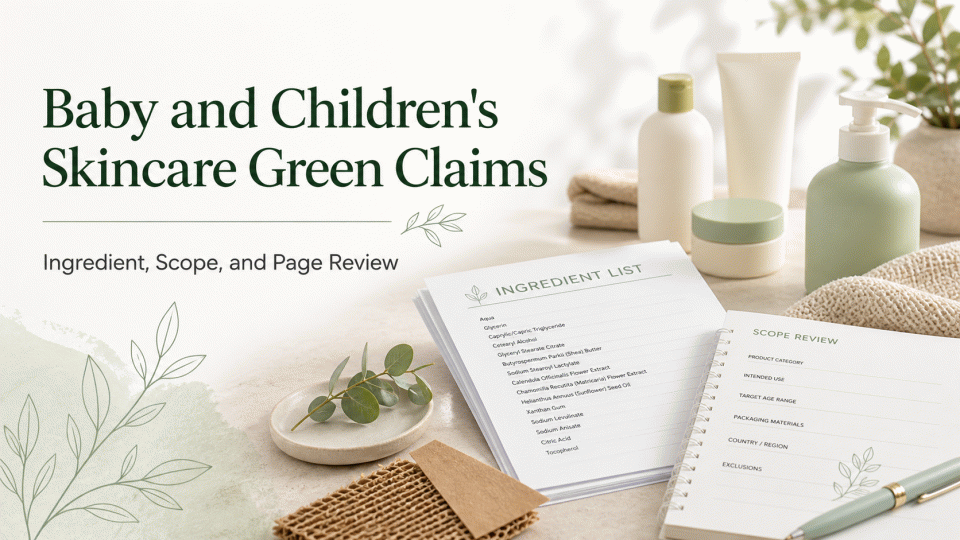
For baby and children’s skincare, wording such as “natural,” “organic,” or “sustainable packaging” should be tied to a defined claim object. The formulation, packaging records, supply-chain evidence, and page copy must describe the same product. This page is an organizing framework; it does not replace the cosmetics, certification, or platform requirements applicable in a target market.
1. Define the product, user group, and claim scope
Start with a product–claim–market record: product name, SKU, format, net content, formulation version, manufacturing entity, package components, destination market, and proposed page wording. Baby, infant, child, and adult positioning should not be blended. “Natural,” “plant-derived,” “organic,” “sustainable packaging,” and “recyclable” are different claims that require different records.
Track four matters separately: product safety and labeling, environmental-claim substantiation, certification or mark permission, and platform or buyer requirements. Their responsible parties, scope, and sources can differ. A formulation does not automatically carry the same conclusion across packages, markets, or manufacturing entities.
2. Map ingredients and environmental claims to evidence
Give each claim a unique index and record the proposed wording, claim object, applicable SKU and formulation version, ingredient or material source, supplier and production step, evidence number, issuer, document date, applicable standard or scheme, limitations, verification link, and owner. A “natural,” “organic,” or responsible-sourcing statement should make clear whether it covers the full formula, one ingredient, the package, or a supply-chain step.
Formulation records may include the INCI list, specifications, supplier statements, and change history. Environmental records may include source and batch records, package specifications, recycled-content support, or disposal-condition information. For tests, assessments, and certificates, check the sample, model, entity, scope, and applicable version. Do not replace scheme-specific document rules with a generic “24-month” rule.
3. Review green wording, marks, and skincare performance separately
The U.S. Federal Trade Commission’s Green Guides caution against broad, unqualified claims such as “green” or “eco-friendly.” A marketer should identify the specific environmental benefit and make qualifications clear, prominent, and close to the claim. The European Union’s common criteria for cosmetic claims likewise address evidence, truthfulness, fairness, and clarity. Do not turn “natural” into a conclusion about safety, or a packaging attribute into an environmental conclusion about the whole formula.
Certification names, certificate status, mark permissions, and page copy are separate records. For “organic,” “certified,” “free-from,” or “suitable for babies” wording, review the relevant scheme, evidence scope, labeling conditions, and safety or performance basis independently. The U.S. FDA notes that a cosmetic claim to treat or prevent disease, or to affect the structure or function of the body, may make the product a drug under the law. Environmental or natural wording should not be used to imply unsupported therapeutic or safety outcomes.
4. Conduct a line-by-line bilingual page review
Check each sentence for four points: whether the claim matches a defined ingredient, package, or sourcing scope; whether qualifications are visible and understandable; whether the Chinese and English versions describe the same object and boundary; and whether an environmental attribute has been presented as a safety, performance, certification, or platform conclusion. Remove unsupported wording such as “safe for all infants,” “100% natural,” “valid in every market,” or “permanently valid.”
Archive the official source, link, access date, and applicable version for every regulation, guide, scheme, or platform rule cited. A change to the formula, supplier, manufacturer, package, label, market, or claim wording should trigger a new review. Whether testing, documents, or permissions must be updated depends on the applicable rules.
5. Self-check list and boundaries
Before submission, confirm that the product and user group are defined; formulation and package versions are traceable; every environmental claim has a supporting record; safety, performance, environmental, and certification evidence have not been treated as interchangeable; certificate and mark permissions have been checked separately; destination-market cosmetics labeling and advertising requirements are listed; the bilingual pages have been compared manually; and sources, versions, and changes are archived.
This framework organizes records and exposes gaps; it does not replace legal advice, regulatory judgment, a certification-body decision, or a platform review. 绿色方舟(深圳)认证有限公司 can help organize traceable product–evidence–page records, while the responsible party must confirm applicability against current official materials and scheme rules.
Sources: U.S. Federal Trade Commission, Environmental Claims: Summary of the Green Guides; European Commission, Commission Regulation 655/2013: common criteria for cosmetic claims; U.S. FDA, Cosmetics Labeling Claims. These sources provide general review direction; use the current official materials applicable to the market and scheme.


