
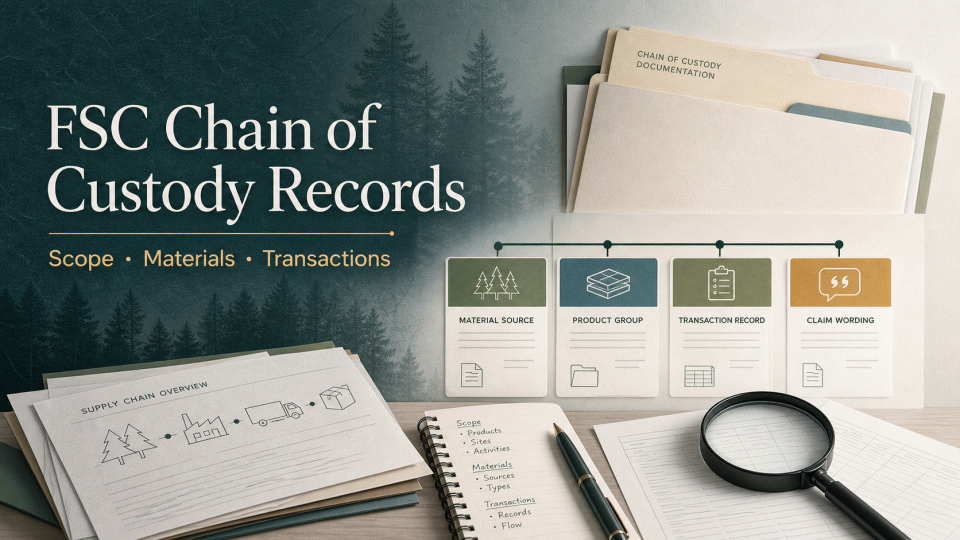
Companies that buy, process, or sell products containing paper, wood, or other forest-based materials should first identify the relevant FSC certification route and the products and sites that belong in scope. This reference page focuses on documentation for FSC Chain of Custody (CoC): how to connect material inputs, product groups, transaction records, and external claims in one traceable file set. A documentation review is not an FSC certification decision and does not replace an audit by an FSC-accredited certification body.
1. Define the organization and certificate scope
FSC CoC normally applies to an organization, site, or defined supply-chain operation rather than giving a brand or every SKU one blanket conclusion. Start with the legal entity, operating sites, outsourced activities, purchasing and sales functions, and the product categories proposed for the certificate scope. FSC identifies FSC-STD-40-004 as the core CoC standard; FSC-STD-40-004a can be used to review product classifications.
Build a scope register with the product or product group, forest-based material type, purchasing and processing location, outsourced steps, proposed FSC claim, and responsible record owner. A supplier’s FSC document does not automatically give a finished product the same claim. Check the supplier’s certificate status, scope, transaction documents, and delivered material for each relevant flow.
2. Map inputs to product groups
For each product group, answer four questions: What is the input material? Which verified supplier provided it? Where is it processed or combined? Which claim may be used when the finished product is sold? Inputs may include FSC-certified material, controlled wood, reclaimed material, and non-certified material, but the permitted inputs and claims must be checked against the applicable FSC standards, product classification, and certification-body guidance.
Keep a bill of materials or product specification, purchase orders, supplier invoices or delivery notes, material claims, receiving and batch records, production issue and loss records, and finished-goods dispatch records. Where mixing or conversion is involved, document the control method, such as physical separation, batch controls, or a material-accounting approach. Company names, addresses, product descriptions, quantities, dates, and certificate or licence references should be mutually consistent.
3. Make transaction records traceable
An audit file should contain more than a certificate scan. Select samples and follow the chain from supplier and input material, through an internal batch or production record, to the finished product group, customer order, and sales claim. Record the document number, date, quantity, owner, and storage location for each link. If a warehouse, printer, or processor is outsourced, identify its role in both the scope and the records.
Also define exception handling: a supplier certificate-status change, material or specification change, new product group, packaging or claim revision, quantity mismatch, missing page, or broken traceability link. Keep the investigation, correction, and review records. A later document should not be used to conceal a gap in the original record.
4. Prepare people, procedures, and audit evidence
FSC materials also state that CoC certificate holders must implement FSC core labour requirements and be able to demonstrate this to external auditors. Alongside product and transaction records, the file should therefore cover responsibilities, training, operating procedures, complaints or corrective actions, and relevant labour-requirement self-assessment or verification records. A supplier certificate cannot replace the organization’s own controls.
Run an internal sample check before the audit. Pick one finished-goods sales record and trace backward to the input material and supplier evidence, then forward to the label, invoice, or page claim. Pick a separate purchase record and trace it forward to the product group in which it was used. Put document references and gaps into an evidence index. The certification body’s formal scope, audit findings, and corrective-action decision remain authoritative.
5. Verify certificate records and trademark wording
Use the FSC official search tool to look up certificate records by organization name, licence code, or certificate code, and review the certificate type, status, certification body, and scope. Save the search date and record. A supplier’s verbal statement or an old screenshot is not a substitute for a current record check.
If FSC trademarks will appear on products, packaging, websites, or promotional material, check the applicable trademark standard and the approval process with the certification body. FSC-STD-50-001 V3-0 has been published; FSC’s official information lists an effective date of 1 July 2026 and a transition period to 1 January 2029. Confirm the latest requirements that apply to the certificate and material before use. Trademark approval should not be treated as a conclusion about other regulatory requirements.
6. Five checks before submission
1. Do the applicant, sites, and outsourced activities match the real operation?
2. Does every product group have a defined input, supplier, and proposed claim?
3. Can a sample be traced through purchasing, production, storage, and sales records?
4. Are material, supplier, claim, and exception changes assigned to an owner and recorded?
5. Are the FSC search record, applicable standard version, and trademark-approval materials dated and retained?


