
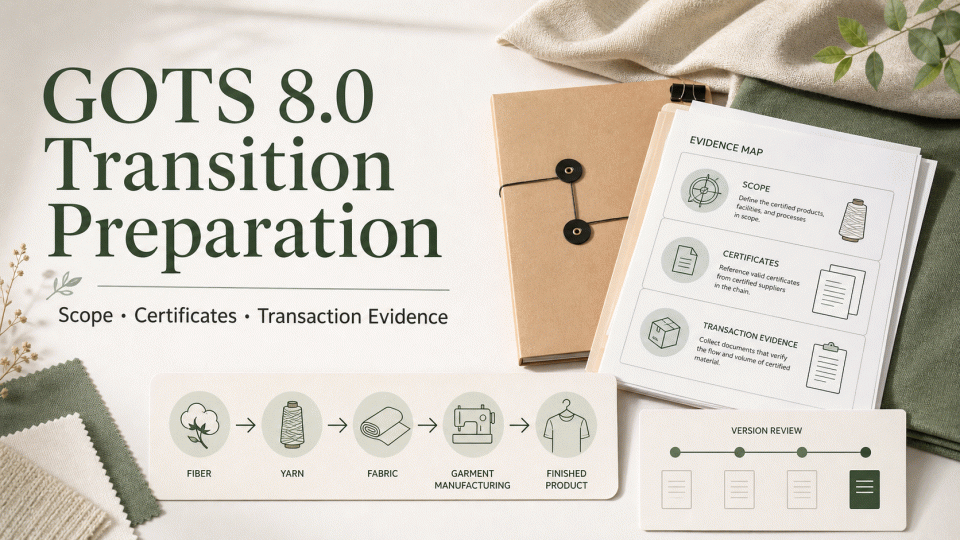
GOTS 8.0 was released on 1 March 2026. The official standard states that the new version becomes effective for certified entities and approved chemical inputs on 1 March 2027, with a one-year transition period from release; early adoption is permitted. The practical task is not simply replacing an old certificate file. It is to check that each product scope, processing step, transaction record and customer-facing statement is supported by the relevant evidence.
1. Confirm what the GOTS scope covers
GOTS addresses textile and apparel supply chains using organically produced fibres and covers relevant stages such as fibre processing, spinning, weaving or knitting, wet processing and product manufacturing. Start by listing the certified entity, sites, processes, product groups and chemicals in use, then compare them with the current standard and its Implementation Manual.
Do not treat a brand, factory, individual SKU or supplier certificate as interchangeable scope. The certificate holder, sites, product groups and transaction stages should correspond to the product and supply-chain records behind the proposed statement. Ask the certification body to clarify any scope question.
2. Build four evidence registers for the transition
Scope register: Record the certified entity, sites, processes, product groups, fibre inputs and proposed GOTS statements. Map each SKU or product family to the certificate scope and flag unresolved differences.
Inputs and process register: Record fibre sources, chemical names and uses, formulations or technical records, outsourced processing and relevant approval or assessment records. Keep GOTS 8.0 clauses separate from customer requirements and other schemes.
Transaction and traceability register: Preserve dates, batches, quantities, trading parties, product descriptions and certificate or transaction-document references for purchasing, production, stock, sales and shipment records, as applicable to the chain.
Claims register: Keep the product name, fibre composition, claim location, certificate information and supporting evidence version together. Do not use “organic fibre”, “made according to GOTS” and “GOTS certified product” as if they were the same statement.
3. Organise the 8.0 transition review
Read the official GOTS 8.0 text, Implementation Manual, change logs and transition Q&A first. English is the language of the official GOTS documents; where a translation differs from the English original, the original text should be used for interpretation.
For a scope currently managed under 7.0, create a register with “current record, 8.0 clause, missing evidence, owner and review status”. Do not turn one date into a universal deadline for every product. Record audit or assessment arrangements, clause-specific details and certification-body guidance separately.
绿色方舟(深圳)认证有限公司 can help organise the relationship between products, certificates, transaction records and page statements. Whether a scope meets GOTS requirements and how it is assessed remain matters for the current Global Standard documents and the relevant certification body.
4. Pre-submission review list
① Do the certificate holder, sites, product groups and claim subject match? ② Can fibre, process and chemical records be traced to the relevant product or batch? ③ Do purchasing, production, stock and transaction records retain useful traceability fields? ④ Are the GOTS standard, Implementation Manual and change documents official current versions? ⑤ Does the page distinguish GOTS scope, fibre facts, legal requirements and customer requirements? ⑥ Are unresolved clauses assigned an owner with a source to verify and a documented review result?
Sources: GOTS Version 8.0, GOTS Revision, and the Implementation Manual, change logs and transition Q&A published by Global Standard. Standards change; check the official page for the current version and date before use.


