
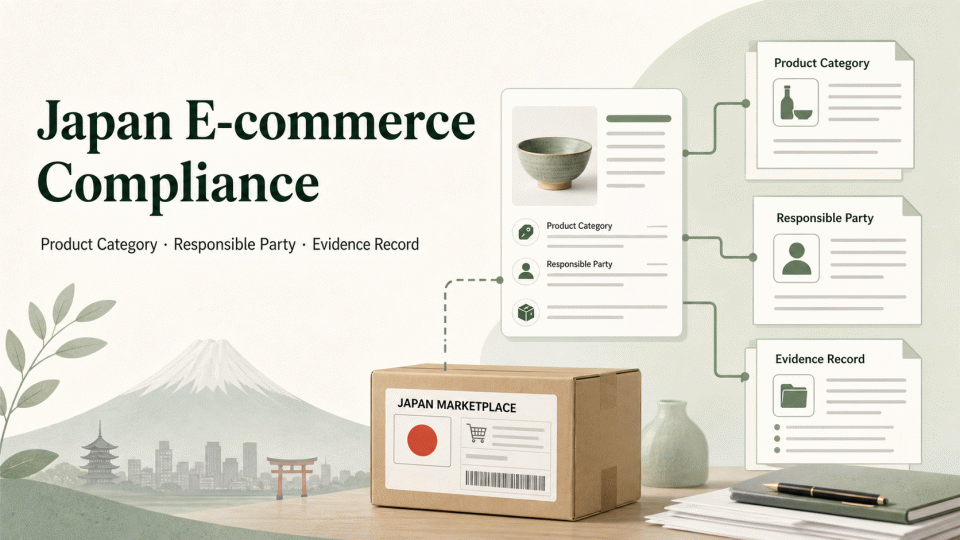
Selling to consumers in Japan is not a single “Japan marketplace compliance” task. Start with the product category, import arrangement, responsible parties and page claims, then identify the rules and records that actually apply. This page is a documentation framework, not legal advice and not a promise of customs clearance, listing approval or certification.
A supplier report does not automatically cover a different SKU, material, use case or legal entity. Keep product facts, applicable requirements and supporting files in one traceable record, including document version, issuer and review date.
1. Define the product and responsibilities
Create a product card for each SKU: name and model, photos, materials or main components, intended use, electrical status, food-contact status, target users, packaging and instruction-language requirements, origin, proposed HS classification and the intended Japanese importer. Mark unknown fields for review instead of filling them with a supplier’s generic category.
Record the manufacturer, exporter, seller, importer of record and any Japan-based contact or representative separately. Different parties may carry different duties. The party responsible for declarations, labeling, safety records or marketplace submissions should be identified from the actual transaction and product arrangement. Brand ownership, distribution authorization and the testing laboratory are separate records; a brand owner is not automatically the legal party for every obligation.
2. Route the SKU to the relevant Japanese rules
Electrical products: If the product falls within the scope designated under Japan’s Electrical Appliances and Materials Safety Act, use METI’s classifications and technical requirements to review business notification, conformity steps, inspections and PSE labeling. Whether a product is a Specified Electrical Appliance and Material cannot be decided from appearance alone. METI states that covered products cannot be sold or displayed without the required measures and PSE labeling.
General consumer products and quality labeling: Product-safety statutes and the Household Goods Quality Labeling Act have different scopes. For designated household goods, the latter sets matters such as composition, performance, use and handling precautions, together with labeling methods. Confirm the applicable item rule and whether the manufacturer, seller or labeling contractor is the relevant labeling party. Review the product page, package and instructions as separate customer-facing surfaces.
Food utensils, containers and packaging: For food-contact materials, review the Ministry of Health, Labour and Welfare requirements for specifications, manufacturing control, information sharing and the Positive List for relevant synthetic resins. Map resin, additives, intended use, contact conditions and supply-chain statements. A food-contact report prepared for another market is not, by itself, proof that Japanese requirements are met.
Other categories: Toys, cosmetics, textiles, wireless devices, lithium batteries and medical-related products may follow different rules and authorities. Products with batteries, radio functions, child use, chemical exposure or health-effect claims require an additional category review. If the scope is uncertain, pause absolute wording on the page until the facts are checked.
3. Fields for a Japan-market evidence table
Product facts: model and revision, specifications, materials, ratings, dimensions and weight, intended use, warnings, packaging and Japanese instructions. For electrical products add power, plug, battery and radio parameters. For food-contact products add material, food type and conditions of use.
Parties and trade: manufacturer and importer/seller names and addresses, authorization or distribution records, invoices, packing lists, bill of lading or air waybill, origin, HS classification rationale, and the importer, goods, quantity and value used in the Japanese customs declaration.
Technical and test records: risk assessment, technical files, specifications, label artwork, instructions, test reports and laboratory information. Capture report number, model/sample, test items, method, date, limitations and signatures. Laboratory credentials do not prove that a report covers the current SKU or that every marketplace will accept it.
Page and version control: map each title, specification, warning, environmental statement or safety claim to its evidence. Record the marketplace, submission version, feedback and review date. A marketplace requirement is a separate track and should not be presented as a Japanese legal requirement.
4. Four review actions before submission
First, match model, material, use and revision across the product and sample. Do not treat a family or supplier template as the current SKU. Second, match names, addresses and roles; an authorization letter does not rewrite the legal entity on a report. Third, compare labels, instructions, packaging and the product page against the same product facts, including Japanese translations. Fourth, save the source page and rule version with an access date; official guidance and marketplace policies can change.
Japanese customs documents are a separate file from product-safety and labeling records. Japan Customs lists information such as the declarant, goods description, quantity, value, origin and shipping location. From October 12, 2025, some electronic-commerce cargo declarations also include platform-related items. Confirm applicability from the actual import model and the latest Customs guidance.
5. Final checklist and boundaries
Before submission, confirm that the SKU matches the sample; responsible parties are identified; the product category and authority are recorded; Japanese labels and instructions were reviewed by someone familiar with the product; reports and declarations trace to the model and revision; customs documents match the transaction records; the page stays within the evidence; and change triggers are documented.
Reassess when the factory, material, formulation, rating, packaging, instructions, importer or sales channel changes. No universal fixed validity period replaces that change assessment. This page makes no promise of customs clearance, listing approval, certification or review outcome. Specific conclusions depend on the applicable law, authority, Customs, marketplace and product facts.
Sources: METI: Electrical Appliances and Materials Safety Act; METI: procedures for product-safety businesses; Consumer Affairs Agency: Consumer Safety; CAA: Household Goods Quality Labeling Act handbook; MHLW: utensils, containers and packaging; Japan Customs: Import Procedures.


