
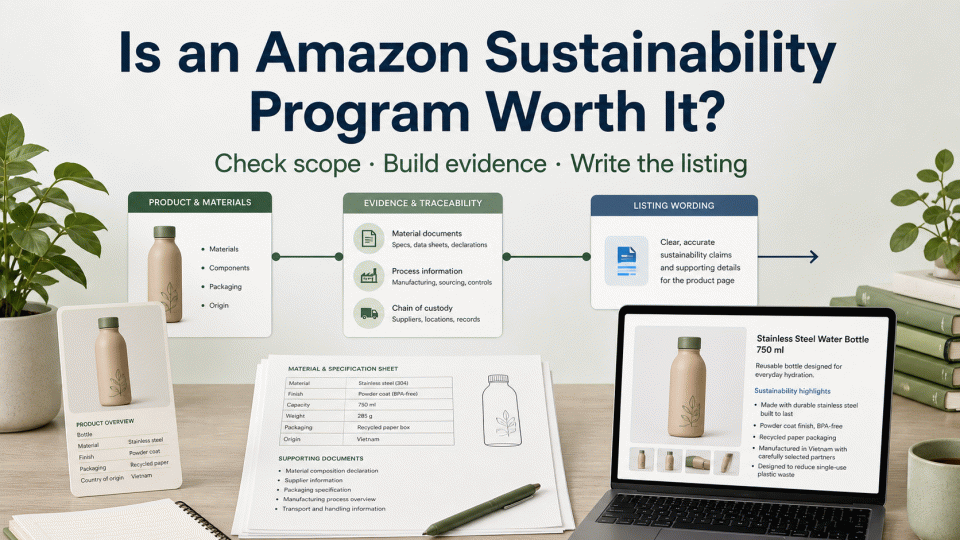
An Amazon sustainability program is not a universal “green certification.” The investment question depends on the specific program, product scope, accepted evidence, and permitted listing use. This article offers a practical review framework; current Seller Central or program rules remain the controlling source.
1. Separate the program, legal requirements, and environmental claims
A platform program, a mandatory market requirement, a voluntary third-party standard, and an environmental marketing claim are different layers. Amazon participation criteria and accepted evidence should be checked against the current Seller Central or program guidance. Destination-market law governs market access. A standard or certificate supports only the scope it clearly covers. A product-page claim needs its own evidence and consumer-interpretation review.
A supplier certificate does not automatically support your SKU. At minimum, align the certificate holder, brand or manufacturer, model, materials, production site, transaction chain, target market, and document status. Any mismatch should be confirmed with the program owner or issuing body before use.
2. Use four registers to estimate whether the work is justified
Program-scope register: record the program, marketplace or market, target SKU/ASIN, product and packaging scope, accepted standard or certification route, and the rule version and review date. Do not merge conditions from different programs or marketplaces.
Product-and-materials register: record the model, composition, components, packaging, suppliers, and production sites for each SKU. Link every environmental attribute to a specification, material declaration, purchasing record, or test/assessment document. If a material percentage, mass-balance statement, or recycled attribute cannot be traced, keep the listing wording narrow.
Evidence-and-traceability register: record the file name, issuer, certificate holder, covered SKUs, version/date, scope, original-file location, and reviewer. Keep supplier documents, third-party certificates, laboratory reports, and transaction records distinct; one file should not be treated as proof for every conclusion.
Listing-claim register: record each proposed title, bullet, A+ or other page statement, its supporting evidence, qualification, and scope. Say only what the evidence supports. Do not turn an application, review, or participation step into a claim that a program outcome has been granted.
3. When the investment may be more meaningful
Break the decision into four questions: Does the target SKU have a defined sales or customer use case? Does the current program guidance cover the product category and proposed proof? Do the existing records cover the product, materials, supply chain, and listing wording? Can someone own version control and periodic review? Only then is it useful to compare cost, effort, and intended business use.
If the plan is simply to “get a certificate first,” or the records cover only a supplier or factory rather than the seller’s product scope, resolve the scope and evidence mapping first. A certification, test, audit, or submission does not by itself guarantee Amazon acceptance, page placement, or a sales outcome.
4. Keep environmental wording within evidence boundaries
The U.S. Federal Trade Commission’s Green Guides state that environmental marketing claims should be supported by competent and reliable evidence. Broad claims such as “green” or “eco-friendly” can imply an overall environmental benefit; specific, clear, and supportable attributes are safer, with relevant trade-offs considered. Other markets also require review of local advertising, consumer-protection, and platform rules.
A more defensible page can identify the verified object, such as “the packaging specification states…” or “the material record for this model shows…,” while the internal register retains scope, date, and source. Avoid claims such as “zero impact,” “fully eco-friendly,” “guaranteed approval,” or “guaranteed program acceptance” when a single document cannot substantiate them.
5. Pre-submission review checklist
Check each point: Is the program and rule version current? Do the target SKU, model, materials, and packaging match? Are the holder, scope, date, and issuer of each certificate or report verifiable? Can supply-chain and transaction records explain the material or attribute? Does every page sentence have evidence and a clear limitation? Do the Chinese and English pages state the same facts? Would a change in product, supplier, formulation, or packaging trigger a new review?
Bottom line: “Worth it” is not a generic comparison of certificate prices. It is a question of whether a specific program can be supported by a specific SKU, specific records, and specific page wording. 绿色方舟(深圳)认证有限公司 recommends completing the scope–evidence–listing mapping before deciding whether to seek testing, consultation, or submission. Use current Amazon and relevant standard or certification-body rules, preferably with written confirmation, for the final decision.
Sources: current Amazon Seller Central or program guidance; the FTC Guides for the Use of Environmental Marketing Claims (16 CFR Part 260) and FTC environmental-claims summary. This article is a documentation framework, not legal advice, a platform decision, or a certification-body determination.


