
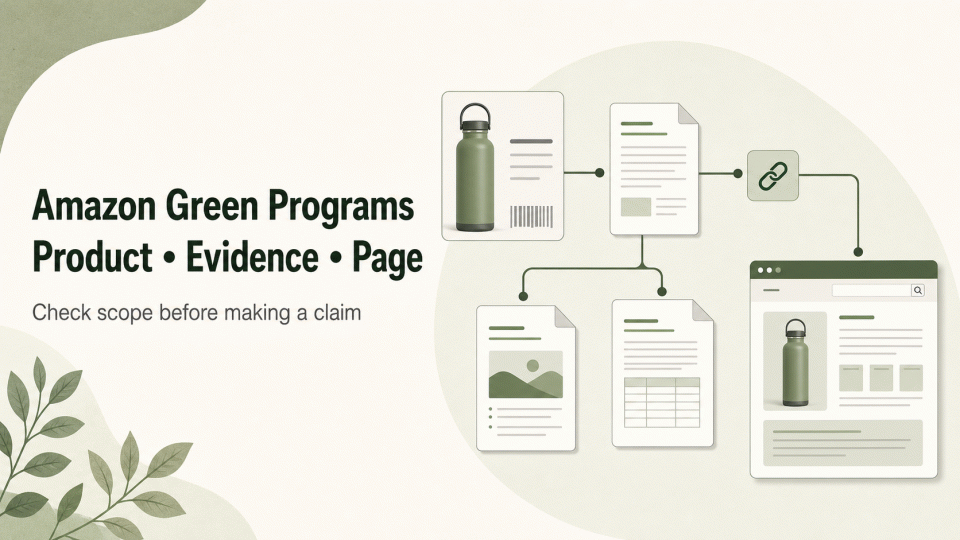
An Amazon sustainability program is not a standalone “green certificate” that can be separated from the product. Amazon describes Climate Pledge Friendly (CPF) as a way to highlight products with recognized sustainability certifications or related features. The current Seller Central program pages should control the accepted schemes, regions, and submission requirements. For a seller, the practical question is whether the product scope is clear, the evidence supports the intended claim, and the wording stays within that evidence.
1. Define the Question Before Choosing a Program
“Green certification” is not one regulatory category. You may be dealing with an Amazon program such as CPF, a mandatory product or packaging rule in a target market, a third-party scheme such as FSC, GRS, or GOTS, or a retailer’s own sourcing audit. Each has different applicants, product scopes, certificate fields, and verification routes. Evidence that supports one environmental claim does not automatically satisfy a platform, customs authority, or every market.
Start with the marketplace, category, ASIN or SKU, model or formulation, packaging version, and proposed page claim. Then check whether the program covers that product. A document held by a brand or factory may not cover every SKU. A change in formulation, material, supplier, production site, or destination can require a fresh scope review.
2. Map Each Claim to the Product Evidence
Build a claim-to-evidence record: what exactly is being claimed; which ASIN, SKU, material, or feature it concerns; which certificate, report, transaction record, formulation, or technical file supports it; and what the page may say. Record the certificate or report number, issuing entity, standard, covered products, version, date, and verification source. Keep the original files and the verification trail.
Check legal-entity alignment separately. The certificate holder, brand authorizer, manufacturer, seller account, and importer of record may be different entities. If names differ, document the authorization or supply relationship instead of treating a supplier document as automatic proof for the listed product. Test reports should identify the actual model and cover the relevant parameters. There is no universal “24-month validity” rule; follow the applicable scheme, standard, contract, or current platform instruction.
3. Keep Page Wording Inside the Evidence Boundary
A page can state which feature or certification the product has, who issued it, what it covers, and where the supporting information can be checked. Do not expand a claim such as “contains recycled material” or “certified under a named scheme” into “zero impact,” “fully compliant,” “valid in every market,” or “guaranteed to pass a platform review.” Use certification names, marks, and any CPF display only as permitted by the rights holder and platform rules; do not draw a badge or present an internal evidence image as an official mark.
Review the Chinese and English pages independently. Product names, model numbers, material terms, certification names, and claim strength should correspond, but the English page should be localized for its reader rather than translated line by line. Broad terms such as “sustainable,” “green,” and “eco-friendly” should be tied to a specific, verifiable attribute. Remove or narrow any sentence that the available evidence cannot support.
4. File Set and Review Triggers
Product: ASIN or SKU, model, specifications, BOM or material composition, packaging and label version;
Evidence: certificates, test or assessment reports, scope, transaction or supply-chain records, issuing entity, and verification route;
Page: exact claim, target market, placement, language version, and link to the supporting file;
Program: the current Seller Central program description, recognized schemes, submission template, and submission record.
Review the record after a model, material, factory, supplier, or package changes, when a certificate scope changes, or when the platform updates its program page. The purpose is not to predict an approval outcome. It is to confirm that each current claim still has evidence and to keep unresolved points visible for follow-up.
5. Sources and Boundaries
The CPF description in this article is based on Amazon Sustainability’s products-and-services information and Seller Central program guidance. Accepted schemes, regions, templates, and handling may change, so the current Seller Central page and case-specific instructions control. Product safety, packaging, chemicals, import requirements, and environmental claims still require separate review against official rules and the relevant certification scheme. 绿色方舟(深圳)认证有限公司 can help organize the product–evidence–page map, but does not replace Amazon or a competent authority in deciding program eligibility, certification outcomes, or market access.


