
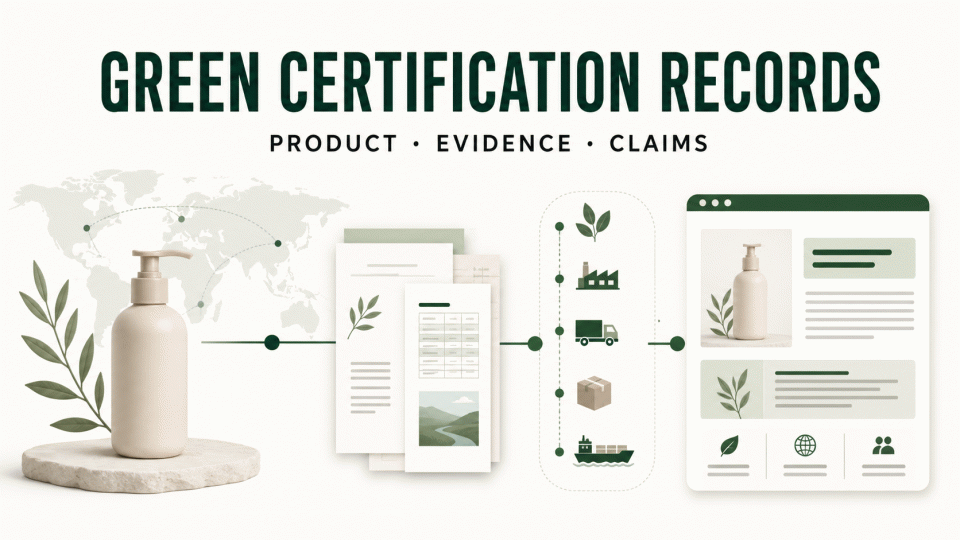
A green certification is not a stand-alone pass for every product, market or sales channel. A cross-border seller should identify the scheme, product scope, market, certificate holder and permitted wording before linking technical, supply-chain and page records. This is a preparation reference, not a certification, platform or regulatory decision.
1. Define what the certification is meant to cover
Write the scope as a checkable record: product or material, covered SKUs or models, formulation or packaging, destination market and channel, applicant or certificate holder, and the type of statement involved. The statement may relate to a third-party certification, an ecolabel, a chain-of-custody claim or the seller’s own environmental marketing. The phrase “green certification” does not replace the name and rules of a specific scheme.
Build a product–scheme–market table with SKU or model, materials, production site, brand and legal entity, target market, sales page, proposed claim and evidence owner. For a product family, mark which models are actually in scope instead of assuming that similar appearance means shared coverage.
2. Map each claim to the records that support it
Entity records show who applies, manufactures, sells or is authorised to use the claim. Product records describe specifications, materials, formulation, packaging, labels and revisions. Supply-chain records may cover source, transactions, processing steps or volume balance where the scheme requires them. Assessment or test records should identify report number, issuing body, standard, sample or batch, scope of conclusion and date. Each file should point back to a product, site, batch or claim.
Do not treat a supplier’s certificate as automatic evidence for the brand. Check the named holder, product scope, facility, revision, permitted wording and current status. Where branding, contract manufacturing or import arrangements are involved, retain the authorisation chain and responsibility map. If a record does not support a statement, remove it, qualify it or mark it for verification.
3. Keep page wording within the evidence boundary
An environmental statement should identify the specific attribute and scope, such as a material input, packaging component, production stage or documented lifecycle information. Avoid broad conclusions such as “green,” “eco-friendly” or “no impact” without clear support. The U.S. Federal Trade Commission’s Green Guides explain the need for competent and reliable substantiation; the European Commission also highlights the risk of vague or unfounded environmental claims. Sources are listed below.
Review a certification mark, certification name and the seller’s own claim separately. Check licence conditions, covered products, required qualifiers and current scheme rules. Do not turn a certification into a claim of official endorsement, turn one material attribute into an overall product advantage, or imply guaranteed marketplace placement, sales eligibility or buyer approval.
4. Pre-delivery record checklist
Before submission or publication, ask: (1) Does the product scope match the certificate, report or assessment object? (2) Are the brand, manufacturer, importer and authorised entity relationships clear? (3) Do model, material, formulation, packaging and label revisions align? (4) Can records trace back to the relevant batch, supplier or site? (5) Have document versions, dates and status been checked by an owner? (6) Does the page include necessary qualifiers? (7) Are there scheme-specific or marketplace requirements for marks, files or review?
List missing evidence as an open item rather than filling the gap with an assumption. Reassess the evidence and wording after a material change, such as a new material, factory, package, formulation, label, market or certificate scope. Greenark (Shenzhen) Certification Co., Ltd. should also use the specific scheme and client scope as the basis for a checklist, not a generic template.
5. Sources and limits of use
For a starting point, consult the U.S. Federal Trade Commission Green Guides on environmental marketing claims and certification seals, and the European Commission Green claims page on reliable environmental information for consumers. For a specific certification, verify the scheme’s current standard, rules, certificate directory and mark-licensing documents.
These sources establish a review direction; they do not replace market-specific legal advice, current marketplace requirements, a certification body’s decision or a product-specific applicability assessment. Publish only statements that the corresponding records support.


