
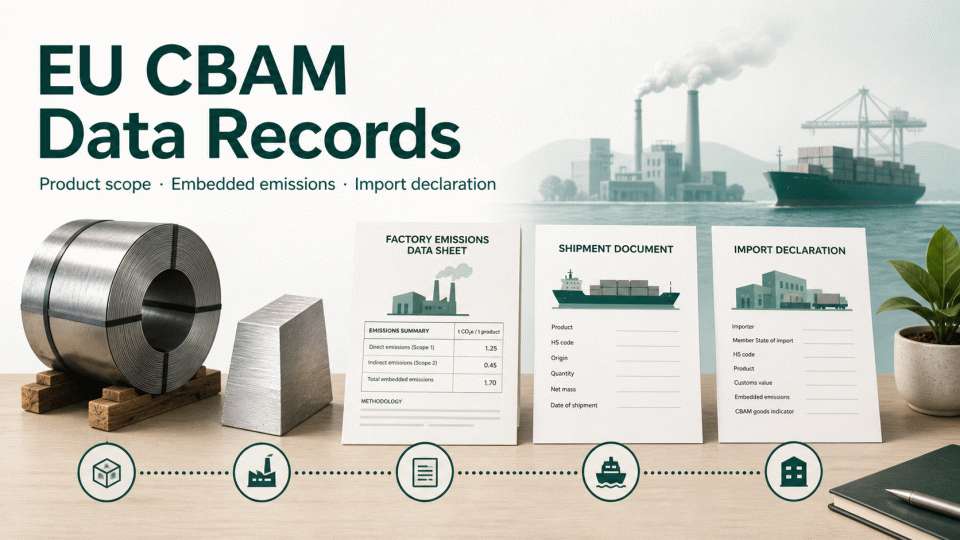
A useful CBAM file is not a generic “compliance pack.” It starts by determining whether a specific imported good falls within Annex I, then links the good to its installation, embedded-emissions data, importer and declaration records. This reference framework is designed for exporters, non-EU installations and EU importers working together.
1. Determine whether the goods are in scope
CBAM is not a universal label for every exported product. The Commission currently identifies cement, iron and steel, aluminium, fertilisers, electricity and hydrogen sectors. Scope still has to be checked against the CN code, goods description and import context in Annex I to Regulation (EU) 2023/956. A metal component or a customer request for carbon data is not, by itself, a CBAM determination.
Create one scope record per product or goods line: SKU or model, goods description, CN code, country of origin, installation, quantity and net mass, Member State of import, EU importer or indirect customs representative, legal basis and review date. The party responsible for customs classification should confirm the CN code against TARIC and the actual goods.
2. Link each product to the installation
An exporter may work with several installations, while one installation may produce several goods. Record the installation name, address, identifier, production process, reporting period, energy and material boundaries, and the products, lots or invoice lines connected to it. When the supplier, factory, invoice holder and importer are different entities, retain the relationship evidence and role explanation instead of treating one name as all parties.
Use “goods line—installation—production period—lot or invoice—emissions record” as the minimum traceability unit. If a lot passes through multiple installations or processes, retain the allocation basis and version history rather than entering an unsupported combined figure.
3. Build an embedded-emissions record
For each relevant good and installation, record at least the reporting period, output and unit, direct emissions, indirect emissions where applicable, system boundary, activity-data sources, emission-factor sources, calculation method, EU or installation methodology version, data owner, source-file location and review date. Do not allocate emissions across products or processes without a documented basis.
For actual emissions, retain energy meters, fuel and raw-material consumption, production records, calculation workbooks and supporting emission factors. If default values or another permitted method is used, document why it was selected, where it applies and which official version was used. The Commission publishes definitive-period guidance, default values and benchmarks; record the download date and version instead of copying only a final number.
4. Keep importer and declaration records distinct
The CBAM definitive regime applies from 1 January 2026. The Commission states that an EU importer of CBAM goods, or its indirect customs representative, importing more than the single mass-based threshold of 50 tonnes must apply for authorised CBAM declarant status. The importer should confirm the threshold, any applicable exemption and the relevant procedure under the current rules. Keep authorisation status, Member State of import, customs declaration reference, quantities, embedded emissions, any claimed carbon price paid in a third country and certificate records as separate fields.
Annual declarations and surrendering certificates are importer-side regime obligations. Exporters can provide reviewable production and emissions evidence, but should not describe data submission as automatic authorisation, customs clearance, tax relief or any other guaranteed outcome.
5. Pre-delivery evidence checklist
Check one evidence item per row: (1) CN code and scope basis; (2) product, installation, lot or invoice link; (3) production period, quantity and unit; (4) direct and indirect emissions plus calculations; (5) original metering, energy, material and production records; (6) emission-factor, default-value or method version; (7) importer, indirect representative and declaration reference; (8) third-country carbon-price evidence where relevant; and (9) version, owner, review date and change note.
Reassess scope and mark affected records when the factory, process, energy mix, product specification or CN code changes, or when the EU rules are updated. 绿色方舟(深圳)认证有限公司 can help organise the evidence structure and wording boundaries, but this page does not replace the official EU texts, customs classification or the importer’s legal duties.
Sources: European Commission, CBAM definitive regime; CBAM legislation and guidance; CBAM sectors; Regulation (EU) 2023/956 on EUR-Lex. Recheck the current official text and guidance before an actual declaration.


