
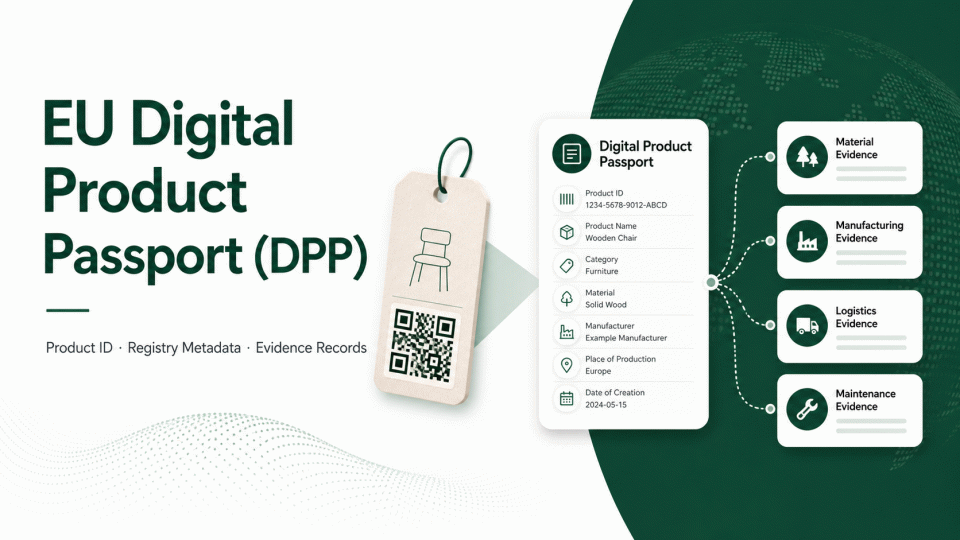
The EU Ecodesign for Sustainable Products Regulation (ESPR) establishes a framework for the Digital Product Passport (DPP). A DPP is not a generic certificate. It is a product-specific data set accessed electronically through a data carrier; the required fields, carrier, granularity, and access rights depend on the applicable product-group rules. This page is an evidence-organizing framework, not a substitute for the regulation, a delegated act, or an authority’s request.
1. Separate the DPP, the registry, and product files
The DPP is the electronic product data set. The registry is the Commission’s digital system for storing at least the identifiers required by the applicable rules. The Web Portal is an access and search layer governed by permissions. None of these is automatically a certification certificate or an Amazon upload record.
Under the ESPR, a product covered by applicable information requirements may be placed on the market or put into service only with a DPP meeting the relevant rules. Whether a particular product is covered cannot be inferred from the phrase “DPP is live”; first identify the product group, the applicable delegated act, and the information requirements.
2. Build a product and responsibility index
Use the product model, batch, or item as the working key, with the level determined by the applicable product-group rules. Record the product name, model or variation, product group, market, manufacturer, importer or other economic operator, legal basis, data version, and change history. Do not assume that products from the same brand or factory share the same DPP scope.
Maintain identifiers for the relevant operators and facilities, together with roles, authorization records, and relationship evidence. The ESPR requires a persistent unique product identifier connected through a data carrier and provides for rules on unique operator and facility identifiers and their lifecycle. Confirm the identifier format and issuing process under the applicable EU rules and technical requirements.
3. Prepare evidence by data field
Product identity and carrier: retain the product identifier, carrier location, model/batch/item scope, and carrier-version records. The carrier may be placed on the product, packaging, or accompanying documents, as specified by the applicable delegated act.
Attributes and technical files: map specifications, materials, durability, reparability, recycled content, spare parts, or other environmental attributes to the product-group requirements. Keep methods, measurements, technical files, version numbers, and conditions; do not turn one product group’s fields into a universal checklist.
Supply-chain and production records: where relevant, connect raw materials, suppliers, facilities, batches, transport, repair, refurbishment, remanufacturing, or recycling records. For every data point, record its source, owner, date, scope, and supporting file rather than treating a supplier statement as a conclusion about the whole product.
Access and privacy: DPP data should use open, interoperable formats and role-based access. The ESPR states that customer personal data must not be stored in the DPP without explicit consent, so customer, order, and public product information should be managed separately.
4. Review registration separately from page wording
Make the title, bullets, image text, and DPP link consistent with the same product version. For “sustainable,” “recyclable,” or “recycled content” statements, identify the object, calculation basis, model scope, and conditions. A data carrier does not mean the product is certified, and a registry record does not by itself establish market access or a sales outcome.
Where a product is sold online or cannot be physically inspected, the relevant economic operator must provide dealers and online marketplaces with a digital copy of the carrier or unique product identifier as required. The ESPR also addresses backup copies and service-provider requirements; the actual fields, access rights, and recipients must be checked against the product-group rules.
5. Maintenance and human review checklist
Before submission or launch, confirm: the product group and legal basis are identified; product, operator, and facility identifiers agree; the carrier points to the correct version; every field has a source and scope; data is complete, current, readable, and interoperable; public and restricted data are separated; page wording matches the evidence; and backup, update, withdrawal, and change reasons are recorded.
Reassess affected fields when the model, material, supplier, facility, label, carrier, DPP service provider, or applicable rule changes. Keep superseded versions and reasons. 绿色方舟(深圳)认证有限公司 can help organize the relationship between product files, evidence sources, and page wording; the responsible entity must confirm the applicable obligations, data submission, and market decisions against the EU text and product-group rules.
Sources and boundary note
Primary source: Regulation (EU) 2024/1781, including its provisions on DPPs, data carriers, access rights, and the registry, together with the European Commission’s DPP infrastructure information. Product-group rules, registry arrangements, and required fields may be set by separate EU measures. This page does not infer a registration duty for a particular product and makes no promise about registration, sales, or market outcomes.


