
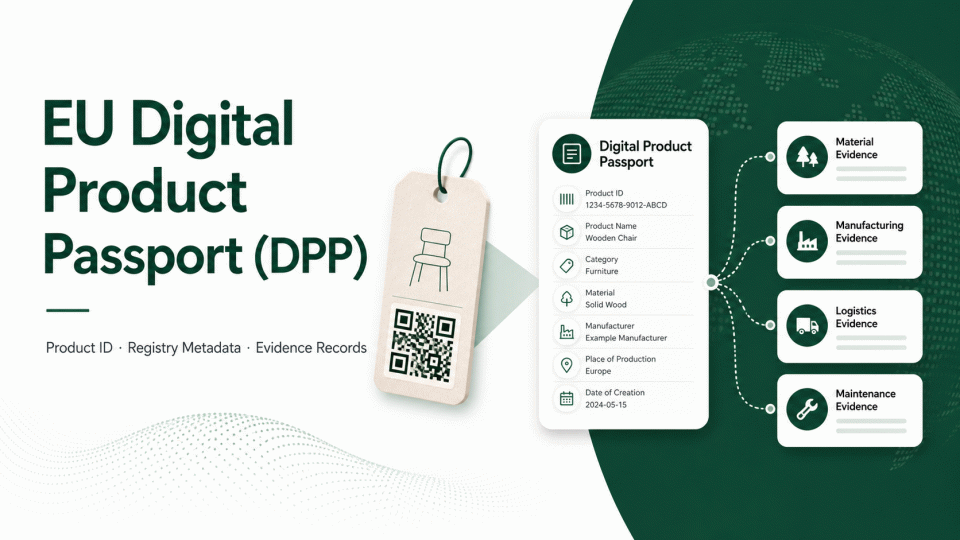
The EU Ecodesign for Sustainable Products Regulation (ESPR) creates a framework for Digital Product Passports (DPPs), but it does not mean that every product immediately has the same registration or data duties. Whether a product needs a DPP, which fields apply, and when they apply must be checked against the Regulation and later product-specific delegated acts. For exporters, the practical starting point is a traceable record linking the product, responsible operators, data carrier, and supporting evidence.
1. Confirm the product scope before building fields
Start a scope register with the product category, model or SKU, target market, manufacturer or importer role, legal basis, and review date. ESPR is a framework Regulation; detailed information duties are established through product-specific delegated acts. Do not infer that a product must already be registered simply because it is sold in the EU or described as sustainable.
Record the brand, manufacturer, importer, authorised representative, and other economic operators separately. Where names, addresses, unique operator identifiers, or responsibilities differ, retain the authorization and supply relationship. One brand file does not automatically cover every SKU, facility, or market version.
2. Link the product identifier to its data carrier
The core DPP relationship is “data carrier—persistent unique product identifier—product data.” Depending on the applicable act, the carrier may be placed on the product, packaging, or accompanying documents. Record its location, encoded content, identifier, version, and change history, and confirm that consumers, authorities, repairers, or other authorized users can access the information relevant to them.
A working field map may reserve columns for durability, reparability, material or recycled content, spare-part availability, dismantling or recycling information, manufacturing location, and supply-chain evidence. The final field set remains product-specific. When using open, interoperable, machine-readable data structures, also record the source, owner, update date, and location of the underlying file.
3. Map each product claim or field to evidence
Each row should identify the product or batch, claim or field, evidence file, coverage, data period, issuing or maintaining party, version, verification route, and open gap. Technical files, bills of materials, supplier statements, test or assessment reports, repair records, and recycling information should not sit in disconnected folders; each record should point back to the actual product version.
A DPP page may state a specific attribute supported by evidence, but a single sustainability data point should not be expanded into “fully sustainable,” “valid in every market,” or “certain to pass review.” If a field is not yet defined by the delegated act, evidence does not cover it, or the product changes materials or facilities, mark it for confirmation instead of guessing.
4. Keep registration, access, and privacy records separate
The framework addresses the DPP registry, web portal, unique operator and facility identifiers, and access rights for different users. Track registry data, public information, and information restricted to authorities or business partners in separate columns. “Internal preparation complete” must not be presented as “official registration complete.”
For customer or other personal data, first confirm that collection is necessary and has a lawful basis. A DPP should avoid placing unnecessary personal data directly in the passport. The responsible operator should review access, retention, supplier interfaces, and change logs under applicable data-protection rules.
5. Pre-release review and source boundaries
Before release, check: ① the product category and delegated act; ② product, model, batch, facility, and operator alignment; ③ traceability of the identifier and carrier; ④ source, version, and owner for each field; ⑤ separation of public and restricted data; ⑥ wording that stays within the evidence; and ⑦ a recheck trigger for material, facility, packaging, software, or rule changes.
This reference is based on Regulation (EU) 2024/1781 (ESPR) and European Commission public material on DPPs. Product duties, technical standards, registry arrangements, and implementation dates must be checked against the applicable delegated act, official registry arrangements, and current target-market requirements. Greenark (Shenzhen) Certification Co., Ltd. may help organize product–field–evidence mappings, but it does not replace an EU institution, customs authority, or other competent body in deciding registration, market access, or certification.


