
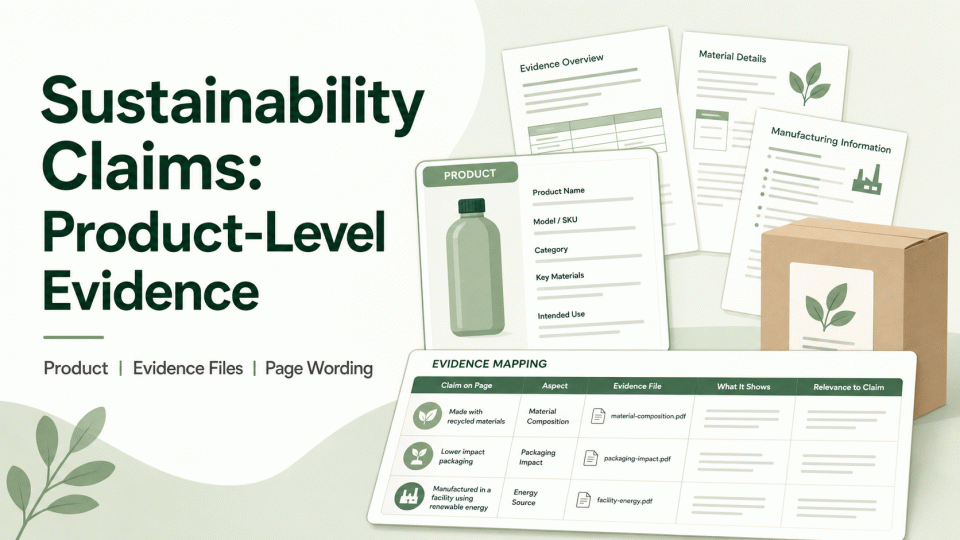
For a sustainability statement on an Amazon detail page, connect the specific product, the wording of the claim, the supporting file, and the page version. Climate Pledge Friendly (CPF) is an Amazon program that helps customers find products with sustainability features supported by relevant certifications or standards; it is not a blanket endorsement of an entire brand or every SKU. Check the current Amazon rules and the relevant certification body’s records for the specific product and marketplace.
1. Define the Product and Claim Scope
Create one master record for each SKU: ASIN or internal SKU, model and version, product category, marketplace, responsible brand or listing entity, key materials and packaging, and the exact sustainability wording under consideration. Record claims such as recycled content, reduced packaging, or organic content separately. Do not turn supplier, factory, or brand-level information into a product conclusion without checking its coverage.
Also record the market and the page location where the wording will appear. Amazon materials describe CPF in connection with third-party certifications, but certification scope, certificate holder, product category, and verification method differ. A generic “green badge file” cannot replace an item-by-item review.
2. Map Each Claim to Evidence
Useful fields include the exact page claim, product attribute, evidence filename and version, issuer, certificate or declaration holder, covered model/SKU, marketplace, date or version, public verification route, open gaps, and items requiring confirmation.
Materials and composition: retain formulas, bills of materials, material declarations, packaging composition, and supplier batch information, with the covered model stated.
Certifications or standards: retain certificates, scope documents, and relevant transaction or supply-chain records; check the holder, scope, status, and public record.
Packaging and lifecycle: document packaging structure, materials, recycling or reduction support separately; do not turn a packaging attribute into a claim about the whole product.
Page wording: retain the final copy, image text, and approval version so every environmental statement points back to evidence.
3. Check Identity, Scope, and Verifiability
A supplier file supports only the entity, product, or supply-chain scope stated in that file. Compare the listing entity, brand authorization, certificate holder, manufacturing location, model, and material coverage. Record discrepancies and ask the issuer or certification body to clarify; do not infer that the document can be used.
Laboratory accreditation, a material test, or a factory management certificate does not automatically establish CPF eligibility. Evidence for one scheme should not be transferred to another scheme. Check dates, versions, and status against the applicable official rules; “within validity” has no standalone meaning outside those rules.
4. Review the Page Line by Line
Compare the title, bullets, description, image text, and certification explanation. Confirm that the claim still describes the SKU, qualifiers have not been removed, “made with a material” has not become “better for the environment,” and a certification scope has not been expanded to a brand or product family. Delete, narrow, or flag any sentence that the current file set cannot support.
Keep the page version, evidence identifiers or hashes, reviewer, and review date. A page edit, supplier change, material or packaging change, or change in scheme rules should trigger a new review. This checklist does not assume a universal renewal interval or platform response time.
5. Sources and Boundaries
For CPF positioning, product-level labeling, and certification partnerships, consult Amazon Ads’ Climate Pledge Friendly guidance and the latest Seller Central help material. For a specific certification, return to the scheme owner’s official rules and verification record. For U.S. environmental marketing wording, consult the FTC Green Guides. These sources provide a review framework; they do not replace a factual assessment of an individual SKU, marketplace, and file set.
Final checklist: the product and claim are defined; each page sentence has supporting evidence; entity, model, market, and scope align; certification or declaration status was checked through an official route; unsupported absolute environmental wording is removed; and changes trigger a versioned review.


