
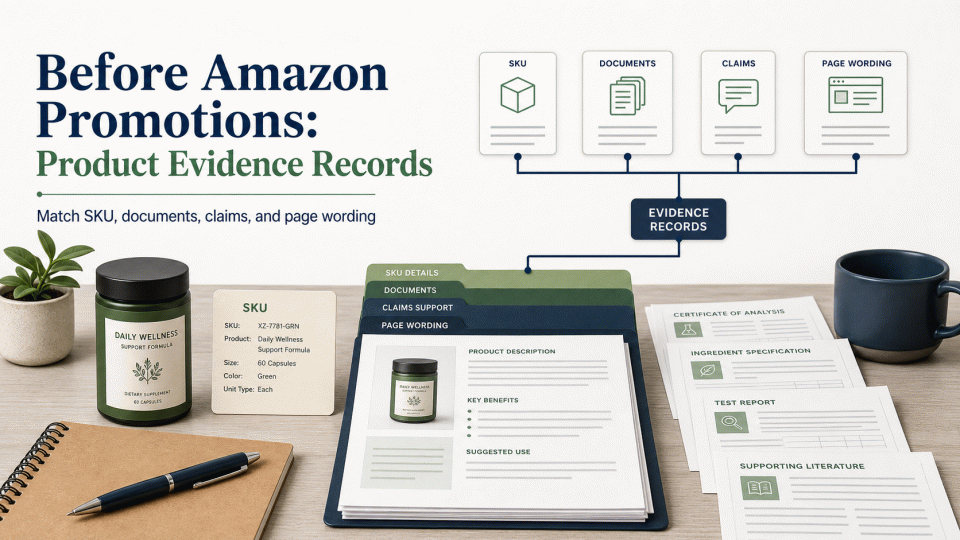
Promotion preparation is not a matter of uploading a generic certificate to every product. The reliable unit of review is the specific SKU, market, product-page claim, and supporting file. This reference page gives sellers a practical record structure for finding missing documents, mismatched evidence, and inconsistent wording before a promotion. Actual requirements depend on the product category, destination market, and the request currently shown in Seller Central.
1. Define the products in scope
Start with a SKU register containing the ASIN, seller SKU, product name, model or variation, packaging version, marketplace, responsible entity, and current page version. Do not treat a brand, factory, or product family as the evidence scope. Changes to materials, formulation, construction, packaging, or destination may require a fresh assessment of whether an existing file still applies.
Separate records into three groups: legal or safety requirements, platform documentation requests, and private requirements from a brand customer or retailer. Their sources and submission routes may differ, so one document should not be used as a substitute for another determination.
2. Build a claim-to-evidence-to-page map
Record each material statement in the title, bullet points, detail-page images, A+ content, and packaging copy. For every claim, note its object, qualifiers, market, evidence file, version, holding entity, and review date. Environmental or sustainability claims should identify the relevant product, material, packaging, or supply-chain element rather than presenting a limited attribute as a conclusion about the whole product.
Potential records include specifications, BOMs, formulas or material declarations, labels and instructions, applicable test or assessment reports, supply-chain records, authorization documents, and certification or program documents. A file does not automatically validate page wording: check the product identifier, entity, sample, test scope, standard version, issue date, and limitations.
3. Pre-promotion document checklist
Product and entity: product specifications, model or variation, BOM or ingredient information, packaging and label version, instructions, brand or distribution authorization, and the responsible entity shown in the listing records.
Requirements and evidence: destination and category assessment, applicable law or standard source, the platform request record, testing or assessment files, claim support, supply-chain or transaction records, and the scope and limitations of any certificate.
Submission and version control: original files or traceable copies, document number, version and date, the key linking the file to the SKU, submission record, platform response, and any follow-up record. Do not infer content from a filename or copy a file from another product or entity.
4. Review the page and files together
Compare the product, files, and page as one set. Check the model, color, size, quantity, materials, and packaging; confirm that claims stay within the evidence scope; compare text in product images with the title and detail page; and confirm that different language versions preserve the same qualifiers. Mark an issue as “evidence needed,” “page wording to revise,” or “scope to confirm” instead of replacing facts with an “approved” or “compliant” conclusion.
Amazon may request documents or additional information for an ASIN through Seller Central Product Compliance Requests. Use the specific request and official instructions shown in the account when checking file types and submission steps. A platform request record does not replace a destination market’s legal, labeling, or product-safety assessment.
5. Suggested fields for the evidence register
Useful fields include ASIN or seller SKU, product and variation, marketplace, exact claim, claim object, evidence file number, evidence entity, coverage, version and date, page location, language version, reviewer, review date, gap, next action, and source link. Preserve the prior version and reason for change whenever a page or product file changes, so another reviewer can reconstruct the basis for the decision.
Sources for further checking
For platform product-document requests, see the Amazon Seller Central Product Compliance guidance. The submission route, file type, and status shown in the account control the practical next step. For environmental claims, consult the official guidance and law applicable to the specific market.


