
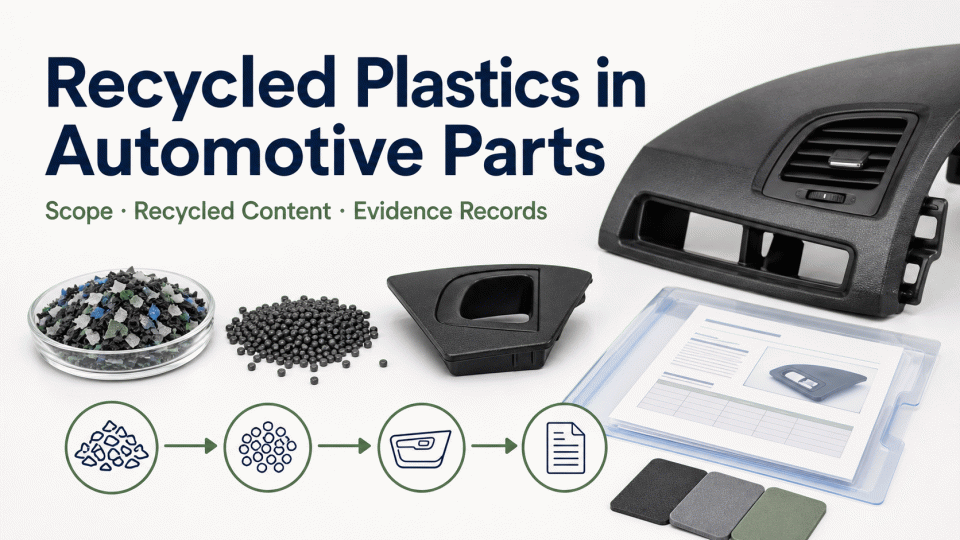
Requirements for recycled plastics in automotive parts cannot be reduced to a single “recycled-material certificate.” Start with the vehicle category, component scope, material formulation, and target market. Then map the recycled-content calculation, source records, batch traceability, and type-approval or customer documentation to the exact part and material version.
Separate legal requirements, customer specifications, and voluntary schemes
The EU regulation on circularity requirements for vehicle design and the management of end-of-life vehicles covers vehicle design, production, maintenance, and end-of-life treatment. The European Commission says that the Regulation entered into force on 13 August 2026 and will apply from 1 September 2028; it sets recycled-plastic targets of 15% from 2032 and 25% from 2036 for new vehicles. This is a vehicle-type and manufacturer-level regulatory framework. It does not mean that every aftermarket plastic part must currently obtain a particular certificate.
GRS, RCS, or another voluntary scheme may support a defined supply-chain or recycled-content claim, but the certificate holder, product scope, material source, transaction chain, and wording of the claim must be checked separately. A voluntary certificate does not automatically replace type approval, chemical restrictions, customer engineering specifications, or other requirements in the target market.
Define the scope down to the part and material
At a minimum, freeze these identifiers in the evidence record:
- Vehicle or platform: model, vehicle category, relevant type-approval scope, and target market.
- Component: part name, part number, revision, supplier, installation position, and mass.
- Material: resin grade, formulation revision, reinforcement, additives, recycled-material source, and whether the input is post-consumer or another source.
- Boundary: calculation basis, whether the record covers one part, a part family, or a vehicle type, and which methodology is being used. Do not turn a component ratio into a vehicle-level conclusion without a documented basis.
Parts that look identical may have different evidence requirements when the resin, supplier, formulation, process, or part number changes. Freeze the product and material revision before mapping documents.
Build a three-column claim, data, and document map
| Check object | Record | Typical evidence |
|---|---|---|
| Recycled content | Calculation basis, mass basis, post-consumer or other source, covered part or vehicle type | Formulation and BOM, supplier declaration, batch or mass-balance records, calculation sheet |
| Material identity | Resin grade, additives, reinforcement, revision, and change history | Specification, BOM, material data sheet, approved change record |
| Source and traceability | Recycling source, processing steps, batch, parties, and quantities | Purchasing records, invoices, batch records, transaction certificates or applicable chain documents |
| Product and performance | Part number, dimensions, mass, mechanical/thermal performance, and safety-related boundaries | Engineering drawing, validation tests, material tests, supplier technical file |
| Customer or page claim | Claim object, qualifiers, covered product, and evidence reference | Customer specification, technical or label copy, sentence-level review record |
Each document should answer: which part and revision does it cover, which data point does it support, who issued it, and what are its date and scope? A generic supplier statement does not automatically prove recycled content for the complete vehicle, another part, or another batch.
Keep regulatory dates separate from document dates
The Commission’s current summary distinguishes the ELV Regulation’s entry-into-force date, application date, and recycled-plastic target dates. Store the regulatory date, type-approval planning, customer project milestone, and document review or validity date in separate fields. Do not present the 2032 or 2036 targets as a single current certification deadline for every component, and do not add a fixed testing interval unless the applicable program or project file supports it.
When the target market, vehicle, part number, formulation, supplier, or recycling source changes, reassess whether the calculation boundary and evidence still apply. External copy should state only product-level facts supported by the current file. Avoid outcome claims such as “complies with all regulations,” “guaranteed to pass review,” or “accepted by every automotive manufacturer.”
Pre-submission review checklist
- Confirm the vehicle category, target market, part number, and material revision.
- Record the recycled-content calculation basis and distinguish post-consumer inputs from other sources.
- Map the BOM, material data, batch traceability, and test or validation files to each claim.
- Check the issuer, scope, revision, date, and quantity chain for every certificate or declaration.
- Review technical files, customer submissions, and page wording sentence by sentence; do not expand part data into a vehicle-level or regulatory outcome.
- Log formulation, supplier, process, part-number, and market changes and trigger a reassessment.
Sources and boundaries
The EU dates and recycled-plastic targets in this article are based on the European Commission’s End-of-Life Vehicles page and New rules for a more circular European automotive sector; use the latest formal text and procedure status on EUR-Lex. The scope, certificates, and chain requirements of GRS and other voluntary schemes should be checked against the scheme owner’s current documents. 绿色方舟(深圳)认证有限公司 provides a framework for checking product scope, evidence mapping, and wording; it does not replace the final determination of a regulator, type-approval body, customer, or scheme owner.


