
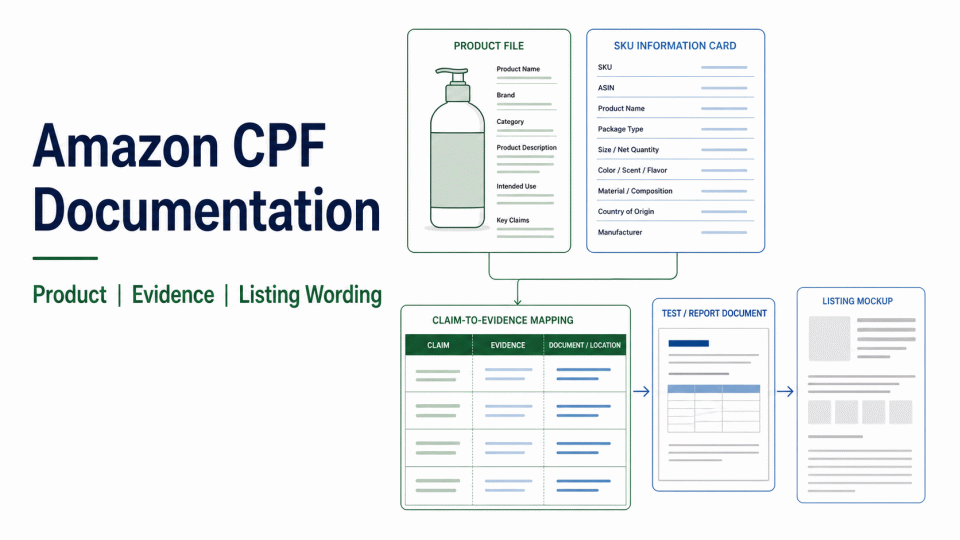
Amazon Climate Pledge Friendly (CPF) helps identify products with sustainability features in the Amazon store. Preparing for the program is not a matter of combining every regulation or certificate in one file. The practical task is to connect a specific product, a supportable environmental attribute, the evidence behind it, and the wording shown to shoppers.
1. Break the CPF question into four objects
Product object: Record the ASIN, SKU, variation, category, materials or formulation, packaging, manufacturer, and country of origin. Product-level information should not be replaced with a brand-level sustainability slogan.
Environmental attribute: Define the single attribute being described, such as recycled content, a recyclable design feature, a sourcing characteristic, or packaging reduction. State the comparison basis, covered component, and limitations. An attribute supported for one component should not be expanded into a claim that the whole product is “green” or has no environmental impact.
Evidence file: Assign an evidence ID to each claim and record the document name, issuer, covered product or batch, data scope, date, version, and storage location. Whether a certificate or report is usable depends on its scope, holder, product match, and applicable requirements—not on its title alone.
Listing wording: Review the title, bullets, description, image text, packaging, and advertising separately. Every environmental claim that shoppers can perceive should map back to evidence, with necessary qualifications kept close to the claim.
2. Build a product–claim–evidence register
For each ASIN, keep fields for product identifier; marketplace; exact claim wording; covered component; evidence type; document ID and location; evidence holder; scope; limitations; listing location; reviewer; and review date.
If a claim covers only one part of the packaging, say so in the listing wording. If a file comes from a supplier, verify the supplier identity, product model, material formulation, and batch or scope. A generic supplier document should not automatically be treated as evidence for the seller’s ASIN.
For a third-party certification or environmental label, record the scheme name, authorization or certificate scope, holder, and whether Amazon currently recognizes the route for CPF. A certification also does not substantiate other express or implied advertising claims by itself.
3. Three listing-language checks
Replace broad words with checkable facts. Words such as “green,” “eco-friendly,” or “better for the environment” can imply an overall environmental advantage. Prefer a specific attribute, covered component, and comparison basis. If the likely overall interpretation cannot be supported, do not use the broad wording.
Place qualifications next to the claim. Qualifications should be clear, prominent, and connected to the claim rather than hidden at the bottom of a page. For “recyclable,” “recycled content,” or “sustainably sourced,” check facilities, material percentage, component scope, and actual conditions of use.
Separate Amazon presentation from legal duties. CPF is an Amazon product-sustainability presentation program. It is not a substitute for mandatory product safety, labeling, import, or chemical requirements in a market. Identify and retain those obligations separately by product, market, and responsible party.
4. Pre-submission checklist
□ The ASIN/SKU matches the specification, photographs, and variation; □ the claim covers only the evidenced component; □ holder, product, scope, and version are checked; □ supplier evidence has a confirmed relationship or authorization; □ test or calculation methods, data sources, and limitations are traceable; □ title, bullets, description, image text, and advertising are consistent; □ certification names and marks follow the relevant authorization and Amazon rules; □ the submitted version, attachment list, and account feedback are retained.
5. Maintenance and boundaries
Reassess the evidence when the formulation, materials, packaging, manufacturer, supplier, certification scope, or listing claim changes. Expiry, scope changes, and listing revisions should trigger a review. Do not assume one universal validity period or review timeline; confirm the applicable document, scheme, and current Amazon requirements.
The FTC’s Environmental Claims: Summary of the Green Guides notes that broad “green” or “eco-friendly” claims are difficult to substantiate, and that a certification or seal does not automatically substantiate other express or implied claims. Amazon’s public Sustainability Solutions Hub describes CPF as working with recognized third-party certifications and Amazon-created programs, with program information and submission paths available through the Hub. Current account-specific requirements control.
Sources: Amazon Sustainability Solutions Hub; Amazon Ads Climate Pledge Friendly Creative Guidelines; FTC Environmental Claims: Summary of the Green Guides. These sources describe public program and environmental-claim boundaries; they do not determine eligibility or an outcome for a specific product.


