
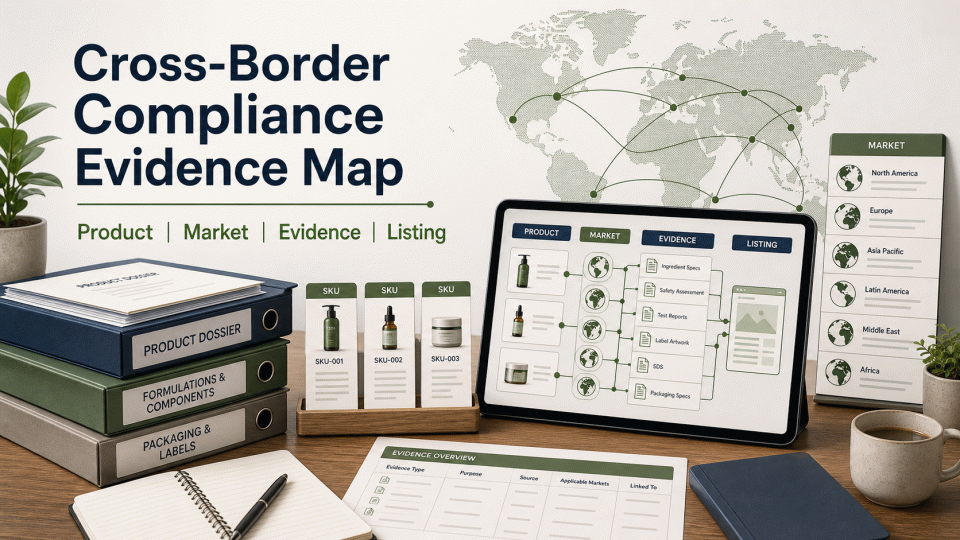
There is no single “global compliance certificate” that covers every product and destination. A more defensible working method is to connect each SKU, target market, responsible party, applicable requirement, supporting file, and listing statement in one traceable evidence map.
1. Define the record scope first
Give each SKU a unique record covering the product name, model or version, materials/formula, packaging, destination market, seller, manufacturer, importer, and any other relevant role. Requirements can differ by destination, channel, and product category; different SKUs should not automatically inherit the same evidence set.
Separate the requirement tracks: mandatory product rules in the destination market; platform information or file requests; and customer, retailer, or procurement standards. For each track, record the source, applicability condition, owner, and status. This prevents a platform request from being presented as a law, or a voluntary scheme from being presented as a universal market-entry requirement.
2. Turn requirements into verifiable evidence fields
Product and technical records: specifications, BOM, critical components or ingredients, packaging and label artwork, instructions, risk assessments, and applicable test or calculation methods. Files should identify the product version instead of relying on a supplier’s generic brochure.
Entity and responsibility records: seller or brand owner, manufacturer, importer, authorised representative where relevant, and the evidence connecting those roles. Compare names across certificates, declarations, reports, listings, and import records, and preserve the decision trail when a role or entity changes.
Supply-chain and environmental-claim records: purchase and production batches, source information, transaction or chain-of-custody documents, calculation support for recycled or organic claims, and the source for each environmental statement. If a claim concerns packaging, say so clearly rather than implying it describes the product.
Index fields: file number, version, issuer, covered SKU, market, issue date, reviewer, source link, and the event that would trigger another review. Do not assume every report has one universal validity period; assess updates against the applicable rule, document type, product changes, and platform request.
3. Check each market instead of using a global checklist
EU product obligations depend on the product category, the roles in the supply chain, and the specific legislation. For example, CE marking applies only where harmonised EU rules require it; the manufacturer must identify applicable requirements, prepare technical documentation, and sign the relevant declaration of conformity. In the United States, environmental marketing language should be checked against the FTC Green Guides and the evidence for the specific claim. These sources describe their own scopes; they do not create one workflow for every market.
Make the market field a combination of destination, sales channel, and product category, and link it to the official regulation, authority, platform help page, or customer standard. For changing or interpretive requirements, record the review date and open questions rather than turning a news summary, supplier statement, or internal schedule into an effective legal date.
4. Make listing language traceable
Review the title, bullets, images, attributes, and detail-page copy sentence by sentence. Does each statement describe the product, packaging, material, process, or company? Does the evidence cover the same object, version, and market? If broad terms such as “eco-friendly,” “sustainable,” or “recyclable” are used, is the qualification clear and the support reliable? The FTC’s basic guidance is that environmental claims need competent and reliable scientific evidence, with particular care for broad unqualified claims.
If a certification or label is shown, confirm the authorization, scope, certificate holder, and graphic rules first. Do not expand one scheme’s document into a claim that the product is compliant in every market, and do not turn “documents organized” into a guaranteed review or sales outcome.
5. Human review before submission
① SKU, version, materials/formula, and packaging match the evidence; ② entity names and roles are consistent; ③ destination and channel are explicit; ④ each requirement links to an official or customer source; ⑤ reports, declarations, images, labels, and listing language support one another; ⑥ versions, changes, reviewers, and open questions are recorded; ⑦ Chinese and English pages express the same scope without turning an inference into a fact.
When the product, supplier, packaging, rule, or listing changes, reassess the affected SKU record. 绿色方舟(深圳)认证有限公司 can help structure records and review evidence boundaries, while applicability remains subject to the destination market’s official requirements, current platform rules, and customer standards.
Reference sources: U.S. Federal Trade Commission Environmental Marketing and Green Guides; European Union Your Europe pages on general product compliance and CE marking (accessed 27 August 2026). This is a documentation reference, not a promise of any product, market, or platform outcome.


