
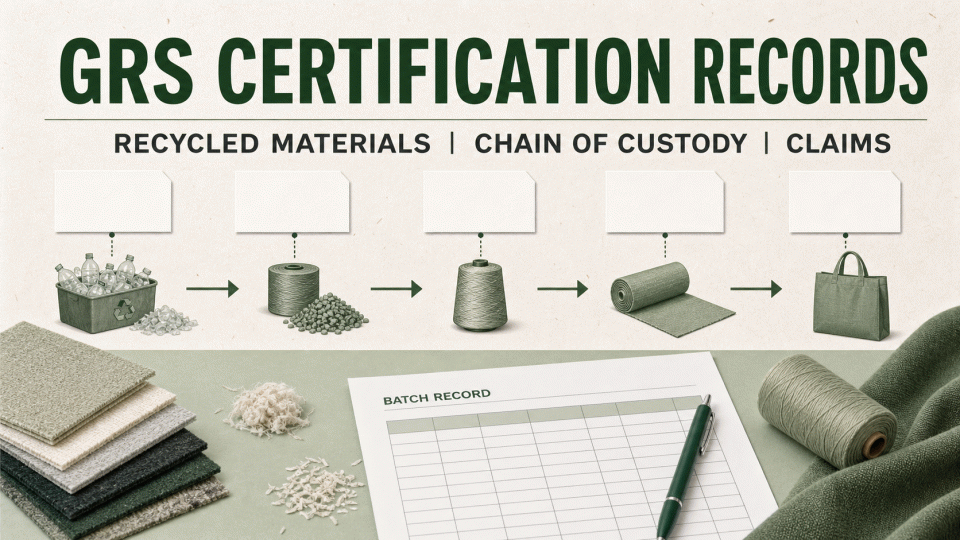
The Global Recycled Standard (GRS), managed by Textile Exchange, is a voluntary third-party standard for verifying recycled materials and tracing them through the supply chain. It also includes social, environmental, and chemical requirements for processing. A useful preparation file connects the certification scope, product composition, supply-chain sites, and proposed claims item by item; a supplier certificate should not be treated as universal evidence for every SKU.
1. Define the certification scope first
Start with a scope table covering the applicant or certificate holder, production and processing sites, product categories, recycled-material types, process steps, outsourced operations, supply-chain entry points, and the seller in the final business-to-business transaction. A brand, trader, factory, and seller may have different roles; the brand name alone does not establish certificate coverage.
GRS 4.0 materials describe chain-of-custody tracking through the Content Claim Standard (CCS). Earlier documents also distinguished the product eligibility threshold from the threshold for product labelling. Textile Exchange published the GRS-101 V5.0 document in 2026 and is transitioning toward the Materials Matter system, so older thresholds, label rules, and transition dates should not be copied into a current project without checking the applicable version.
2. Build product and recycled-material evidence
Create an evidence index by SKU, batch, or product family. Include specifications, a BOM or formulation, material composition and source statements, the basis for identifying recycled material, mass-balance or quantity records where relevant, production batches, losses, and blending records. If a range uses different colours, fibres, trims, factories, or recipes, mark those differences instead of assuming that similar appearance means identical scope.
Each record should lead back to a product, supplier, site, and transaction. For purchase orders, invoices, transport documents, batch records, and applicable transaction certificates or electronic transactions, retain the reference number, date, quantity, parties, and related material. For supplier-provided files, check the certificate holder, scope, status, and position in the chain.
3. Organise processing-site and management records
GRS is not only a review of the recycled content in a finished item. Organise site records by process: receiving and segregation, storage identification, production movement, batch traceability, output and loss, subcontractor controls, waste and energy records, responsible staff, and training. For chemical processing, compile the chemical inventory, purchasing and use records, supplier technical information, and risk controls requested by the current standard and certification body.
Social, environmental, and chemical requirements are part of the certification scheme, but they are not a universal conclusion about product safety, environmental performance, or legal status in every market. Keep certification-scope evidence separate from product-law and market-access files.
4. Map certificates and claims
Use four columns: claim object (product, material, site, or supply chain), proposed wording, supporting record, and scope or limitation. Before using the GRS name, mark, or recycled-content wording, check the current Logo Use and Claims Guide, certificate status, product scope, and whether the relevant final business-to-business seller has the required certification basis.
“Contains recycled material,” “covered by a GRS certification system,” “eligible to use a GRS mark,” and “meets the law of a particular market” are not interchangeable statements. Do not substitute RCS, GRS, FSC, OEKO-TEX, or a platform sustainability programme for one another. State the material, percentage, product scope, evidence date, and market where supported; remove unsupported wording or mark it for verification.
5. Pre-submission checklist
Ask: Does the certificate holder match the applicant and relevant transaction party? Are every site and process step in scope? Can recycled-material source, quantity, and batch records be reconciled? Are outsourced operations and transactions continuous? Does every environmental claim on the product page have a supporting record? Are versions, signatures, identifiers, and dates traceable? Are market-law and platform questions clearly separated instead of being answered by the GRS certificate?
Reassess the scope and wording when the product, supplier, formulation, process, site, or sales market changes. Maintain green claims, certification marks, and market-law requirements as separate controls. 绿色方舟(深圳)认证有限公司 should base any customer-facing file review on the actual certificate scope and verifiable records, without promising a certification result or a timeline.
Sources and version note
This reference uses Textile Exchange materials describing GRS, the GRS-101 document page, GRS 4.0 certification procedures, and CCS chain-of-custody information. The standards system is changing, so confirm the current Textile Exchange documents, the certification body's applicable procedures, and the claim rules in the markets where the product is sold.


