
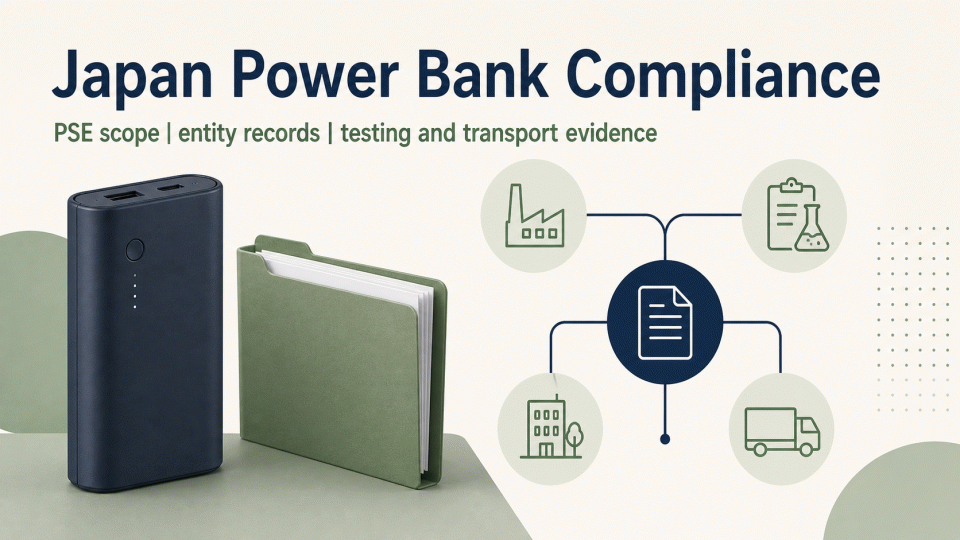
A Japan power-bank project should begin with product classification, not with a generic certificate. First determine whether the product falls within Japan’s Electrical Appliances and Materials Safety Act (the Electrical Safety Act), then link the product, responsible entity, technical file, markings, labeling and transport records. This page is a preparation framework; it does not replace a case-specific determination by the Japanese authorities, the responsible importer or the carrier.
1. Confirm the product boundary
METI materials list qualifying lithium-ion storage batteries within the Electrical Safety Act. The scope still requires a product-specific review of cell volumetric energy density, intended use and construction. METI’s FAQ on portable lithium-ion storage batteries explains that a mobile battery used mainly as an external power source for electronic equipment may be treated as a lithium-ion storage battery even when charging or voltage-boosting components are built into the same housing. Detachable designs require a separate assessment of the battery and the housing. The product name alone is not enough.
Create one scope record per SKU: cell chemistry, cell and pack construction, rated voltage and capacity, volumetric energy-density calculation, external-power use, any AC output, product photos, model number and revision. Chargers, cables and other electrical items sold with the product may require their own scope review.
2. Separate PSE records from entity responsibility
For a mobile battery within the Electrical Safety Act, the seller or responsible business must address the applicable technical requirements, notifications and inspection records before sale, and display the required PSE mark and responsible business name or other prescribed information. PSE is not a generic “METI-issued certificate.” The mark, inspection route, record retention and allocation of responsibility must be checked against the applicable law, technical requirements and official guidance.
At minimum, record the Japanese sales or import-responsible entity, manufacturer and factory, model and change history, applicable electrical-appliance category, technical file, standards and test items, inspection records, PSE artwork, Japanese labeling and instructions, and the link between production lots and models. A supplier report is input evidence; it does not automatically prove that the legal entity, model, construction and revision match the current SKU.
3. Keep PSE and transport evidence in different tracks
UN 38.3 belongs to lithium-battery transport testing and shipping documentation. It is not the same determination as PSE scope under Japan’s Electrical Safety Act. Before shipment, review the battery type, watt-hour rating, packaging, transport mode and carrier rules, including the UN 38.3 test summary, packaging and marking requirements, shipping declaration and emergency information. Air, sea, road and express channels may apply different conditions. A UN 38.3 document does not replace PSE records, and PSE records do not replace transport documentation.
Maintain a separate transport file: battery specifications and watt-hours, UN 38.3 test summary, packaging and short-circuit protection, dangerous-goods classification assessment, carrier or forwarder confirmation, carton marks and shipping labels, shipment lot and change records. Recheck the links whenever the cells, protection board, housing or packaging changes.
4. Reconcile the page, label and instructions
Review the product page, packaging, nameplate and Japanese instructions as one version set. Model, rated input and output, capacity wording, manufacturer or responsible entity, warnings, PSE marking and usage limits should correspond across the set. Do not turn “a test report exists” or “the shipment is transportable” into an unconditional Japan-market sales claim, and do not use another country’s certification mark as a substitute for Japanese requirements.
Record page, image, label and instruction revisions with their effective dates. A cell, protection circuit, charging protocol, housing, supplier, manufacturing site or responsible-entity change should trigger a combined scope, testing, marking and transport-file review.
5. Pre-delivery evidence index
Organize one SKU file in this order: (1) product specification, model and revision; (2) battery construction and scope assessment; (3) responsible entity and manufacturer records; (4) technical file, tests and inspections; (5) PSE marking, Japanese labels and instructions; (6) UN 38.3 and transport documents; (7) page, packaging and image versions; and (8) change, sampling and open-question logs. If the scope, notification or marking is uncertain, confirm it with the Japanese authority, the local responsible entity or an appropriately qualified specialist. Greenark Certification (Shenzhen) Co., Ltd. can help organize the evidence logic, but the applicable law and current official requirements govern the final determination.
Boundary note: This page does not promise a sales authorization, marketplace acceptance, customs outcome or fixed processing time. PSE scope, responsible entity, labeling and transport requirements must be confirmed against the actual product and current official requirements.
Official references: METI, FAQ on portable lithium-ion storage batteries; METI, scope examples under the Electrical Safety Act; METI, English overview of the Electrical Appliances and Materials Safety Act.