
Preparation under Japan’s Consumer Product Safety Act starts with classification, responsibility and evidence—not with a generic certificate bundle. A seller or importer should identify whether the product is within a designated category, determine which business operator has the relevant duties, and align technical files, warnings and product markings with the actual model.
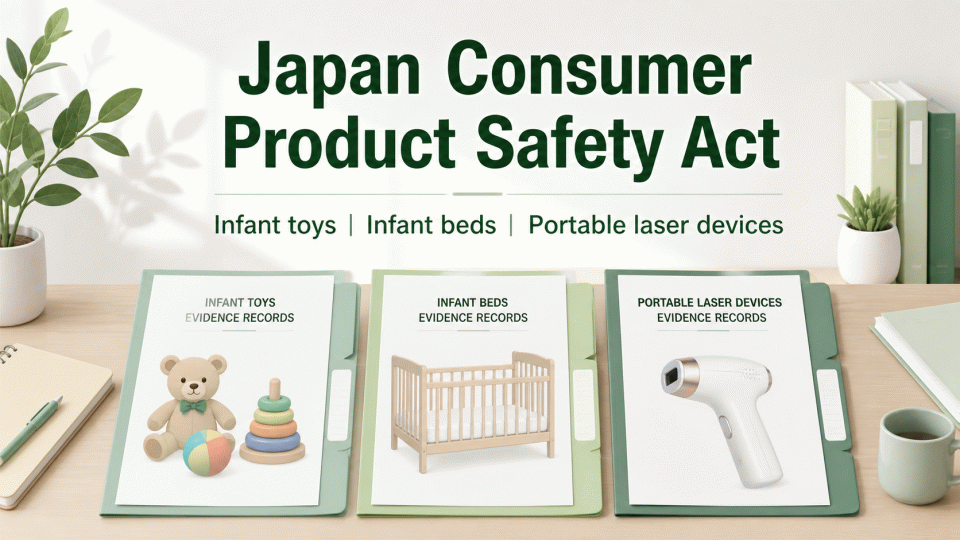
This reference page focuses on three categories that are often mixed together: toys designed for infants under 36 months after birth, infant beds designed mainly for sleep or care of infants under 24 months, and portable laser application devices designed to project visible laser light externally to display text or figures. The final classification depends on the product’s intended use, construction and the official Japanese scope.
1. Separate the three product scopes
Infant toys: METI describes the regulated category as products designed for play and intended for infants under 36 months after birth. A product that an infant might use is not automatically a toy under this definition; the play purpose is a relevant fact.
Infant beds: The definition focuses on products designed mainly for household sleep or care of infants under 24 months, with a specific exclusion for rocking types. Ordinary furniture, bed guards and other children’s products should not be placed into the same category merely because marketing language sounds similar.
Portable laser application devices: The official product list addresses devices designed to externally emit visible laser light to display text or figures. Examples include laser pointers, laser sighting devices, laser distance meters and toys that emit laser light. Classification should be checked against the laser type, intended output and construction; not every light-emitting product is a regulated laser device.
2. Understand the PSC categories
METI lists infant beds as both specified products for children and specially specified products. Infant toys are specified products for children, while portable laser application devices are specially specified products. The marking category, technical requirements, inspection route and operator duties therefore need to be mapped separately.
For infant toys, METI states that the new children’s-product rules took effect on 25 December 2025. Manufacturers and importers must check the applicable technical requirements and warnings such as intended age and precautions for use; the sales rules also address products without the required Children’s PSC marking. The infant-bed and laser-device requirements should be checked through their own official product entries and technical rules.
A test report, marketplace upload or overseas certification does not by itself replace a Japanese statutory marking or prove that every obligation has been met. Japanese labels, instructions and the actual product information should be reviewed as one model-specific evidence set.
3. Build a model-level evidence record
Product identity: Record the SKU, model, photographs, intended use, target age, dimensions, materials, critical construction, laser wavelength and output purpose where relevant, plus manufacturer and importer information. Keep version numbers and change reasons when the product changes.
Technical and test files: Keep specifications, drawings or BOMs, hazard identification, critical-component information, a check against the applicable technical requirements, test or inspection reports, and Japanese instructions and warnings. The report should identify the model and sample. Laboratory status, methods and scope must be checked against the actual requirement; do not impose a universal “24-month validity” rule across product categories.
Markings and responsible operator: Record which PSC or Children’s PSC marking applies, who is responsible for it, where it appears, and how Japanese precautions align with the packaging, instructions and product page. For cross-border sales, separately confirm the Japanese business operator, import arrangement and sales route; a supplier’s name is not automatically the responsible operator.
Evidence index: For each file, record its filename, version, date, covered model, issuing or preparing entity, linked rule and reviewer. Link photographs, label artwork, reports and change records to the same SKU instead of keeping an unexplained “compliance certificate” PDF.
4. Common mistakes and wording limits
First, do not collapse the three categories into one universal checklist. Route the product by intended use and construction, then maintain separate rule-to-evidence records for toys, infant beds and laser devices.
Second, do not turn “testing completed” into “market access granted.” A report is one part of the record; markings, operator identity, labels, instructions, sales route and other applicable laws still need separate review. State the model and evidence scope that was checked instead of generalizing to every SKU under a brand.
Third, do not present marketplace action, customs treatment, recalls, fines or delisting as automatic outcomes. A Consumer Product Safety Act reference page should stay with official rules, operator duties and evidence preparation. Case-specific action depends on the facts, authorities and sales route.
5. A practical review sequence
Keep an auditable sequence: intended use and construction → designated product category → responsible operator → technical requirements and inspection → Japanese labels and instructions → PSC or Children’s PSC marking → page and sales route → post-change review. If the product also raises electrical, radio, chemical or other sector requirements, create a separate record instead of placing them under the Consumer Product Safety Act heading.
This page reflects METI material checked on 27 August 2026 and is for preliminary evidence review, not legal advice for a particular product. Greenark (Shenzhen) Certification Co., Ltd. should review the current Japanese text and the specific model, use, responsible operator and sales route before customer-facing conclusions are made.


