
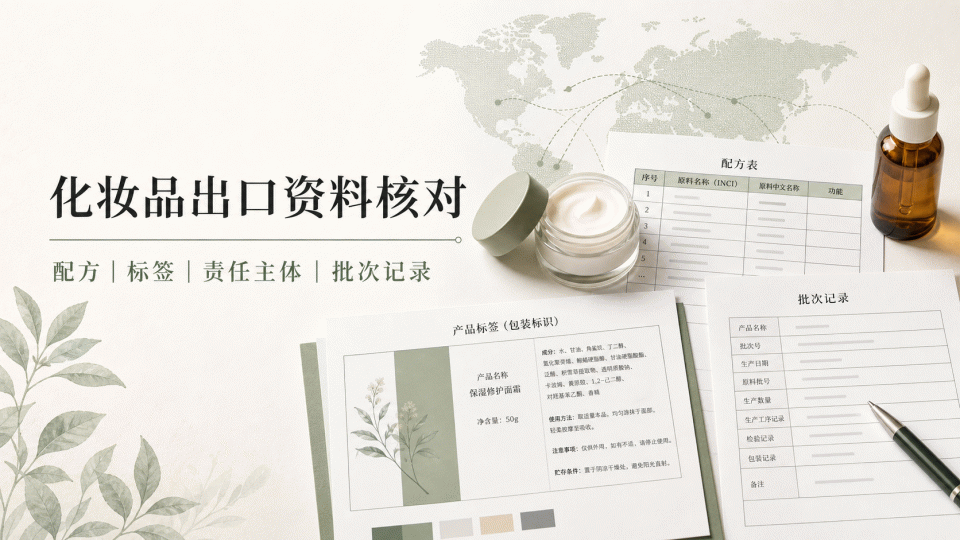
Cosmetics export documentation is not a single “universal certificate.” A defensible file starts with the product category, target market, and responsible parties, then maps the formula, label, manufacturing and batch records, post-market records, and listing claims to a specific SKU.
1. Lock the product, market, and responsible party
Create one baseline record per SKU: product name, form, net contents, formula version, packaging version, manufacturing facility, brand or label entity, target countries or regions, and the rationale for classifying the product as a cosmetic, drug, or another category in each market. If the marketing claim treats or prevents disease or changes body function, do not assume that a cosmetics-only file is sufficient; review the classification first.
For the United States, MoCRA requirements for facility registration and cosmetic product listing apply to the relevant facilities and responsible persons. FDA states that registration and listing are not an approval program and that FDA does not issue a “certificate” for them. FDA also describes product listing information, including ingredients and required updates, and notes exemptions for certain small businesses and products. These points require a product-specific review rather than a universal checklist.
For the European Union, Regulation (EC) No 1223/2009 requires a cosmetic product placed on the market to have an EU-established responsible person. Before placing the product on the market, the responsible person must ensure a safety assessment and a product information file (PIF). Article 13 also provides for Cosmetic Product Notification Portal (CPNP) notification. The responsible party, label information, PIF location, and import arrangement should tell the same product story.
2. Map the four documentation groups
Formula and ingredients: retain formula versions, INCI names, supplier information, the basis for restricted ingredients, and change records. A supplier document is not automatically complete substantiation for the finished product; confirm the identity, specification, concentration, use, and version.
Safety and technical file: assemble the material needed for the target market’s safety assessment or safety substantiation, such as finished-product specifications, relevant stability or microbiological information, packaging compatibility, manufacturing quality records, and applicable test reports. The required evidence depends on the product, formula, use conditions, and market; a universal “all reports are valid for two years” rule is not a safe substitute.
Label, packaging, and listing: check the product name, net contents, ingredient declaration, responsible party or address, batch or identification information, warnings, directions, and language. Claims such as “repair,” “hypoallergenic,” “free from,” “natural,” or “eco-friendly” should be mapped to evidence that supports that exact wording. Keep cosmetic presentation separate from drug-like efficacy claims.
Manufacturing, batch, and post-market records: index production batches, raw-material lots, release records, packaging versions, retained samples, complaints, and adverse-event records. A batch record supports traceability and internal review; it does not by itself prove that every market requirement has been met.
3. Minimum fields for an evidence register
For each SKU, record at least: document name and version, linked product or formula, responsible party, manufacturing facility, applicable market, document date, issuing source, the exact label or listing claim supported, limitations, reviewer, and change triggers. If evidence is missing, mark it as pending. Do not substitute another product, another company’s certificate, or an unchecked secondary summary.
Laboratory accreditation, report formatting, and signatures describe formal features of a document; they do not alone prove that the report covers every obligation in a target market. Check the sample name, batch, method, parameters, findings, laboratory entity, and customer against the current SKU.
4. Review sequence before launch and after changes
First, lock the target market and product classification. Second, identify the roles of the manufacturer, brand owner, importer, and local responsible party. Third, compare the official regulation, authority guidance, and current platform requirements. Fourth, map the formula, packaging, label, batch records, and listing claims. Fifth, preserve submission records, versions, and review conclusions.
A formula, supplier, manufacturing facility, package, responsible party, target market, or marketing claim may change. Each change should trigger a review of the affected files, labels, notifications, and listing content. Do not assume one renewal window for every document; follow the applicable rule, the document itself, and the current instruction of the relevant authority.
5. Sources and scope
This page is a documentation framework, not a market-specific legal conclusion. The U.S. section is based on FDA’s Registration & Listing of Cosmetic Product Facilities and Products and related guidance. The EU section is based on Regulation (EC) No 1223/2009 and the European Commission’s CPNP page. A real project still requires a product-, market-, formula-, and date-specific review.
绿色方舟(深圳)认证有限公司 may help organize an evidence map from the product, entity, and market information supplied by the client. A document review is not a regulatory approval, a guarantee of platform acceptance, or a promise of a particular outcome.


