
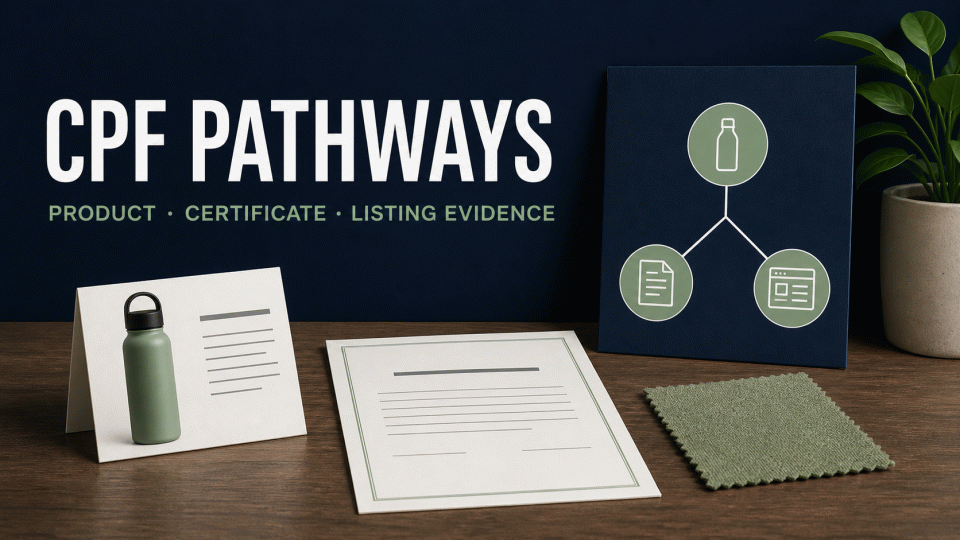
Amazon Climate Pledge Friendly (CPF) helps customers discover products associated with sustainability certifications or relevant product attributes. It is not a universal certificate detached from a specific scheme, and it does not replace mandatory product, labeling, chemical, packaging, import or producer-responsibility requirements. A practical path starts with the product facts and the certification evidence already available.
1. Separate CPF from mandatory product compliance
CPF is a discovery and sustainability-information program. Product obligations still depend on the product category, destination market and responsible parties. A sustainability certification does not by itself establish compliance with every market rule, and it does not guarantee that Amazon will display a CPF label for a particular ASIN.
Amazon’s seller guidance describes CPF as a program that works with participating third-party certifications. Sellers should review the certifications currently included, obtain the relevant certification, and then confirm the ASIN status through the current Seller Central process. The accepted schemes, markets and submission routes may change, so an old checklist should not be treated as current platform policy.
2. Choose the evidence path from product facts
Start with a SKU–product version–scheme map. Record the ASIN or SKU, model or style, materials and formulation, production site, brand and marketplaces. The evidence for textiles, wood products, electronics, cleaning products and packaging is not interchangeable. A supplier’s certificate should not be applied to a product, legal entity or scope that it does not cover.
Then review the certificate: scheme and version, certificate or license number, certificate holder, covered products, facilities or materials, certifier, current status, limitations and public verification route. Where supply-chain traceability is part of the scheme, link batch, transaction and material records to the product version.
Finally, reconcile the Amazon-side record: seller and brand information, ASIN-to-certificate relationship, product attributes and the current Seller Central submission or appeal record. Platform fields are operational evidence; they are not a substitute for defining the product’s regulatory scope.
3. File checklist and listing language
Product file: model, variations, specifications, BOM or material composition, packaging and label artwork, production site and revision history.
Certification file: the complete certificate or license, scope, holder, number, certifier and verification record. For schemes with chain-of-custody requirements, retain the related purchasing, processing and delivery records.
Claim file: each environmental or material claim should trace back to product facts and evidence. Do not present an application or an open review as a completed certification, or describe a CPF label as government approval, a regulatory exemption or a safety outcome.
Maintenance file: recheck the evidence link when materials, formulation, factory, supplier, packaging, certification scope or ASIN changes. Use the certifier’s current record and Seller Central for status and process details; do not assume one universal validity period or review timeline.
4. Sources and limitations
The explanation of CPF’s role, certification paths and ASIN labeling is based on Amazon Seller Central’s seller guidance on Climate Pledge Friendly. Confirm the current scheme list, product scope, certificate-holder requirements and submission route with the relevant certifier and Amazon’s current pages.
绿色方舟(深圳)认证有限公司 can help map products, certificates and listing evidence. This article does not promise a CPF label, certification outcome, platform display, sales result or processing time.


