
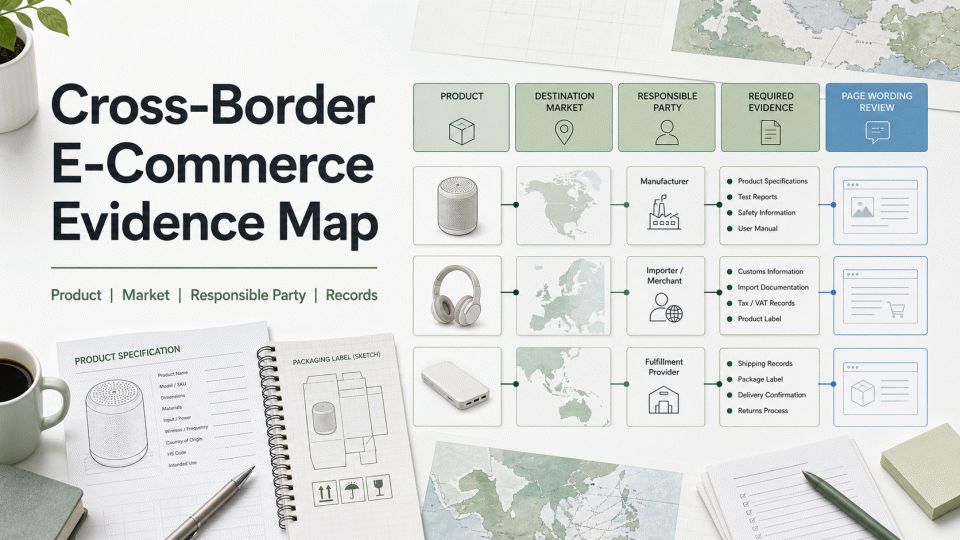
There is no single “global compliance certificate” that covers every product, destination and marketplace. A more reliable working method is to map each specific product, destination market, responsible party and page claim to the rule and record that actually supports it.
1. Start with a five-column matrix
For each SKU, record at least five fields: product facts such as model, materials, formulation, function and packaging; destination market including country, sales channel and import arrangement; responsible party such as manufacturer, brand owner, importer, authorised representative or fulfilment provider; applicable requirements such as mandatory law, product standards, labelling or producer responsibility; and evidence and page versions including technical files, test reports, registrations, label artwork, claim support and review date.
Do not use the brand or factory as the only unit of analysis. Different models, materials, intended uses, packaging formats and destinations can change the applicable requirements. Supplier documents do not automatically extend to SKUs that they do not cover.
2. Separate three types of requirement
Law and authority requirements: check the official text, annexes, application provisions, product scope, responsible parties, technical-file and labelling rules, and market-specific implementation information. A secondary article or certificate name is not enough to determine scope.
Marketplace or channel requirements: keep the platform help page, upload fields, category rules and case notice as separate records. A platform submission condition is not the same as a regulator’s conclusion, and one third-party report cannot replace every marketplace requirement.
Brand or buyer standards: record the audit questionnaire, supplier code, named laboratory or traceability format, and label it as a contract/procurement condition rather than a legal duty where appropriate. One buyer’s standard should not be assumed to apply to another.
3. Examples that need separate review in 2026
The EU General Product Safety Regulation, Regulation (EU) 2023/988, applies from 13 December 2024, while product-specific EU harmonisation legislation may still govern a particular product. Regulation (EU) 2025/40 on packaging and packaging waste covers packaging across its life cycle and applies from 12 August 2026 according to official EU material. For each example, map product scope, economic operator, warnings/labelling, technical records and producer-responsibility duties as separate rows.
The EU CBAM entered its definitive regime in 2026, but it covers specified imported goods and relevant import actors rather than every cross-border e-commerce SKU. Check the CN code, covered goods, importer or indirect customs representative and reporting responsibility first. EUDR, chemical restrictions, batteries, textiles and food-contact materials also require product-specific review; a shared “green” or “export” theme does not make their evidence interchangeable.
4. Index the evidence files
Build an index that connects fact, rule, document and claim. Product specifications, BOMs/formulas and photographs support product facts; risk assessments, test reports, technical files and registrations support the applicable rule; invoices, batches, supply-chain records and producer-responsibility records support the responsibility chain; titles, bullets, labels and manuals support the page version. Record the issuer, covered model/material, date, version, market and verification route for every file.
Similar file names do not make documents equivalent. Keep the original PDF or official record, report number, laboratory or issuing-body details and scope. If the model, legal entity, address, material, version or market does not match, pause the claim and resolve the discrepancy first.
5. Review page wording after every change
Before publishing, ask five questions: Is the sentence a product fact or a compliance conclusion? Does the source cover the same model and market? Is the responsible party the same? Can the page version be traced to the evidence? Does wording about submitted material or conditional eligibility accidentally become “approved” or “guaranteed to pass”? When uncertain, state the scope, condition and open verification point.
Reassess affected matrix rows when the formulation, material, factory, packaging, label, importer, destination or marketplace category changes. Do not carry forward an old conclusion without checking the new facts. 绿色方舟(深圳)认证有限公司 can help organise product facts, scope checks and evidence indexes, while the applicable duty remains governed by current official rules, contract terms and case-specific marketplace requirements.
Sources and use note
The EU examples above are based on official materials: Regulation (EU) 2023/988, Regulation (EU) 2025/40 and the European Commission CBAM definitive regime page. Regulations, official guidance, marketplace pages and product facts can change; reopen the source and recheck scope and dates before making a submission or publishing a claim.


