
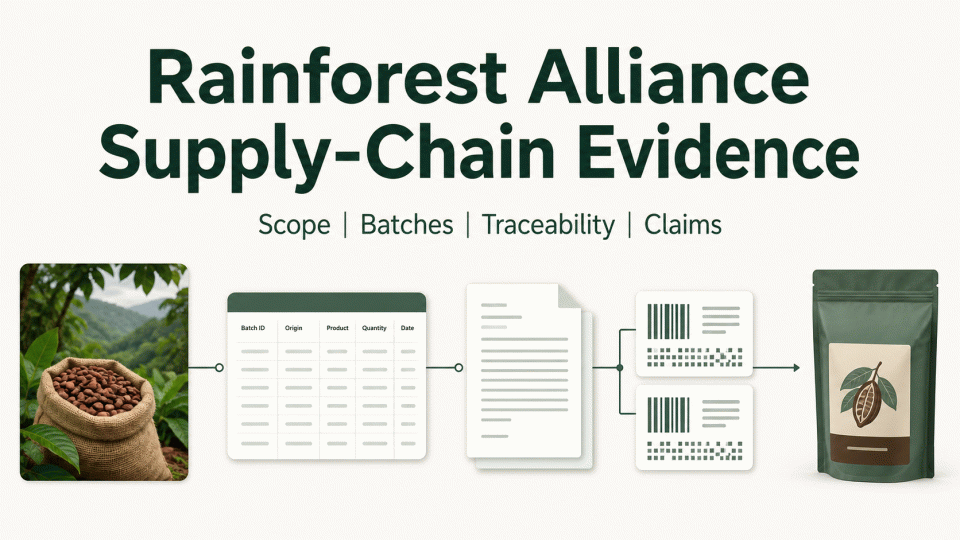
Rainforest Alliance evidence should not be treated as a universal certificate for every product. Start with the applicable certification standard, certificate holder, and supply-chain role. Then connect the certified scope, transaction records, traceability method, and proposed product wording.
1. Identify the layer being reviewed
Farm level: confirm that the farms or producer organizations connected to the material fall within the applicable Rainforest Alliance standard, crop scope, and certificate status.
Supply-chain level: determine whether processors, traders, brands, or other actors must follow the current Supply Chain Requirements and what records their role requires.
Product-claim level: discuss packaging, product-page, or marketing wording only after the product, volume, origin, and traceability records support the proposed claim. A brand name or supplier statement is not a substitute for that chain of evidence.
2. Fields to check in the certified scope
Build a “party–crop–product–market–claim” matrix. Record the certificate holder or supply-chain entity, applicable standard and version, covered crop or material, sites or facilities, certificate status and check date, relevant material in the product, batch or quantity, and the exact proposed claim.
If the scope, invoices, purchase records, or product SKU differ in entity name, specification, quantity, or product identity, pause the claim and reconcile the records. A certificate for another company or crop cannot be used as a substitute.
3. Build the supply-chain traceability file
Keep a batch-level file containing purchase orders, invoices, delivery or transport records, production or blending records, supplier certificate or license information, traceability-platform records where applicable, and the link between the finished product and its SKU. The file should show how the certified material moved from source to finished product, rather than preserving only a certificate scan.
The Traceability Annex gives further detail on traceability options and responsible actors. Select and document the option that matches the actual product and supply chain; do not describe every product as using the same traceability level by default.
4. Review product-page and packaging wording
Define whether the claim concerns a material, a finished product, or a company sourcing commitment. Check the required scope, traceability level, and permission for that claim. Then confirm that the wording does not extend beyond the certificate or records. A statement with a defined material and product scope is different from saying that an entire product range, brand, or all SKUs are certified.
The Rainforest Alliance Labeling and Claims Policy also addresses predefined claims, intended users, communication locations, and traceability conditions. Before publication, review the current policy and applicable brand or label rules; do not rely on an old screenshot, third-party template, or platform anecdote.
5. Keep other regimes separate
Rainforest Alliance evidence does not by itself prove compliance with PPWR, EUDR, food-contact, chemicals, import-labeling, or platform requirements. Review those requirements separately by market, product category, and responsible party. If a product also carries organic, recycled, carbon, or another environmental claim, create a separate object, source, and evidence index for each claim.
This page is a documentation reference. It is not a certification result, platform-acceptance decision, or market-access conclusion for a particular product. Standards, platform rules, and claims policies can change; return to the current official documents before submission or publication.
6. Internal review checklist
① Entity and certificate status are checked; ② crop, material, site, and product scope align; ③ SKU, batch, quantity, and transaction records connect; ④ the traceability option matches the records; ⑤ page wording describes only the evidenced object; ⑥ the current standard, traceability annex, and claims policy are reviewed with their version date retained.


