
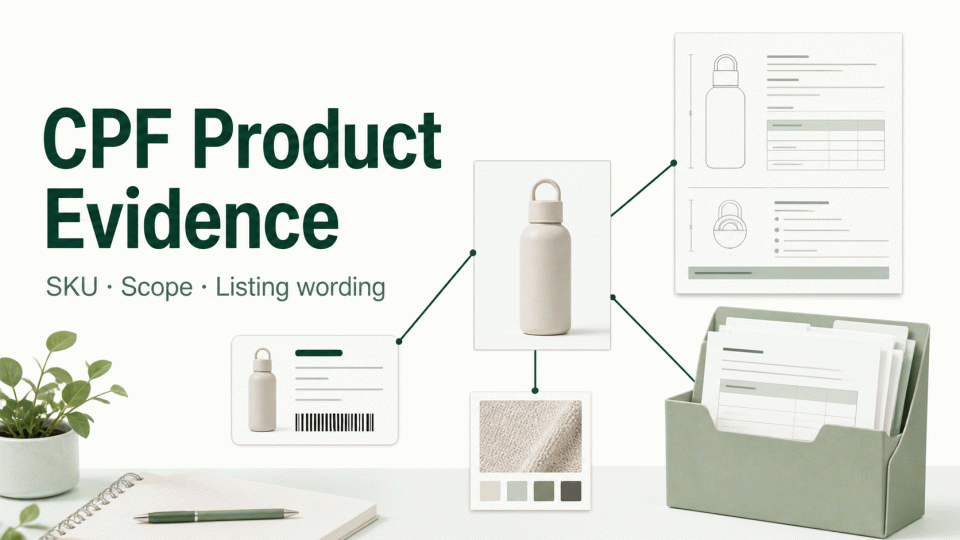
Climate Pledge Friendly (CPF) is an Amazon discovery program for products with sustainability features. It relies on recognized third-party certification standards and also includes some Amazon-developed programs. A product’s visibility under the program depends on the specific product and pathway; it is not an automatic attribute of a brand or a company.
This reference page organizes the review around four questions: what the product is meant to demonstrate, which evidence belongs to which SKU, whether the certificate or program scope covers the product, and whether the Listing wording stays within the evidence. CPF should not be presented as a universal market-access certificate or as a substitute for safety, labeling, chemical, packaging, or producer-responsibility obligations in a target market.
1. Confirm what the CPF identification applies to
Start with a SKU, variation, and marketplace register. Record the brand, model or variation, material or formula, packaging configuration, selling marketplace, and Listing owner for each product. Do not use a company certificate, a factory certificate, or evidence for another product in the same range as a substitute for the current SKU’s evidence.
Then identify the pathway: an Amazon-recognized third-party certification or an Amazon-developed program, and the attribute it addresses—such as recycled content, energy efficiency, chemicals, packaging, carbon impact, or another defined area. Each pathway can have different applicants, product scopes, certificate fields, and review methods. A generic “CPF certificate” does not describe all of them.
Amazon’s public materials describe CPF as a collaboration with government agencies, nonprofits, and international standards setters to help distinguish sustainability features through certification standards. The identification is tied to products rather than automatically to a whole brand. Review the Amazon Sustainability Solutions Hub and CPF Creative Guidelines for the applicable program language.
2. Build a product-to-evidence map
Useful fields include SKU/ASIN, variation, brand and responsible entity, certification or program name, certificate number, certificate holder, product or facility scope, material or formula scope, marketplace or country, issue and expiry information where supplied by the document, standard version, evidence location, and the last review date.
Test four links: first, can the relationship between the certificate holder and the Listing owner, manufacturer, or supplier be explained; second, do the product name, model, material, and specifications fall within scope; third, do purchase, batch, or supply-chain records support the stated attribute; and fourth, does every environmental statement on the page have a corresponding document and condition? If one link is missing, record an evidence gap instead of replacing it with a broad “certified” statement.
3. Keep Listing wording auditable
Separate the program identification, the certification fact, and the company’s own environmental claim. It is possible to state the certification name, product scope, and evidence date accurately; if the evidence covers only a material, model, or marketplace, place that condition in the same statement or close to it.
Do not turn CPF into a legal compliance certificate, customs clearance document, sales guarantee, or brand-level environmental conclusion. Avoid “guaranteed,” “100% approved,” “every product is sustainable,” “carbon neutral,” or “officially certified” unless the exact source supports that wording. For an unverified certificate, scope, display status, or product attribute, mark it as pending and identify the missing evidence.
When explaining the program, link to Amazon’s current CPF description instead of combining a certification body’s standard, Amazon’s product identification, and target-market regulations into one conclusion. Amazon’s public advertising policy also states that the CPF label qualifies a single product, so creative content should correspond to the product that actually has the relevant qualification.
4. Pre-delivery document checklist
(1) Product master data: SKU, ASIN, model, variation, material or formula, and packaging configuration; (2) certification records: certificate or program record, holder, scope, number, version, and dates; (3) supporting evidence: BOM, formula, supplier statement, transaction or batch records, and documents explaining the product-to-certificate relationship; (4) Listing evidence: title, bullets, description, image wording, and page version; (5) change records: reassess the evidence after a material, formula, supplier, facility, model, or marketplace change.
The purpose of filing is traceability, not volume. A reviewer should be able to move from a page statement to the exact SKU, source document, scope, and review date. Where evidence is incomplete, the holder relationship is unclear, or the program status cannot be confirmed, keep the item as an internal action rather than making a definitive customer-facing claim.
5. Conclusion: treat CPF as a product evidence workflow
A reusable CPF review connects the program pathway, the specific product, certificate scope, supply-chain evidence, and Listing wording, with a source retained for each conclusion. It does not replace market-specific regulatory analysis and cannot promise Amazon display, review, or commercial outcomes. GreenArk (Shenzhen) Certification Co., Ltd. can review the certification path, material scope, and page wording against the actual product records and target market.


