
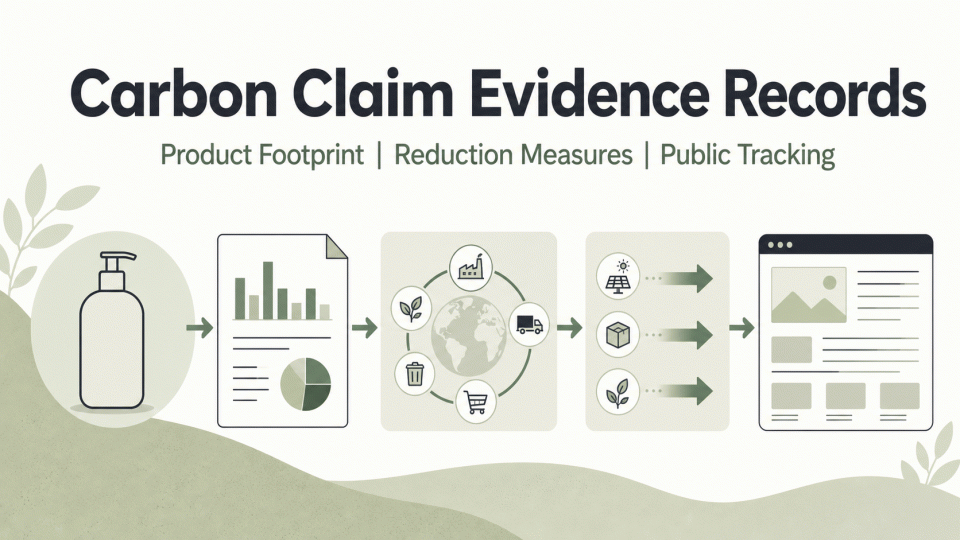
A ClimatePartner-related claim should not be reduced to a generic “low-carbon” or “carbon-neutral” phrase. First identify whether the subject is a company, product, or service, then connect the footprint boundary, source data, reduction measures, and public tracking page.
1. Define the footprint and claim subject
A Product Carbon Footprint (PCF) describes greenhouse-gas emissions across a product life cycle. ClimatePartner’s official material describes stages that can run from raw materials and production through distribution, use, and end of life. The page should state the object measured, system boundary, functional unit, and data version. A corporate footprint does not automatically substantiate a claim about every product, and a product page should not turn a service or company action into a universal product conclusion.
2. Organize four evidence groups
Product and boundary: model, specifications, life-cycle stages, included and excluded processes, and assumptions for packaging, transport, use, and end of life.
Data and method: supplier data, activity data, emission factors, calculation files, data-quality notes, and version history. If estimates are used, record their scope and the primary data still needed.
Reduction measures: measures implemented or planned, responsible owners, covered products or facilities, dates, and progress tracking. A reduction target, a measure, and an achieved result are different statements and must not be collapsed into one.
Public tracking: when a ClimatePartner solution is used, check the label category, Climate ID or related public page, and the information shown there, such as the footprint, reduction targets, measures, and climate projects. Customer-facing wording should match the specific subject and public record.
3. Keep ClimatePartner solutions distinct
ClimatePartner’s official pages describe its solutions separately. ClimatePartner certified emphasizes traceable climate action, data, reduction targets, and a public Climate ID page. Financial Climate Contribution describes calculating emissions for a company, product, or service and supporting climate projects under that approach. Names, subjects, label categories, and evidence pages must not be interchanged. Before writing, verify the current solution documentation, category, and public ID page.
4. Review every page statement
Map each statement to a concrete record: a product footprint, a reduction measure, climate-project support, or a public tracking page. Are the subject, boundary, and status consistent? “Measured,” “being reduced,” “projects supported,” and “available through a Climate ID” describe different facts. Without sufficient evidence, use a qualified “being collected” or “to be verified” note, or remove the claim.
Environmental claims aimed at EU consumers also require attention to applicable consumer-information rules and scheme updates. ClimatePartner’s official pages describe timing and third-party-verification details for relevant labels; that does not make every product automatically compliant with every EU rule, nor does it remove the need for claim-level evidence.
5. Pre-publication file checklist
Keep: confirmation of the company/product/service subject; PCF boundary and method statement; input data and quality record; calculation and review record; reduction-target and measure log; climate-project or contribution record; Climate ID or public-page link; label category and placement; a claim-by-claim evidence index; and the review record for changes.
绿色方舟(深圳)认证有限公司 recommends using this as an evidence-entry checklist, not as a basis for presenting a ClimatePartner label as a universal “certified” or “approved” result. Final wording should follow the applicable solution, subject, boundary, and latest public record.
Sources: ClimatePartner Product Carbon Footprint; ClimatePartner certified label; Financial Climate Contribution. Scheme details may change; verify the original pages before publication.


