
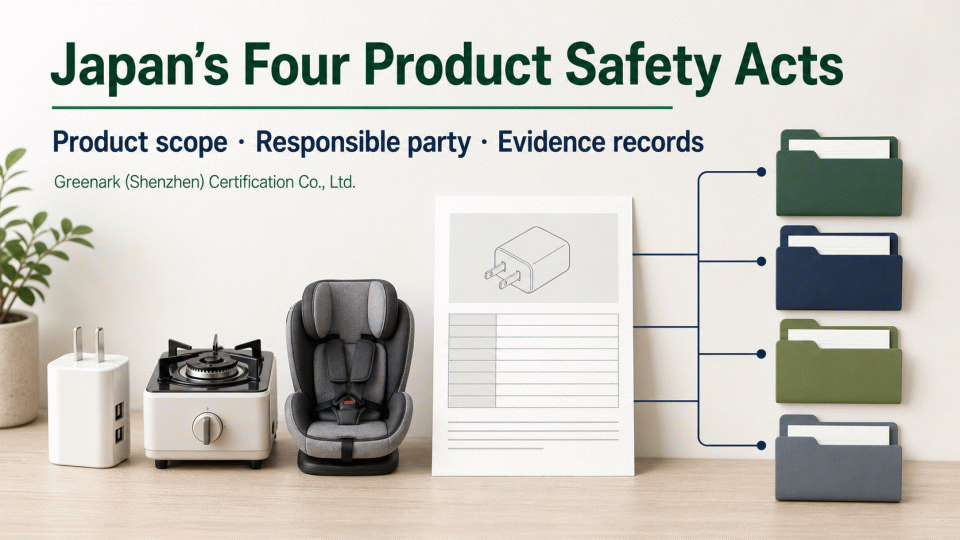
Japan’s “Four Product Safety Acts” form a product-safety framework for specified consumer products, electrical appliances and materials, gas appliances, and liquefied petroleum gas appliances. They are not a universal certificate checklist. Applicability depends on the product, the sales model, and the responsible business arrangement in Japan.
For a cross-border seller, start by documenting the SKU, intended use, energy source, construction and route to market. Then identify the potentially applicable Act, designated product category, technical requirements, notification or inspection steps, and marking or record obligations.
1. What the four Acts cover
Consumer Product Safety Act addresses consumer products designated as particularly likely to cause harm to consumers’ lives or bodies. The Electrical Appliances and Materials Safety Act covers designated electrical appliances and materials, including certain power-supply units and batteries. The Gas Business Act covers designated gas appliances. The Act on Securing Safety and Optimizing Transactions of Liquefied Petroleum Gas covers designated LPG appliances and related transaction-safety requirements.
Each Act has its own designated products and technical requirements. A product should not be assigned a PS-mark category merely because it is electrical, uses gas, or is sold for household use. Check the Ministry of Economy, Trade and Industry’s product lists, legislation and applicable business guidance against the actual specifications.
2. Put the SKU, sales route and responsible party in one record
For each SKU, record the model and variants, product photographs, intended use, rated voltage or fuel type, key construction, manufacturer, importer or responsible party in Japan, sales channel, packaging and manual versions, and the legislation or official pages used for the assessment.
A 2024 amendment clarified an online-sales scenario in which an overseas business sells directly to Japanese consumers through a digital platform without a Japanese importer. In that situation, the overseas business may become a notifying business under the Four Acts and may need to appoint a domestic supervisor in Japan. The relevant amendments came into force on December 25, 2025. Whether the rule applies depends on the transaction structure and product category, not simply on where the storefront is located.
3. Evidence checklist
Product identity: model, variant, intended use, ratings, components and version-change history. Keep product photographs and construction information where relevant.
Applicability assessment: the potentially relevant Act, designated product category, technical requirements, notification or inspection status, and the basis for any conclusion that a requirement does not apply.
Testing and manufacturing records: test reports, inspection records, manufacturing and quality-control records, and the models, samples and technical requirements covered. A report cannot be accepted for a current SKU solely because of the laboratory name or document title.
Marks and accompanying information: required product marks, warnings, manufacturer or importer information, Japanese manuals, packaging versions and screenshots of the online listing. Use marks only on the basis of the applicable law and official guidance; do not transfer a mark from another market by analogy.
Responsibility and incident records: keep versioned records of responsible parties, supplier communications, complaints and incidents. The Four-Act framework also contains post-market duties such as serious-product-accident reporting; confirm the trigger and timing in the relevant Act and authority guidance.
4. Three common mix-ups
First, a test report is not the whole legal duty. It proves only the models, samples and items it covers. Notifications, inspections, marks, records and the sales entity must be checked separately.
Second, supplier documents do not automatically cover a seller’s SKU. Compare the manufacturer, model, ratings, sample and version in the report or record with the product actually offered, and retain the source and change history.
Third, a platform request is not a complete conclusion under Japanese law. A platform may request a particular format or additional file, but its workflow does not replace the applicability, responsibility and technical-requirement analysis under the Four Acts.
5. Internal review order before submission
Lock the SKU and product version first, then assess the potentially relevant category under the Four Acts. Next compare the responsible party, technical file, test or inspection records, Japanese label and manual. Finally review the online listing, packaging and physical marking together. Reassess the impact after a product redesign, a change to a key component or manufacturer, or a change in the route to market.
METI’s English pages note that English translations are for reference and that the Japanese originals have legal effect. For product classification, marking, notification and domestic-supervisor questions, retain the official Japanese page, guidance version and internal assessment record used.
Official references: METI Product Safety and METI: Product safety in internet transactions. Check the latest version before relying on a page or Act.


