
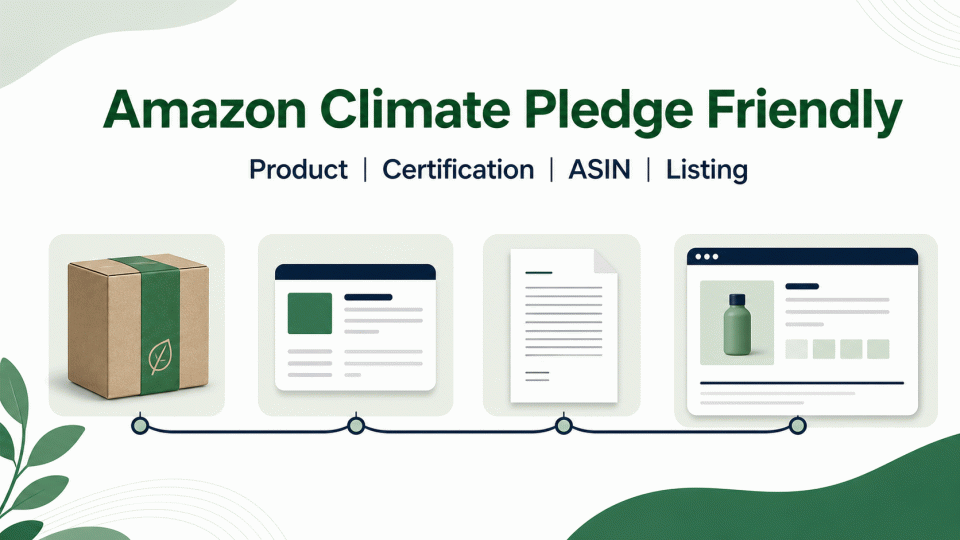
Climate Pledge Friendly (CPF) is an Amazon program that helps customers identify products with sustainability features. It uses participating third-party certifications and also includes certain Amazon-developed certifications or standards. For sellers, the practical task is not to treat CPF as a general compliance certificate. It is to confirm whether a specific product has an applicable recognized certification, then connect the certificate scope, product identifiers, and ASIN records.
1. Define the record you are checking
Start with one record containing the marketplace and account, brand or seller entity, product name, SKU, ASIN, variation, certification, certificate number, certificate holder, scope, and certification body. The CPF label applies to eligible products, not automatically to an entire brand. A certificate may cover several products or only particular models, materials, formulations, or production sites, so a brand name alone is not a scope check.
Separate three questions: does the product have a certification or standard recognized by the program; do the certificate, product, and account records correspond; and has Amazon identified and displayed the product in the relevant marketplace or detail page? The first two are evidence questions. The third is a platform-status question and cannot be inferred from a certificate alone.
2. Certification and product-scope files
Certification record: Keep the current certification name, certification body, certificate or declaration number, certificate holder, issue and validity information, relevant market, and any public verification record. Certification schemes use different document structures and validity rules; do not copy a fixed period from another scheme.
Product mapping: Compare the certificate scope—model, material, formulation, production site, or brand details—with the SKU, UPC/EAN, ASIN, variation, and packaging version. A supplier’s generic certificate does not automatically establish that the seller’s ASIN qualifies. Check the certificate holder, product description, and scope limits.
Account and responsible parties: Record the listing account, brand-registration information, seller, manufacturer, importer, and certificate holder, together with their relationship. Where entities differ, retain the authorization, supply-chain link, or other supporting file required by the current route; whether it is sufficient depends on that route.
3. Keep the submission and listing trail
Use the current Seller Central or Vendor Central path to submit or update certification information. Retain the template version, submission date, marketplace, ASIN list, uploaded files, system receipt, and subsequent status. A historic forum post or a workflow from one marketplace should not be treated as a universal current rule. If the route requires a certification body or designated program process, follow that process.
Listing copy should state only what the certificate and product record support, such as that a named product holds a named certification within a stated scope. Broad claims such as “eco-friendly,” “zero impact,” “compliant with every regulation,” “guaranteed to receive the badge,” or “will increase traffic” do not follow from a CPF label or one certificate. The CPF display, the product evidence, and the listing claim are separate records and should be checked separately.
4. A four-step evidence index
Step 1 — identify the product. Lock the marketplace, SKU, ASIN, variation, packaging, and current listing version.
Step 2 — identify the certification. Compare it with Amazon’s current recognized-program information and confirm the certification name, scope, body, and original file.
Step 3 — cross-check. Put the certificate holder, product identifiers, scope, dates, ASIN, and listing statement in one index. Assign each mismatch and record its owner.
Step 4 — retain platform status. Keep submission receipts, status changes, and marketplace display checks. Recheck the relevant ASIN after a status change; do not use another marketplace, another variation, or an old screenshot as the current conclusion.
5. Changes, ownership, and boundaries
The product or brand team owns SKU, variation, material, and listing wording. The supplier or manufacturer owns authentic, traceable certification files and scope changes. Marketplace operations owns submission records, ASIN mapping, and marketplace status. The compliance owner decides whether the evidence supports the proposed wording. A factory, material, formulation, package, certificate scope, certificate status, or ASIN relationship change should trigger a fresh review before the old mapping is reused.
绿色方舟(深圳)认证有限公司 can assist with the product–certification–listing evidence index and boundary questions. Program eligibility, Amazon display, and certification decisions remain decisions of the relevant certification body, scheme owner, or Amazon under their applicable rules.
Sources: Amazon Ads: Climate Pledge Friendly Creative Guidelines; Amazon Seller Central: How to certify your products as Climate Pledge Friendly; Amazon Buy with Prime: Sustainability features. This page is a documentation reference. Check the current account workflow, recognized programs, and display status before use.


