
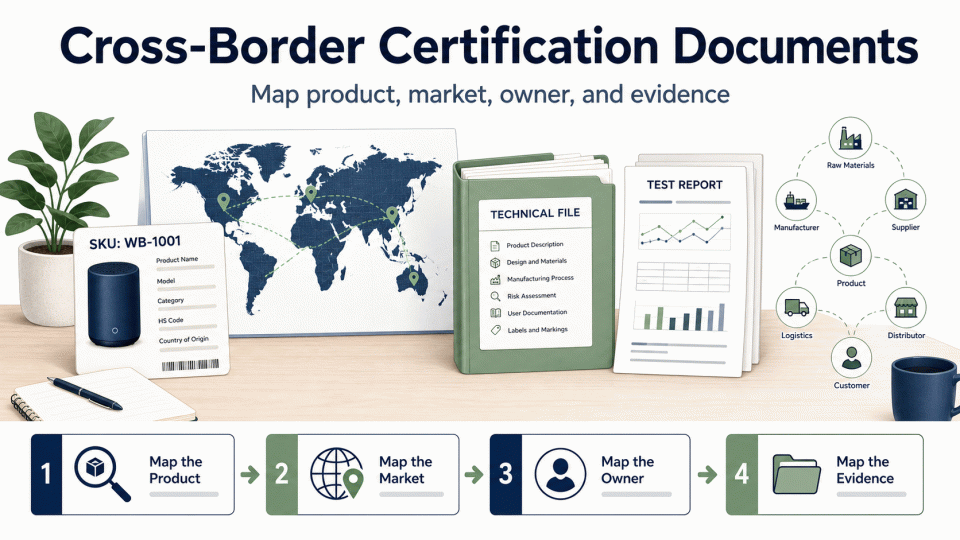
In cross-border e-commerce, “certification” is not a document that can be separated from its product and market context. Start with the product, destination market, responsible party, and page claim, then connect each requirement to evidence that can be checked. This page is a documentation method; it does not state that any SKU is compliant, certified, approved, accepted by a platform, or cleared by customs.
1. Fix the product record first
Create one product master record for each SKU. Include the product name, model, SKU, revision, materials or formula, intended use, packaging components, label and manual versions, and manufacturing location. Add HS code, serial number, or batch information when relevant. Electrical goods, children’s products, cosmetics, and food-contact materials require different evidence fields; one undifferentiated “global checklist” cannot replace an applicability review.
When the product, material, formula, manufacturer, packaging, or destination market changes, keep a change record and check whether existing files still cover the current version. A change record creates a clear review point; it is not itself a compliance conclusion.
2. Build a market-specific applicability matrix
For each destination market, build a matrix linking the requirement, product, responsible party, file, and page wording. Use current legislation, competent-authority guidance, or platform rules to identify the scope. Then distinguish mandatory product requirements, platform documentation requests, buyer standards, and voluntary certification schemes. Their legal bases, assessment parties, and evidence formats may differ and should not be treated as interchangeable.
For EU products, official guidance describes identifying applicable requirements, completing the relevant conformity route, and preparing technical documentation and an EU Declaration of Conformity where applicable. Technical documentation can include design, manufacture, operation, and risk analysis information and must be available when requested. Whether a product needs CE marking or a notified body depends on the applicable product legislation; the word “certification” alone is not enough to choose a route.
Sources: EU technical documentation guidance, official CE marking guidance, and the European Commission product requirements overview. Rules and official pages change, so verify the current version before use.
3. Organize four evidence groups
Product and technical files: specifications, BOMs, material or formula information, drawings or circuit diagrams, risk analysis, user instructions, labels, and packaging files. The model, revision, and market language should be identifiable.
Assessment and test files: test reports, assessment records, declarations, certificates, or review opinions where applicable. Check the report number, signing entity, sample identity, test items, standard version, laboratory or assessment body, and any stated limitations. Do not invent one universal “report age” rule for every category.
Entity and supply-chain files: manufacturer, importer, authorised representative, or other responsible-party details; suppliers and manufacturing sites; and purchasing, batch, shipment, and material-origin records. Match the entity, product scope, and address on the file to the actual transaction and page responsibility.
Platform and page files: listing versions, product attributes, warnings, image text, upload records, platform feedback, and change history. Page claims should stay within the evidence and state their object, scope, and conditions. A voluntary scheme, material attribute, or environmental statement should not be presented as a universal legal result.
4. Questions before submission
Ask, in order: Which SKU, model, or batch does this file cover? Which market and requirement version does it address? Who is the manufacturer, brand owner, importer, authorised representative, or applicant named on it? Does the test sample match the product sold? Are limitations stated? Does the page wording go beyond what the file supports? Can the file be traced to the original PDF, signing record, or official lookup route?
If the entity, scope, version, key pages, or page claim is unclear, mark the item for evidence completion or review. Do not substitute a supplier template, an old project file, or a report for another market. The value of a checklist is to expose gaps and ownership, not to create an impression of approval.
5. Maintain the record and hand off ownership
For each key file, retain its source, version, scope, review date, owner, and change triggers. Recheck the matrix when legislation, product design, manufacturing site, materials, packaging, labels, responsible party, or page claims change. Do not replace the requirements of a specific scheme or regulation with one fixed renewal interval.
绿色方舟(深圳)认证有限公司 can provide professional input on document organization, evidence mapping, and claim boundaries. Final applicability still depends on the product, market rules, responsible parties, and verifiable files.


