
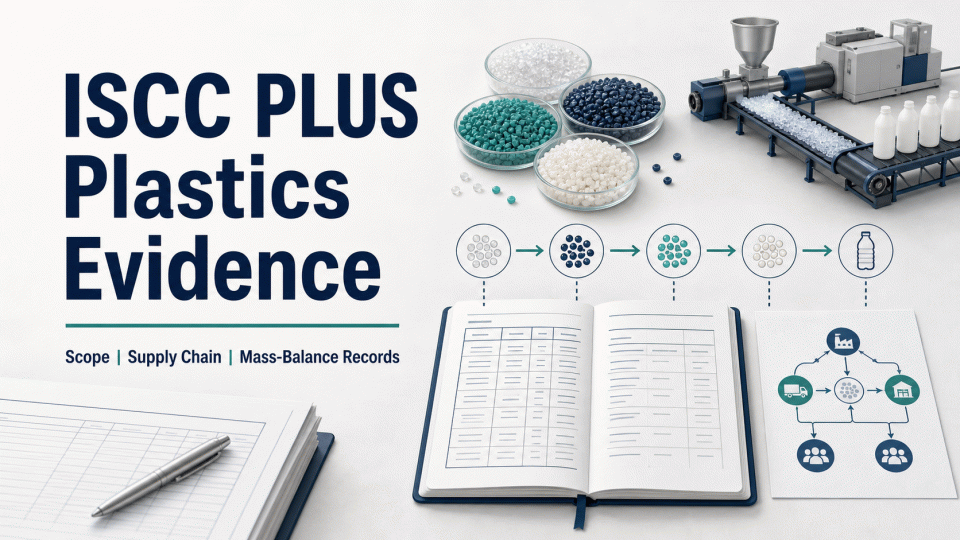
ISCC PLUS is a voluntary certification scheme for the circular economy and bioeconomy. For plastics businesses, preparation should not be a generic mix of customs, platform and unrelated regulatory claims. It should connect the certification scope, supply-chain elements, material flows and traceability records one by one.
1. Confirm the object and scope
Start by identifying the company’s role in the chain: collection, processing, storage, trading or plastics production. Then record the legal entity, site, material categories, production steps and intended products. ISCC expects relevant supply-chain elements to provide evidence of conformity; a downstream product name cannot replace a defined scope.
For plastics, distinguish the actual material source and the attribute being claimed, such as bio-based or recycled feedstock. “Contains recycled material,” “recyclable” and “lower-carbon” are not interchangeable facts. Each external statement should link back to the relevant material record, transaction document, calculation method and certificate scope.
2. Plastics supply-chain records
Entities and sites: legal and registration information, production or storage addresses, responsibilities, scope-application records and activities performed at each site. Do not collapse multiple sites, entities or external warehouses into one unclear entry.
Inputs and transactions: supplier information, material and batch identifiers, purchase orders, invoices, transport or receipt records, supplier declarations, and input/output quantities and attributes. Entity, site, date, batch and quantity should reconcile across the file set.
Production and products: formulations or material structure, production batches, output, losses or conversion factors, finished-product specifications, packaging and dispatch records. A product claim needs a clear product identifier; a generic certificate with no defined scope is not enough.
Chain of custody and certificates: applicable chain-of-custody records, transaction certificates or Sustainability Declarations, supplier-certificate checks, internal ledgers and corrective-action records. The required documents depend on scope, materials and transaction design, so confirm them against the current ISCC documents.
3. How to review a mass-balance ledger
When mass balance is used, eligible inputs must be physically received at the certified site and recorded at the applicable site, scope and material level. The ledger should show opening balance, each input, conversion or loss, output, claimed attribute, date and closing balance. Inputs and outputs cannot be increased by unsupported estimates, and different materials or schemes should not be merged into one un-auditable total.
Mass balance is not a calculator that turns all plastic into recycled plastic. It controls the bookkeeping link between material flows and attributable characteristics, including safeguards against double counting. The applicable balancing period, method, conversion factors and transition requirements must be checked in the current ISCC PLUS documents.
4. Pre-audit review
Build an index with five columns: requirement, evidence, file location, owner and open item. Check that the certificate entity and site match, every relevant supply-chain element is represented, batches and quantities are traceable, input and output reconcile with production records, and wording stays within the certificate scope.
Certification is performed by an independent recognised Certification Body. ISCC describes steps covering the application, audit, certificate issuance and handling of certified material after certification. Do not import a generic “24-month test-report” rule, another scheme’s renewal cycle or a platform-enforcement outcome into an ISCC PLUS checklist unless its applicability is specifically established.
5. Boundaries for claims and use
Before using an ISCC mark or claim, confirm the applicable approval and use requirements. A product page may state verified facts about the product, certificate and supply chain, but it should not present a voluntary certification as proof of every legal requirement or imply guaranteed audit results, platform placement or sales performance.
Greenark Certification (Shenzhen) Co., Ltd. may assist with factual filing and scope review. The certification decision, certificate issuance and mark authorisation remain with the relevant certification body or scheme owner under its rules.
Sources: ISCC PLUS scheme overview; ISCC certification process; ISCC guidance on mass-balance requirements. This article is a reference for document organisation; confirm the latest applicable scheme documents before use.


