
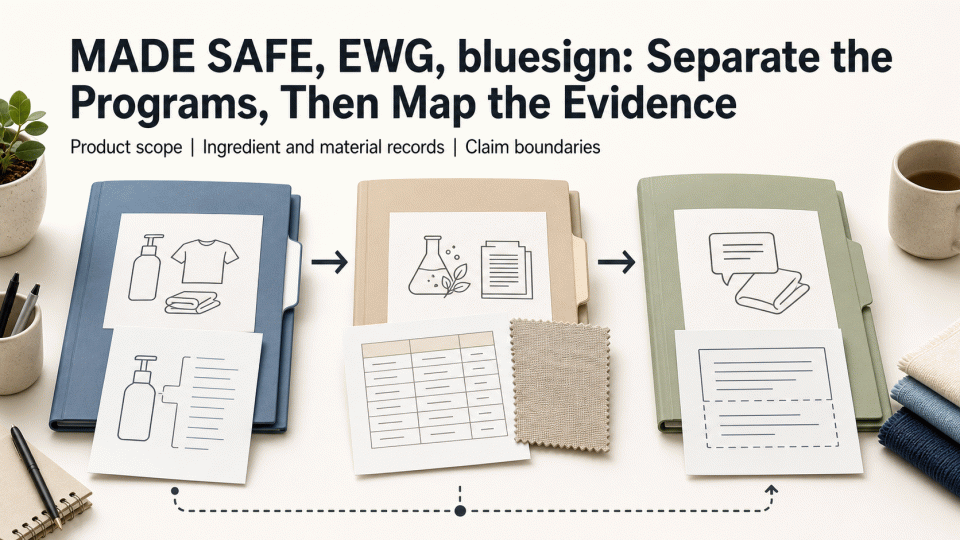
MADE SAFE, EWG Verified and bluesign do not assess the same object. Start by identifying the program, the product or supply-chain object, the submitting party and the records the program actually asks for. Only then should you decide what a product page can say.
1. What each program is looking at
MADE SAFE: added substances, materials and ecosystem context
MADE SAFE’s published standard describes screening against its Banned / Restricted List and asks companies to disclose known added substances and detailed ingredient information. Its Ecosystem Approach considers substances and materials in the context in which they are used. A working file should therefore identify the complete formula, raw-material and material specifications, suppliers, known impurities or contamination information, intended use and packaging. The program record should not be expanded into a universal safety or environmental conclusion for every market.
EWG Verified: category, ingredient transparency and substantiation
First confirm that the product falls within a category currently accepted by EWG Verified. For personal care products, EWG requires disclosure of all label ingredients, including fragrance ingredients, and reviews products against its criteria and unacceptable and restricted ingredient lists. Restricted ingredients may require supporting evidence such as certificates of analysis. A Skin Deep score is not the same as EWG Verified, and a formulation change calls for a fresh check of the program requirements. Customer-facing wording should describe the EWG Verified submission or assessment accurately, without turning it into a statutory safety approval for every product type.
bluesign: production processes, inputs and supply-chain objects
bluesign distinguishes brands, manufacturers, chemical suppliers, and objects such as consumer products, articles and chemical products. Its Criteria cover areas including chemical safety, resource use, pollution control, occupational health and safety, and social responsibility. The bluepass materials describe marks linked to production processes meeting bluesign Criteria and to specific objects in the supply chain. File the production site, input controls, restricted-substance management, material or article identity, Guide records, product scope and authorization chain separately. A supplier’s material record should not be broadened into a claim about the entire finished product or brand.
2. Build one evidence record per product
- Identify the object: record the brand, manufacturer, formula or material supplier, finished-product SKU, model, colour or formula version, and the named program.
- Define the scope: record the accepted category, material or chemical object, production site and supply-chain nodes; mark items outside the scope separately.
- Keep source records: retain formula and ingredient disclosures, material specifications, process records, restricted-substance controls, analytical or test files, supplier statements, authorizations, labels and page versions.
- Map versions: note the product or material version, issuer, date, covered object and linked SKU for each file. Recheck the map after a formula, material, factory or claim changes.
- Review the claim: state only the object, scope and status supported by the file, and retain the program’s current rules, public directory or verification page as the review entry point.
3. Boundaries that are often confused
A program assessment is not a statutory obligation: a MADE SAFE, EWG Verified or bluesign record does not automatically replace destination-market rules on ingredients, labeling, product safety, chemicals, textiles or other mandatory matters. Keep a separate applicability record for the market where the product is sold.
A material or ingredient record is not a whole-product conclusion: a raw-material, fabric or chemical file supports only the object it clearly covers. If the product name, model, formula, site, brand entity or claim text does not match, complete the mapping before using the record publicly.
A public mark is not unconditional authorization: check the program’s current mark, authorization and communications rules before using a name, mark, QR code or program statement. Do not add unsupported wording such as “universally certified,” “guaranteed to pass” or “accepted in every market.”
4. Pre-submission checklist
- Does the product category match the program object, without merging personal care, textile materials, chemicals and finished goods?
- Can the formula, material, production site, brand entity and SKU be mapped to source records item by item?
- Do the records address the program’s relevant controls for ingredients, inputs, pollution, process or social responsibility rather than relying on one generic test report?
- Do labels, packaging, product pages and advertising stay within the scope supported by the files?
- Have the current program rules, public directory, authorization or verification entry point been saved with a version or review date?
Sources and note
This reference is based on public program materials: MADE SAFE Certification Standards; EWG Verified Personal Care Products and Eligible Product Categories; bluesign Criteria & Standards and bluepass Certification. Program rules and eligible categories can change; confirm the current program documents and the applicable destination-market requirements before submission or publication.


