
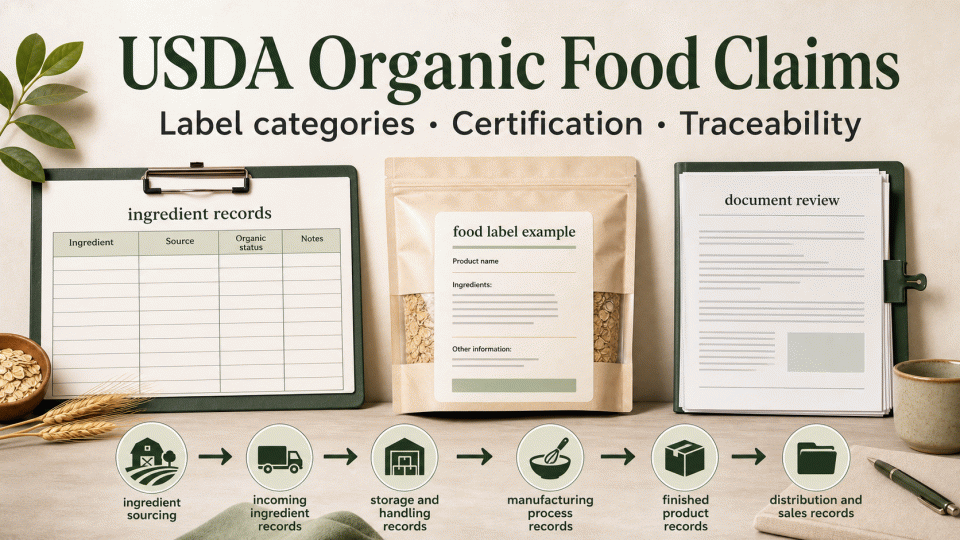
This reference is for teams preparing to sell organic food or make organic-ingredient claims in the United States. It turns the USDA National Organic Program (NOP) workflow into a reviewable evidence chain: product formula, handling activities, certificate scope, label wording, and lot records should all describe the same product. It is not a product-label approval and does not establish that any product is certified or eligible to display the USDA Seal.
1. Start with the claim object: finished food or named ingredient
USDA Organic is a labeling term connected to how agricultural products are produced and handled. First classify the item as a raw agricultural product, a single-ingredient food, or a formulated and packaged product. Then connect each organic ingredient to its certification status, source, and role in the final formula. The presence of the word “organic” in a brand or product name does not by itself make the finished food eligible for an organic claim; the complete label and the actual handling activities still matter.
For multi-ingredient foods, USDA labeling rules generally distinguish four routes: 100 Percent Organic, Organic, Made with Organic Ingredients, and the limited identification of specific organic ingredients when the product contains less than 70 percent organic content. Salt and water are excluded from the organic-content calculation, while the nonorganic portion remains subject to applicable restrictions, including the National List where relevant. Use USDA AMS labeling guidance and 7 CFR Part 205 Subpart D for the exact category and wording instead of combining categories.
2. What to verify for each labeling category
- 100 Percent Organic: verify the organic status of each agricultural ingredient and processing aid, and retain formula and purchasing records tied to the finished product.
- Organic: verify that the finished product meets the applicable organic-ingredient threshold and that nonorganic agricultural ingredients and nonagricultural substances meet the relevant restrictions. The ingredient statement must identify organic ingredients as required.
- Made with Organic Ingredients: limit the front-panel wording to the specified ingredients or food groups. Do not present the finished product generally as “Organic” or use the USDA Seal; the label and formula should be reviewed under the applicable rules.
- Less than 70 percent: do not represent the finished product as organic on the principal display panel. Specific certified organic ingredients may be identified in the information panel where the rule permits.
The USDA Seal is an optional label element, not a substitute for certification status or label review. Whether the Seal or a certifier mark may appear depends on the category, product status, and layout rules. The USDA U.S. organic-market labeling guide also addresses the certifier-name statement, ingredient statements, and traceability information for nonretail containers.
3. Who needs certification: follow the activity, not only the brand
Except for limited exemptions or exclusions, operations that produce or handle organic agricultural products generally need certification. Handling can include processing, packaging, repackaging, labeling, storing, loading, selling, trading, importing, and exporting. The correct conclusion depends on the actual workflow and the applicable regulatory provision, not on whether a brand owner holds a certificate.
Separate the roles of the producer, processor or final packer, and any distributor or logistics provider that handles sealed products. The certifier named on the finished-product label, the certificate holder, and the operation that performed the relevant handling activity should be explainable as one chain. A buyer may also require certification contractually even where a narrow regulatory exemption exists. See USDA’s “Do I Need to Be Certified Organic?” guidance, and keep contractual requirements distinct from regulatory certification requirements and platform-document requirements.
4. Build one product–formula–operator–document–label record
Use the SKU or a specific lot as the smallest review unit. At minimum, capture:
- Product identity: SKU, product name, pack format, production site, and target market.
- Formula: every agricultural ingredient, nonagricultural substance, salt and water treatment, plus the organic-content calculation basis.
- Operator roles: producer, processor, final packer, brand owner, importer or trading entity, and the certificate scope for each.
- Supply-chain records: supplier, lot, purchase and invoice records, transport documents, receiving and dispatch records, and the link from ingredients to the finished lot.
- Label version: principal display panel, information panel, ingredient statement, organic wording, certifier name, and the lot or other unique information that links the package to the audit trail.
- Review status: certifier label-review records, an applicable NOP Import Certificate or other import-traceability record, and version history for formula, supplier, packaging, and label changes.
Organic records are not just a certificate-upload folder. They should explain the movement of material from source, receipt, storage, and processing through finished-product dispatch, and show how organic and nonorganic products are protected from commingling and contact with prohibited substances. For bulk or nonretail products, lot numbers, shipping identifiers, or other unique information are especially important because they connect the container to the audit trail.
5. Do not use an organic certificate as a substitute for other food rules
USDA Organic addresses the NOP production, handling, and organic-claim track. Ingredients, allergens, nutrition labeling, food safety, import requirements, and marketplace page information may involve FDA, FSIS, TTB, or other destination-market rules. An organic certificate does not, by itself, establish food-safety, packaging, environmental, or marketplace approval. Conversely, a general laboratory report does not replace the certifier’s review of the organic operation, product, and label.
For products entering the United States under an equivalence arrangement, confirm whether the import route and supporting records apply. Do not infer current status from a supplier name or an old scan. The USDA Organic Integrity Database can be used to look up operation or certifier information; retain the search date, matching name, and relevant scope in the internal file.
6. Human review before a product page goes live
- Does the Organic wording in the title and product page match the actual label category?
- Are the formula, ingredient statement, and organic-content calculation based on the same SKU and version?
- Do the certifier, certificate holder, and production or handling locations cover the relevant activities?
- Does the label include the required certifier-name statement, avoid an ineligible USDA Seal, and keep “Made with” wording distinct from a finished-product Organic claim?
- Can ingredient lots, purchasing and transport records be reconciled to the finished lot and label version?
- Does the page distinguish an existing certificate or claim from an item pending review, without promising certification, sales, marketplace display, or regulatory outcomes?
Boundary note: This article is a practical evidence framework based on public USDA AMS/NOP materials. The responsible product operator should confirm the category, label wording, import documents, and any exemption with its certifier and relevant authorities under the current rules. 绿色方舟(深圳)认证有限公司 does not replace a certifier’s decision or guarantee certification or market outcomes through this article.


