
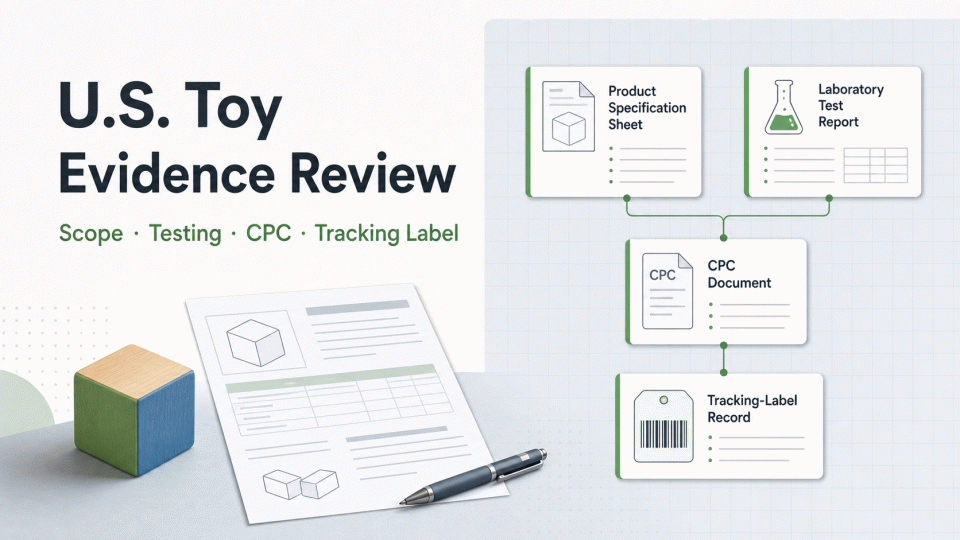
For a toy intended for the U.S. market, begin with the product scope: whether it is primarily intended for children 12 or younger, how it is used, and which materials, components, age grade, and production version are actually being sold. Amazon may request documents for a listing, but a platform request and a federal legal determination are separate review layers.
1. Define the product scope first
Record the SKU, model, product and packaging photos, intended age, principal use, materials, colors, coatings, and production version. CPSC links the toy concept to play value and age; bicycles, furniture, sporting goods, and other products may follow separate rules. “Children’s product” and “toy” should not be treated as interchangeable labels.
Create one scope record per SKU: intended age, play purpose, small parts, magnets, batteries, liquids or powders, surface coatings, and special use claims. The age grade, packaging, and marketing copy should be supported by the product design record. If the boundary is uncertain, retain the reasoning instead of presenting an unverified compliance conclusion.
2. Separate ASTM F963 from other rules
A U.S. toy file should check 16 CFR part 1250 and the applicable ASTM F963 sections. CPSC’s ASTM chart shows that testing treatment differs by section. Lead content, lead in paint, phthalates, small parts, certain magnets, and other product-specific rules may also apply. A CPC should not simply say “complies with ASTM F963”; it should identify the applicable rules and sections for that product.
Keep U.S. toy safety separate from EU, UK, Japan, food-contact, textile, and electronics requirements. A report prepared for one market does not automatically answer another market’s legal question. For multi-market sales, record the target market, responsible party, applicable rules, and labeling language separately.
3. Build the testing-to-CPC responsibility chain
Before testing, identify the SKU, version, materials, and colors or coatings in the test scope. Confirm that the laboratory’s CPSC acceptance covers each applicable rule. One product may require more than one laboratory when no single laboratory covers every needed rule. Reassess testing when the design, component, coating, manufacturing process, or intended age changes.
The responsible U.S. manufacturer, importer, or applicable private labeler issues the CPC; the laboratory does not “grant” the certificate. CPSC’s CPC guidance identifies seven required elements: product identification; the rules and sections certified; the manufacturer or importer; the certificate contact; dates and places of manufacture; dates and places of testing; and the CPSC-accepted laboratory information. The CPC and reports should point to the same product and production scope.
4. Listing and platform file checklist
For each ASIN/SKU, retain product and packaging photos, model and version, intended-age rationale, BOM or material description, applicability review, complete test reports, CPC, manufacture date and place, tracking-label artwork, warnings and instructions, and the version link between those records and any Amazon submission.
Before submission, check the ASIN and model match; the certificate party matches the manufacturer/importer responsibility; reports cover the actual product and applicable sections; the CPC lists the relevant rules; and age, warnings, and instructions agree across the product, package, and listing. Follow the current account-specific Amazon request for file format or additional evidence; do not turn a platform prompt into a universal legal claim.
5. Change control and claim boundaries
When ink, coating, plastic, magnets, batteries, suppliers, factories, packaging, or age positioning changes, compare the tested sample with the marketed version and record whether supplemental testing, a revised CPC, or updated listing files are needed. Do not substitute a generic supplier report, another SKU’s report, or an old version for the current product evidence.
A CPC and test report describe an evidence relationship for a defined product and defined rules; they do not establish that every market, batch, or platform requirement has been satisfied. 绿色方舟(深圳)认证有限公司 can help organize document structure and claim boundaries. The responsible party should confirm applicability, responsibility, and submission decisions against the product and target market.
Sources
CPSC Toy Safety Business Guidance; CPSC Children’s Product Certificate; CPSC ASTM F963 Requirements Chart; CPSC Third-Party Testing Guidance.


