
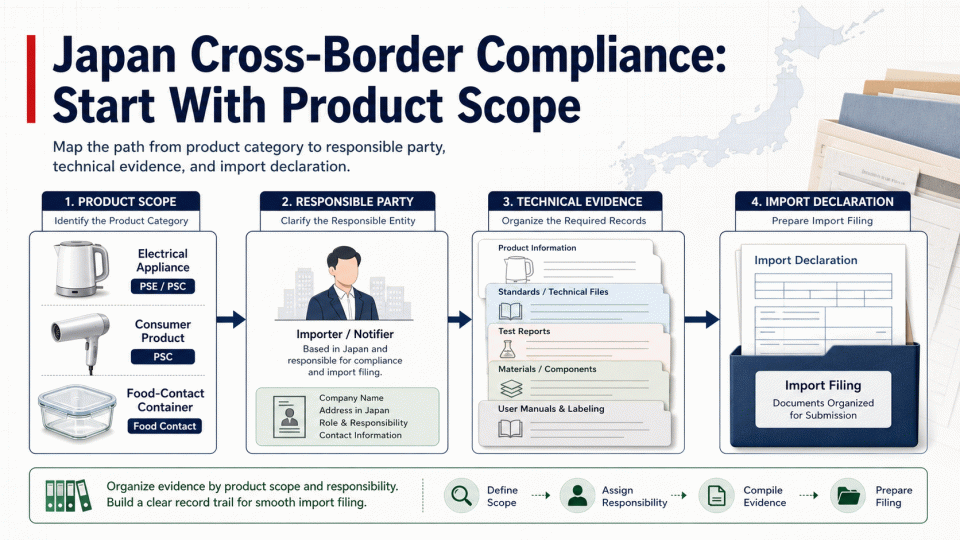
Preparing records for the Japanese market starts with product scope, sales route, and the responsible party in Japan—not with a generic compliance template. Different regimes have different scopes, filing responsibilities, marks, and record requirements.
1. Break “Japan compliance” into four questions
① Product scope: is the item electrical equipment/material designated under Japan’s Electrical Appliances and Materials Safety Act, or a specified consumer product under the Consumer Product Safety Act? ② Responsible party: who is the Japanese importer, manufacturer, or notifying party required by the applicable regime? ③ Technical evidence: do the specifications, construction, materials, risk assessment, tests, and labels all identify the same model? ④ Import filing: do the invoice, packing and transport records, and any permits or certificates required by other laws match the goods?
A product name or HS code is a starting point, not a complete scope decision. For each SKU, retain the model, variant, photographs, ratings, materials, intended use, and sales channel; document which records are shared across a family and which require separate review.
2. PSE: confirm whether the item is electrical equipment or material
METI explains that the Electrical Appliances and Materials Safety Act covers designated items listed by Cabinet Order and distinguishes Specified Electrical Appliances and Materials from other electrical appliances and materials. For an item within scope, the importer or business operator must confirm business notification, technical requirements, self-inspection, and recordkeeping obligations. Specified items also involve conformity assessment by registered conformity assessment bodies. The PSE mark may be used only after the applicable statutory obligations have been fulfilled.
Link the record set to the model and product category: ratings and construction drawings, applicable technical requirements, self-inspection records, conformity-assessment documents where required, label artwork, Japanese importer details, and change history. A supplier’s generic report is not automatically PSE evidence for every model, and PSE should not be presented as a universal Japanese certification.
3. PSC and other product-specific regimes
The Consumer Product Safety Act uses different controls and PSC marking frameworks for Specified Products and Special Specified Products. METI’s guidance lists categories including infant beds, riding helmets, household pressure cookers, portable laser application devices, lighters, and other designated products. The practical decision must return to the product’s construction, intended use, and the current designated list. Do not create a PSC claim merely because a product is sold in Japan.
Food-contact utensils and containers, cosmetics, pharmaceuticals, wireless equipment, toys, and products containing chemicals may fall under separate ministries or regimes. For food-contact materials, MHLW describes a positive-list system under which only substances assessed for safety may be used. The evidence should address the resin, coating, additive, use, and contact conditions; an electrical-product test report is not a substitute.
4. Documentation checklist: link every record back to the SKU
Product and parties: model, version, intended use, photographs, packaging and label artwork, manufacturer, exporter, importer, and authorization or contract relationships where relevant.
Technical and testing records: specifications, BOM or material/formulation list, construction drawings, risk assessment, user instructions, Japanese label copy, test plan, report number, sample model, and test scope. Whether a test report is accepted depends on the specific law, product category, and responsible party; laboratory accreditation alone is not the whole determination.
Import and traceability: invoice, bill of lading or air waybill, packing list, origin documents where applicable, permits or certificates required by other laws, filing version, and change log. Japan Customs states that the importer generally makes the import declaration, although a customs broker may act as agent; restricted goods may also require permits or certificates under laws other than the Customs Law.
5. Page wording and maintenance boundaries
Page wording should state only what the evidence covers: the product, model, market, and point in time. “The records for this model include the test report and label version” is not the same as “all products comply with Japanese law.” Avoid “guaranteed approval,” “certain clearance,” “zero risk,” and universal claims about fines, detention, delisting, recalls, or fixed timelines unless a specific source and scope support them.
When the model, ratings, materials, formulation, manufacturer, importer, packaging, or label changes, repeat the scope review and retain the old version, new version, reason for change, and reassessment. Keep the source files, versions, and source links so the record can be reviewed later.
6. Official sources
METI: Electrical Appliances and Materials Safety Act / PSE; METI: Consumer Product Safety Act / PSC; MHLW: Positive list for food-contact utensils and containers (from June 1, 2025); Japan Customs: Import Procedures.


