
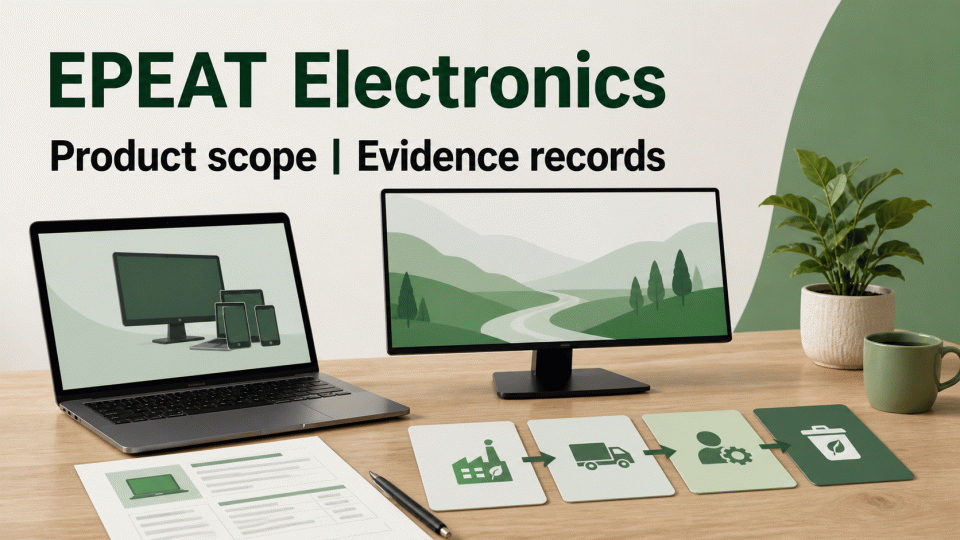
EPEAT is an ecolabel and procurement tool for comparing environmental attributes of electronic products. The Global Electronics Council (GEC) manages the program. EPEAT is not a universal customs admission document, and it does not replace market-specific product safety, radio, electromagnetic compatibility, energy-efficiency or producer-responsibility requirements. A useful review starts with the product category and location of use, then checks the applicable criteria, registration status and model-level records.
This reference page organizes the file set into five linked records: program scope, product identity, conformity evidence, public registration data and claim wording. It is intended for manufacturers, brand owners and procurement teams. It does not determine whether any particular product is registered or eligible.
1. Confirm the EPEAT object and product category
EPEAT uses category-specific criteria. The program’s published materials cover categories including computers and displays, imaging equipment, mobile phones, network equipment, photovoltaic modules and inverters, servers, and televisions. The criteria and conditions differ by category. A document described only as a “green certification” should not be applied to a different type of electronic product without checking its scope.
At a minimum, the product register should capture manufacturer, brand, model or configuration, category, location of use, market version and material changes. For products with multiple configurations, preserve the model-to-configuration relationship. A brand name alone is not enough for a later evidence review.
2. Separate EPEAT records from legal compliance
EPEAT addresses environmental attributes and procurement information. CE, FCC, UKCA, RoHS, energy efficiency, radio, chemicals, and waste-electrical-and-electronic-equipment responsibilities are handled by their own laws, regulatory mechanisms or standards. They may appear in the same procurement project, but an EPEAT record does not by itself establish that another obligation has been met.
Use separate columns for EPEAT category and criteria, market law, product safety and energy files, materials and supply-chain records, and end-of-life arrangements. Label each column with its source and owner. This keeps a purchaser preference, a platform request and a legal duty from being presented as the same type of “certification requirement.”
3. Build manufacturer evidence that can be traced
Create an evidence index for the applicable category and criteria. Typical records may include product specifications and configurations, BOM or key-material information, energy and environmental data, design information on disassembly, repair or recycling, packaging and end-of-life instructions, and the version history supporting each external claim. The exact file set must be checked against the applicable category criteria and EPEAT program documents.
Where a GEC-approved conformity assurance body performs a review or ongoing monitoring, retain the submitted version, questions, supplemental explanations, corrective-action closure and approved claim wording. The EPEAT Policy Manual requires participating manufacturers to be able to provide evidence of conformance when requested. Internal files should therefore connect each claim to a model, data source and document version.
4. Check the public registration record
Search the EPEAT product finder or registry by category, manufacturer, model and location of use. Compare the public name with the internal SKU, configuration and release information. Record the search date, page address, displayed status, category and any qualification notes; do not rely on a search-result screenshot alone.
If the public record and supplier file disagree, pause broad wording such as “registered” or “meets all requirements” and reconcile the manufacturer record, participation documents, category criteria and conformity-assurance evidence. Bronze, Silver and Gold are product-level designations; they should not be rewritten as GEC’s endorsement or rating of the company as a whole.
5. Set boundaries for pages and customer files
A defensible statement can say that a named model was found in the EPEAT registry on a stated search date, while identifying the category, location of use and source. Use a tier or program name only when the record and authorization support it. Do not describe EPEAT as a universal green certificate, an export pass, or proof that a platform will necessarily accept.
When 绿色方舟(深圳)认证有限公司 assists with file organization, the practical output should be a product–criteria–evidence–registry mapping table, with unresolved points listed separately. The responsible product party should confirm the final claim against current program documents, market requirements and verifiable records.
Sources: EPEAT category and criteria information; Global Electronics Council product-finding guidance; EPEAT Policy Manual (P65 Issue 2 Rev 3); US EPA: Identifying Greener Electronics.


