
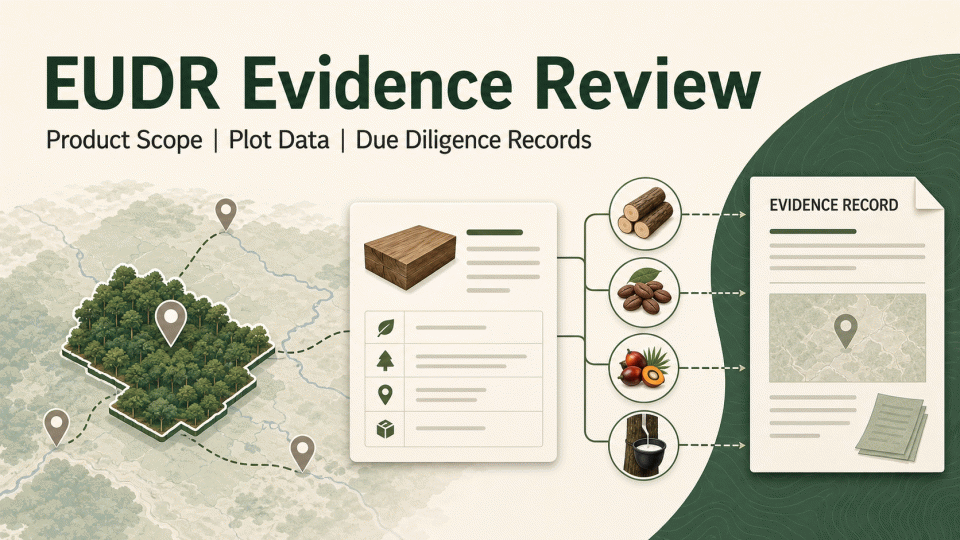
The EU Deforestation Regulation (EUDR) concerns whether relevant commodities and products are deforestation-free, legally produced in the country of production, and supported by the required due diligence record. This page is a practical evidence reference, not a legal opinion or a promise of a regulatory outcome.
1. Confirm whether the product is in scope
EUDR covers the relevant commodities and products listed in Annex I, including cattle, cocoa, coffee, oil palm, rubber, soya and wood, together with the products specified there. Do not decide scope solely from words such as “natural,” “wooden” or “plant-based.” Compare the product description, HS/CN code, material or composition, quantity and intended market activity with the current Annex I text.
Create one scope record per SKU: product and commodity, HS/CN code, Annex I reference, production country, intended placement on the EU market or export from the EU, the source used for the decision and the review date. Keep an open question where classification or scope is uncertain and obtain an appropriate professional or competent-authority view.
2. Map the parties and information flow
Responsibilities depend on where the product sits in the supply chain and on the type of business involved. The upstream operator that first places a relevant product on the EU market or exports it will generally need to complete the applicable due diligence and submit a due diligence statement (DDS) or applicable simplified declaration. Downstream operators and traders may need to keep and pass on the upstream statement reference number or declaration identifier. SME status, operator status and downstream roles can change the duty; one generic template cannot replace the role assessment.
Maintain a role register with the legal name and address, market activity, SME classification where relevant, suppliers and customers, the person responsible for submitting or receiving identifiers, and the internal review trail. An authorised representative may submit on an operator’s behalf, but the operator still needs to confirm the mandate and information.
3. Treat plot and legality evidence as the core chain
The first due-diligence step is to collect information required by the Regulation, including the commodity or product, quantity, supplier, country of production and geographic information connected to the production location. Geolocation must relate to the plot producing the relevant commodity. A factory address, port address or supplier headquarters is not automatically plot information.
Organise legality evidence around the laws relevant to production in the country of production, such as land-use rights, environmental protection, forest management, third-party rights, labour rights, taxes, trade and customs where applicable. The document set varies by commodity and country. FSC, PEFC, transaction certificates and supplier declarations should not automatically be presented as the EUDR conclusion; they may inform risk analysis only after scope, chain and plot data are checked.
4. Document risk assessment, mitigation and the statement
The second step is to assess the risk of non-compliance using the collected information. The third is to apply adequate risk-mitigation measures where risk is identified. The record should show the sources reviewed, production country and supply-chain complexity, plot and forest-change information, legality documents, mixing or traceability gaps, questions raised, additional checks, mitigation actions and the conclusion. EUDR is not a fixed tick-box form: before placing a relevant product on the market or exporting it, the operator must reach no or only negligible risk.
Where applicable, submit the DDS or simplified declaration through the EUDR Information System. Each product, quantity, operator, plot and supporting reference in the statement should be traceable to an internal evidence index. A submission in a training environment does not replace a legally effective submission in the live system.
5. Build an evidence index
| Evidence group | Check | Boundary |
|---|---|---|
| Scope and trade | SKU, commodity, HS/CN, quantity, production country, market activity | Recheck codes and Annex I against the current text |
| Plot and origin | Plot geolocation, production batch, supplier and quantity link | Factory or port address does not replace plot data |
| Legality | Applicable land, environmental, labour, tax and trade records | The required set depends on commodity and country |
| Risk and statement | Risk basis, mitigation, DDS/declaration identifier and version | One statement does not automatically cover every SKU |
6. Final review and wording boundaries
Before shipment or market placement, ask: Is the product in Annex I? Are the parties and roles clear? Do the product, quantity, supplier and production country match? Can the plot data be linked to the production source? Does the legality evidence relate to the country of production? Are risk assessment and mitigation documented? Was the applicable DDS or simplified declaration submitted in the correct system? Is ownership for updates and record retention clear?
Avoid wording such as “one certificate guarantees customs clearance,” “the platform must approve it,” or “all materials are interchangeable.” EUDR rules, annexes, implementation tools and role requirements may change. Use the latest European Commission, EUR-Lex, competent-authority and Information System material. 绿色方舟(深圳)认证有限公司 can organise client-provided product and supply-chain evidence into a review table, but does not replace the operator’s legal statement or guarantee a regulatory result.
Source basis: European Commission EUDR topic pages, Green Forum “Understand due diligence” and “Roles and responsibilities,” and EUR-Lex Regulation (EU) 2023/1115. Later amendments and implementation arrangements should be checked against the latest official text.


