
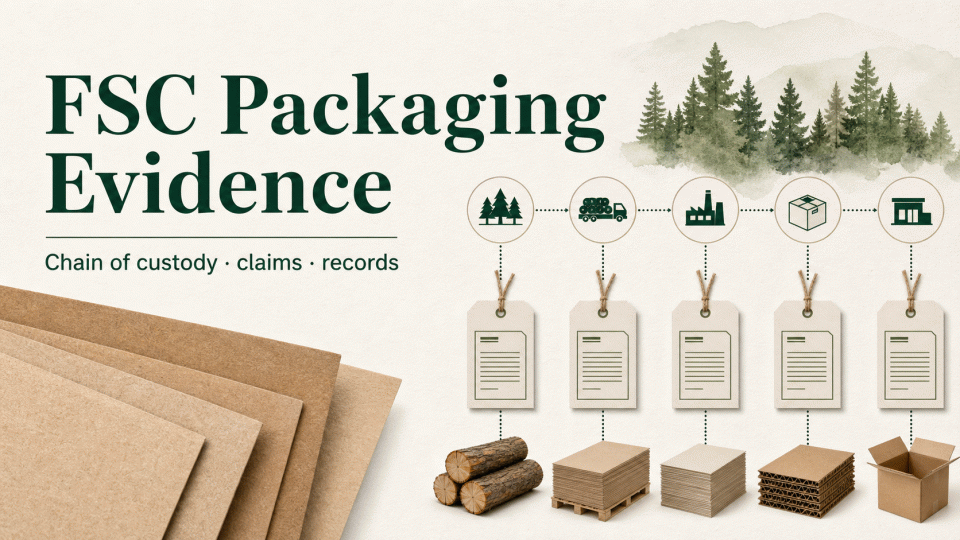
For packaging and paper-based products, FSC evidence is not a generic “green label” exercise. The useful question is whether the product, material input, supplier, processing step, sales document and permitted FSC claim are connected in a traceable record. This page gives packaging, paper-product and supply-chain teams a practical evidence index.
1. Define the FSC object and packaging scenario
FSC CoC is not a universal approval for every product described as sustainable. It supports the control of forest-based products from sourcing and purchasing through processing, conversion, sale and delivery. For boxes, bags, paper, board and printed packaging, start with the material composition, product classification, processing activities and transaction role.
Separate at least three situations. First, an organization processes, cuts, prints, repackages, relabels or takes legal ownership of products and wants to sell them with an FSC claim or apply an FSC label. Second, a company buys finished FSC packaging from a certified supplier and uses it without changing the FSC claim. Third, an organization only transports or brokers a product without taking legal ownership. These situations can have different certification and trademark implications; brand ownership alone does not answer the question.
Record the product/SKU, paper or board composition, processing steps, production or outsourced sites, supplier and customer roles, ownership position, intended sales-document claim and any need for an on-product or packaging trademark. Where a product includes non-forest-based components, apply the relevant product-classification and claim rules rather than treating a component claim as a claim for the whole product.
2. Build the CoC evidence chain
FSC’s core CoC explanation points to three practical controls: applicable FSC material is used, material is identified and tracked through manufacturing and distribution, and records for purchasing, production and sales are retained. Organize evidence as input, conversion and output records instead of collecting a supplier certificate in isolation.
| Record block | Questions to check | Evidence examples |
|---|---|---|
| Supplier and input | Supplier identity, certificate status and scope, product category, available claim, order and batch | Purchase orders, invoices, delivery notes, supplier documents, public certificate check |
| Internal identification | How eligible material is identified and separated or accounted for | Material codes, warehouse records, production batches, process map, responsibilities |
| Processing and outsourcing | Whether printing, cutting, coating, assembly or outsourcing changes the product or claim | Work orders, input/output and loss records, contracts, batch traceability |
| Sales and output | Product group, quantity, customer, sales-document claim and batch connection | Quotes/orders, invoices, shipping files, label artwork, claim approval log |
3. Claims, labels and certificates are not interchangeable
An FSC claim relates to a defined product, transaction document and certification scope. It does not mean that every product made by a certificate holder is FSC certified. Product labels, sales-document claims, certificate scope and trademark permission have different conditions. A supplier certificate cannot automatically be extended to a brand owner, another SKU or packaging outside the covered scope.
Check whether the certificate holder is the organization responsible in the transaction; whether its status can be verified; whether the scope covers the relevant site, product category and activity; whether the supplier’s claim matches purchasing and sales documents; and whether artwork uses the permitted FSC trademark elements. A company that only promotes finished FSC products may have a different promotional-licence route, which should be confirmed against FSC’s current requirements.
4. Prepare an audit-ready document index
For each product group, index: (1) organization and site information, process maps and responsibilities; (2) applicable FSC standards, product classification and claim rules; (3) supplier certificates, scope and verification date; (4) purchasing, inventory, production, loss, outsourcing and sales records; (5) nonconforming material, complaint, false-claim and corrective-action records; (6) labels, packaging artwork, sales documents and trademark approvals; and (7) training and internal-check records.
Names, SKUs, batches, quantities, dates and owners should connect across the index. Treat outsourced conversion, subcontract printing, repackaging and multiple sites as explicit scope questions. Where labour requirements or other FSC normative requirements apply, retain relevant policies and records; an ISO certificate, test report or customer statement is not a substitute for the applicable FSC control.
5. Common errors and wording boundaries
Error 1: treating FSC as a universal environmental certification for packaging. State the material, product and claim scope. Do not merge FSC with recyclability, carbon, plastic-free or other environmental attributes.
Error 2: checking only a certificate screenshot. A screenshot does not replace status, scope, transaction documents and batch records. Keep the public verification record, supplier documents and internal records in one index.
Error 3: promising a fixed audit period or outcome. The process depends on the certification body, scope, sites, corrective actions and evidence quality. It is reasonable to describe an application, assessment, decision and continuing-surveillance path; it is not reasonable to promise a fixed duration, approval, sales uplift or platform result.
6. Practical checklist
- Have we defined the product, material, site, processing activity and transaction role?
- Can we verify the input supplier, certificate status, scope and FSC claim?
- Can purchasing-to-shipment records be tied to the relevant SKU or batch?
- Do sales documents, labels and promotional copy use only permitted claims and marks?
- Are outsourcing, multiple sites, non-forest components and nonconforming material controlled separately?
- Does the page state that evidence review is not an FSC certification decision and does not establish compliance with other laws or platform rules?
Sources: Forest Stewardship Council, “Chain of Custody Certification”; FSC Chain of Custody Certification Standard (FSC-STD-40-004) and FSC Product Classification (FSC-STD-40-004a); FSC Packaging materials. Standards, guidance and licence requirements may change. Use the applicable version and confirm the actual scope with an independent certification body.


