
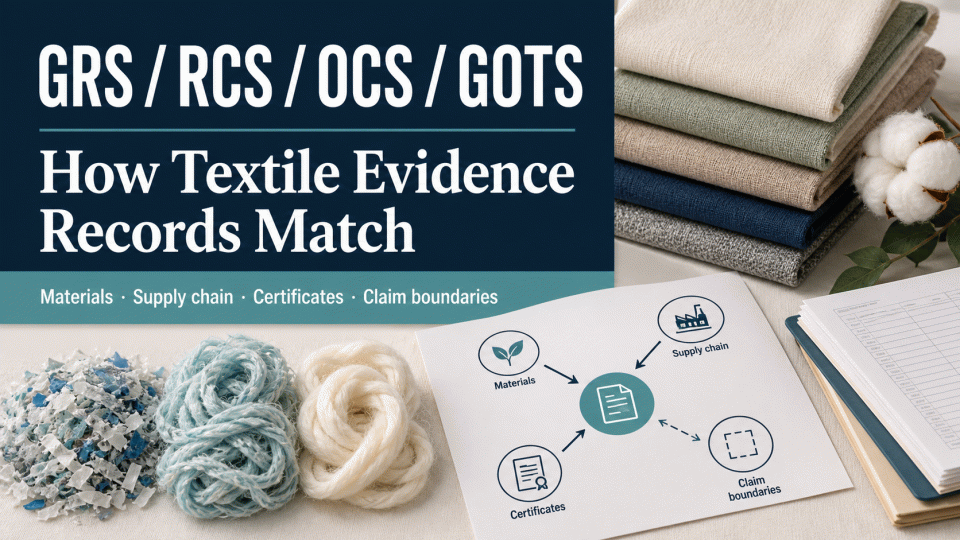
GRS, RCS, OCS and GOTS all touch textile supply chains, but they answer different questions. GRS and RCS focus on recycled materials, OCS focuses on organically grown material content, and GOTS covers the processing of organic fibres into textiles together with environmental, social and chemical-management requirements. Start by separating the product, material, processing stage and intended claim.
1. Route the question by standard
| Standard | Primary question | Evidence focus |
|---|---|---|
| GRS | Recycled material and its supply chain, with additional social, environmental and chemical requirements | Recycled source, processing sites, CCS chain of custody, product scope and transaction records |
| RCS | Recycled material content and tracking from source to product | Material composition, content calculation, supply-chain nodes and transaction records |
| OCS | Organically grown material content in products not intended as food | Organic-material source, processing scope, content claim and chain of custody |
| GOTS | Textiles made with approved organic fibres and their subsequent processing | Scope Certificate, processing activities, chemical/environmental/social records and applicable Transaction Certificate |
GRS, RCS and OCS are Textile Exchange standards; GRS generally adds more processing-related requirements than RCS. OCS is not a substitute for food law, and an “organic” material label does not by itself establish compliance with food, cosmetics or textile rules in a particular market. GOTS is a separate organic-textile standard; a GOTS certificate should not be rewritten as a GRS, RCS or OCS certificate.
2. Pair certificates, transactions and product claims
Create one evidence row for each SKU. At minimum, record the brand or sales entity, supplier and production site, product category, fibre or recycled-material composition, applicable standard, certificate number and scope, transaction reference, invoices or shipping records, and the proposed webpage wording. Recheck the certificate scope when the SKU, colour, composition, processing method or site changes.
A Scope Certificate addresses what a named entity and site are certified to do and which products are listed in scope. A Transaction Certificate links an applicable transaction or delivery to the supply-chain claim. Whether a TC is required, how it is issued and what it must contain depends on the relevant standard and certification-body process. Neither document should be read without checking the entity, product scope and transaction records.
Keep webpage claims at a checkable level, such as “contains verified recycled material” or “uses organically grown cotton material,” and identify the relevant product and standard. Do not turn a supplier’s certificate into “all of our products are certified,” or turn a standard certificate into a guarantee of safety, customs clearance, platform display or sales results.
3. Evidence checklist: from input to webpage
- Entity and scope: certificate holder, sites, certification body, standard version, product categories and listed activities.
- Material records: BOM or fibre composition, material supplier, recycled or organic source, and batch/colour/model mapping.
- Chain records: purchase orders, invoices, shipping documents, production input/output, segregation or volume-balance records, and applicable SC/TC documents.
- Claims and labels: standard name, content or percentage wording, product scope, label artwork and records showing permission to use marks where applicable.
- Review log: date of public-database or certification-body verification, file version, exceptions and the webpage version checked after correction.
Use Textile Exchange’s current GRS/RCS/OCS documents and Standards Claims Policy for those standards. Use the current standard, implementation manual, certification and labelling requirements published by Global Standard for GOTS. Standards change; verify the current version, certificate scope and sign-use conditions against the official source.
4. Four common mismatches
Using the standards as synonyms: recycled-material, organically grown-material and organic-textile-processing claims have different objects. Keep the original standard name.
Reading only the first page: check the holder, sites, products, activities, standard version and status. A file name cannot extend a certificate to an uncovered site or SKU.
Using one transaction record for every shipment: transaction documents should match the actual batch, supply-chain nodes and product records; one delivery does not prove every inventory line.
Calling a voluntary standard a legal market gate: GRS, RCS, OCS and GOTS define the scope of their own standards. They do not replace destination-market product safety, labelling, chemical, import or platform requirements. Maintain a separate market-law checklist.
5. Final webpage review
Check that the title, H1, summary, image text and body use the same standard names; that each claim points back to a product, material and record; that the Chinese and English versions describe the same scope; and that the page does not imply “certified,” “fully compliant,” “officially approved” or “guaranteed clearance” without evidence. If the record is incomplete, narrow the claim or hold publication and retain the review note.
Sources: Textile Exchange: RCS and GRS, Textile Exchange: GRS overview, Textile Exchange: OCS Standard, Global Standard: GOTS key features, and Global Standard: certification and labelling.


