
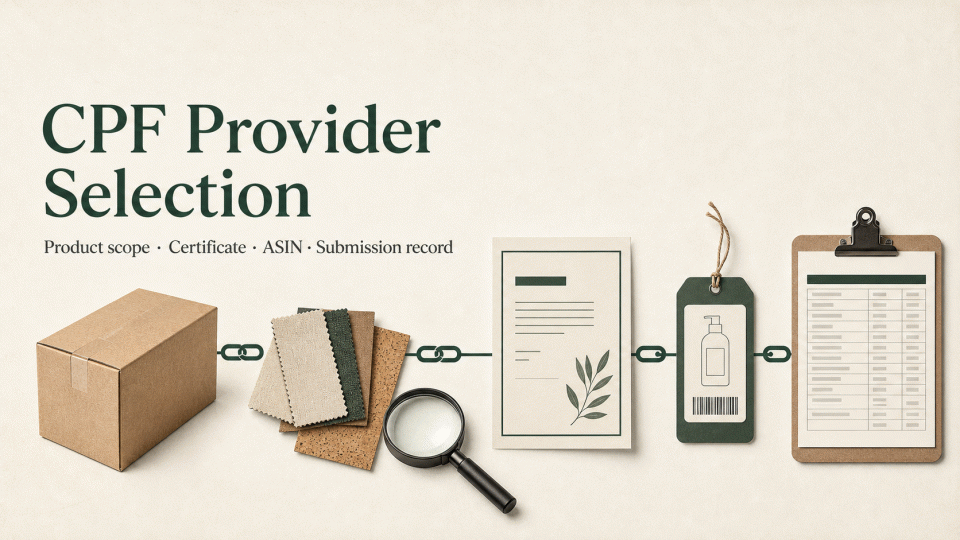
When selecting help for Climate Pledge Friendly (CPF), begin with the product’s qualifying third-party certification route. Then match the certificate, product model, brand entity and ASIN. A service provider may organize evidence and coordinate communications, but it cannot replace the certifier’s decision or promise that Amazon will display a CPF label.
1. Questions the provider should answer first
The practical unit for provider selection is a specific product or SKU, target market and sustainability attribute—not a “green certificate” for the brand. Record the material, formula, model, packaging, production site, brand and selling entity before asking whether the target attribute falls within an approved path, such as organic content, recycled content, forest-based material, electronics environmental performance, chemicals management or another listed feature.
Ask each candidate to separate document preparation, certification application, laboratory work, platform submission and coordination. Identify the actual certifier or standards body, what the fee includes, what remains uncertain, and how product files, certificates and Seller Central data will be reconciled. Pause if the provider offers a “guaranteed badge” or “guaranteed approval” without defining the route and evidence.
2. Separate CPF, certification and legal requirements
Amazon’s program materials describe CPF as a way to help customers discover products with sustainability features supported by third-party certifications and related frameworks. A provider should confirm the current Amazon route first, then verify the standard, scope and certificate requirements with the relevant certification body. Platform display, a third-party certification decision, product-safety law and import documentation are different matters handled by different actors.
| Layer | What to verify | Do not claim |
|---|---|---|
| CPF program | Current qualifying route, product-level eligibility, ASIN/catalog data and submission path | Brand-wide certification or guaranteed display |
| Third-party certification | Certifier, standard version, certificate holder, scope, model and claim | A provider’s report as the certification decision |
| Law and import | Mandatory market rules, labels, responsible entity and import records | CPF as customs or product-safety proof |
| Page wording | Product, attribute, evidence and page location mapped together | Extension to every product or a business result |
3. Evidence checklist for the provider
Create a traceable index for each SKU: (1) brand, manufacturer, importer and other responsible entities; (2) specifications, BOM, material/formula, model and packaging version; (3) target certification, applicable standard and certifier; (4) certificate number, holder, scope, sites, status and verification date; (5) test or assessment reports with sample, model and parameter coverage; (6) purchasing, material, batch and supply-chain records; (7) label artwork, packaging, listing copy and image versions; and (8) seller account, ASIN, variation relationship and submission record.
The provider should identify who checks legal-entity and model matching, who keeps original files, who approves public claims and who answers certifier questions. A certificate screenshot, laboratory report or supplier declaration is only one part of the record; it does not automatically cover another SKU, brand entity or material attribute.
4. Compare quotation, deliverables and scope
Break the quotation into product-scope review, gap analysis, document preparation, certifier communication, sample and testing coordination, platform submission, supplemental-document responses and change management. Ask for assumptions, third-party fees, sample and translation costs, file ownership, confidentiality, deliverable formats and the handling of an ineligible or incomplete application.
A reliable provider will flag when a product may fall outside a route, distinguish verified facts from customer inputs and let the customer retain original certification and submission records. Low price, a fixed number of weeks or a “one submission approval” promise should not replace scope and evidence review.
5. Common errors and wording boundaries
Error 1: treating CPF as a universal certificate. CPF relates to a specific product and sustainability feature; it does not automatically extend to every product under the brand.
Error 2: using a supplier certificate as a blanket authorization. Check the holder, product scope, model or material, transaction relationship and current status before making a claim.
Error 3: merging platform display with legal compliance. A certification submission does not establish that every safety, labelling, packaging, import or environmental requirement in a market is met.
Error 4: losing version control. Recheck the evidence-to-page mapping after a formula, material, factory, package, brand entity or listing change.
6. Pre-submission checklist
- Does the provider identify the actual certifier, standard, product scope and its own role?
- Do the certificate holder, model, material or attribute, brand and ASIN match?
- Are certificate status, scope and verification date supported by saved records?
- Do the submission files match the current listing, packaging, labels and selling entity?
- Does the quotation separate service fees, third-party costs, testing, supplements and change work?
- Does the page state that CPF, certification, legal compliance and sales outcomes are not interchangeable?
Sources: Amazon Seller Central, “How to certify your products as Climate Pledge Friendly”; Amazon Ads, “Climate Pledge Friendly (CPF): Creative Guidelines”; Amazon Sustainability Solutions Hub. Program scope, platform workflow and display conditions may change; confirm current Seller Central guidance and the relevant certifier’s requirements before submission.


