
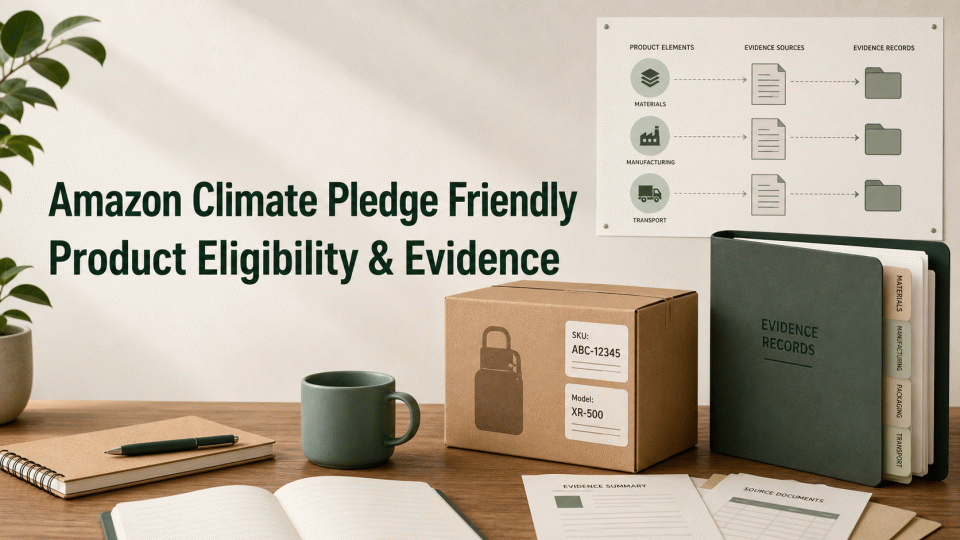
Sellers sometimes treat an “Amazon green certification” as one certificate covering a brand, factory, and every SKU. A more precise view is that Climate Pledge Friendly (CPF) is an Amazon program that helps customers discover products with sustainability-related features, supported by recognized certifications or program features. It is not a blanket conclusion about a brand or all of its products. This article is a documentation framework, not a substitute for current account guidance, certification rules, or legal advice for a target market.
1. Separate CPF from mandatory regulation
Amazon describes CPF as a program that works with trusted third-party sustainability certifications and includes Amazon-created certification programs. The set of certifications and sustainability attributes is reviewed over time. A CPF label, product-page information, or a certification program does not replace mandatory duties concerning product safety, chemicals, packaging, import, or recycling.
Start with the destination store, product function, materials, packaging, and selling entity when building the legal register. Keep a separate CPF eligibility record. Do not combine PPWR, EUDR, CBAM, food-contact rules, or other regimes into one “green certification” file, and do not infer that another obligation is complete merely because a sustainability certification exists.
2. The practical unit is the specific product
Amazon Ads’ CPF guidance explains that the label qualifies a single product, not a brand as a whole. The review should identify the ASIN and its SKU, model, or variation, then record the relationship among the product, its materials or formula, packaging, and the relevant certification program. A supplier’s certificate does not by itself show that the product currently sold has been recognized by CPF.
Create a product–certification–certificate–claim map. At minimum, record the ASIN/SKU, brand and selling entity, manufacturer or certificate holder, model and version, certification program, certificate number or public lookup record, scope, target store, document version, and review date. Do not merge different colors, materials, formulas, or versions merely because they share a product family name.
3. Evidence to check first
Product identity: specifications, model and variation relationships, ASIN/SKU, images, labels, packaging, and version-change records.
Certification scope: the eligible object, sustainability attribute evaluated, certificate holder, product or facility scope, current status, and public verification route. Programs use different standards, processes, and certificate fields, so use the current page from the relevant program or certifier.
Supply-chain support: purchasing and production records, material or ingredient information, batch/model links, relevant transaction or traceability records, and an internal index explaining how the product maps to the certificate scope. If a file covers only a raw material, package, component, or facility, record that boundary instead of extending it to the finished product.
Platform record: retain the ASIN, store, file names, submission date, Amazon prompts, and correspondence used at submission. Eligibility recognition, entry points, and display can vary by store and account, so recheck the current Seller Central or Vendor Central information before submitting.
4. Keep page wording within the evidence
Describe a product as having a relevant sustainability feature or showing a related program label only when the current product record, certification scope, and platform record correspond. Do not turn “under review,” “the supplier has a certificate,” or “the material contains an ingredient” into “the brand is green-certified,” “all products pass,” or a promise of platform traffic or sales. Amazon also requires environmental or green claims to have appropriate substantiation; page wording should stay within the evidence.
Recheck the impact of changes to the model, formula, materials, manufacturer, certificate holder, selling entity, or store. Certificate status, program lists, and platform entry points should be confirmed against current official information at submission; this article does not set a universal renewal period or review timeline.
5. A workable decision sequence
First, define the target store, ASIN/SKU, product version, and selling entity. Second, confirm that the proposed certification program covers the product rather than only its packaging, component, raw material, or facility. Third, map the certificate holder, scope, status, and product records. Fourth, keep CPF platform matters separate from mandatory market rules. Fifth, preserve submission evidence and limit page claims to what has been verified.
绿色方舟(深圳)认证有限公司 can help organize the relationship among product records, certification files, and page claims. The specific program eligibility, platform recognition, and legal duties still depend on current information from Amazon, the relevant certification program, and authorities in the target market.
Official references
Primary references: Amazon Sustainability: Products and services, Amazon Ads: Climate Pledge Friendly Creative Guidelines, and Amazon Sustainability Solutions Hub. Verify the current standard, product scope, and status on the relevant certification program or certifier page.


