
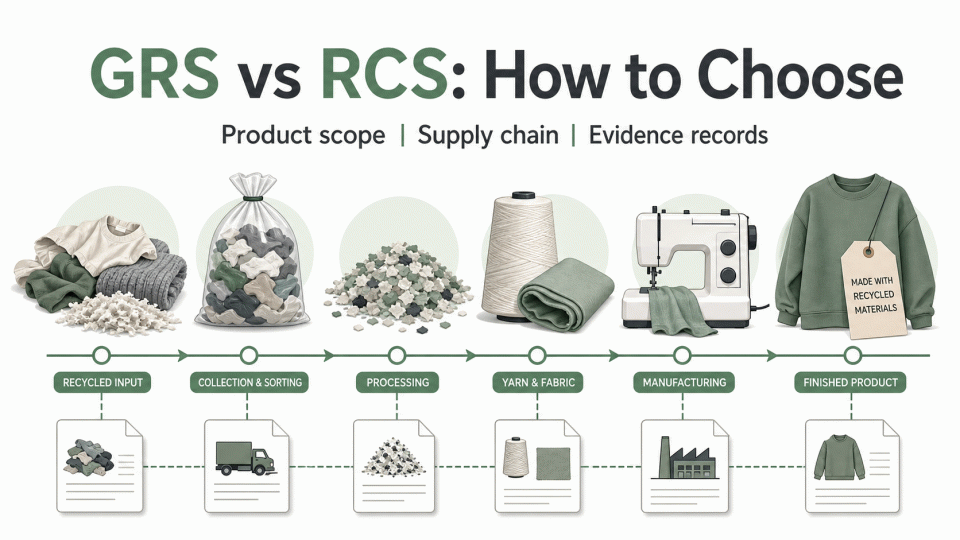
GRS and RCS both address recycled materials and chain of custody, but they do not have the same scope. Start by separating the product, recycled input, supply-chain sites, and intended claim. Neither standard replaces applicable law or a marketplace requirement.
1. What RCS and GRS verify
RCS (Recycled Claim Standard) focuses on verifying recycled material content and tracking it from the recycler or source through the supply chain to the finished product. The exact claim still depends on the applicable version, product category, and claims rules.
GRS (Global Recycled Standard) also tracks recycled material, while adding social and environmental criteria for processing, chemical restrictions, and conditions for product labelling and claims. Textile Exchange’s comparison page describes GRS as having a higher 50% minimum recycled-content threshold and additional processing requirements.
Both rely on the Content Claim Standard (CCS) chain-of-custody framework. Supply-chain sites maintain material identity and flow records through audits and documentation, with a Scope Certificate (SC) describing the certified scope and Transaction Certificates (TCs) linking particular shipments or transactions. An SC and a TC serve different purposes.
2. Match the route to the product and sites
Build a SKU–material–supplier–site–finished-product map. For each SKU, record the recycled-material source, pre-consumer or post-consumer status where relevant, material percentage, processing sites, selling entity, and intended page wording. A supplier’s certificate or a certificate for a neighbouring product is not a substitute for checking the current SKU.
RCS may fit better when: the project is centred on recycled-content verification and chain of custody, without the additional GRS processing criteria. Confirm that each relevant site is covered and that outgoing records can be linked to TCs.
GRS may fit better when: a customer or brand programme also needs social, environmental, and chemical controls at processing sites, and the product and supply chain can support that wider audit scope. GRS is not a promise of an easier outcome; it is a broader evidence route.
3. Evidence to assemble before submission
Product records: SKU, model or style, BOM/material composition, recycled-material definition and calculation basis, finished-product images, and proposed claim wording.
Supply-chain records: recycler or input supplier, actual spinning, weaving, dyeing, finishing, or cut-and-sew sites, each site’s certificate scope, purchasing and shipping records, quantity reconciliation, and segregation or blending controls.
Certificate records: certification body, certificate holder, SC number and scope, product/material description, site addresses, and standard version. For each transaction, match the TC parties, goods description, quantity, and supporting date records. Textile Exchange’s supply-chain guidance states that certified products should be accompanied by, or traceable to, a TC.
Claim records: separate facts supported by evidence from marketing language. Before using a standard name, label, or product-related assured claim, check Textile Exchange’s Standards Claims Policy and the certification body’s authorization requirements.
4. Common mistakes and claim boundaries
An RCS or GRS certificate is not a general product-conformity certificate and does not replace customs, product-safety, chemical, or marketplace requirements. It cannot by itself support claims that all laws are met, a listing will be accepted, or a marketplace label will be awarded.
“Contains recycled material” does not mean every component is certified material. Limit the claim to the product, material, sites, records, and authorization actually covered. Recheck the mapping when materials, suppliers, sites, formulas, or packaging change.
5. A reviewable decision test
Write the decision as four questions: (1) Is the intended claim about recycled content only, or also processing conditions? (2) Are all relevant sites within the SC scope? (3) Do inputs, outputs, quantities, and transactions reconcile to the records and TCs? (4) Does the page wording stay within the certificate, standard, and authorization rules? Only move a claim into customer-facing material when each answer has supporting evidence.
Public sources: Textile Exchange comparison of RCS and GRS; CCS overview; Chain of Custody; Supply-chain certification and TCs; and the Standards Claims Policy.
This reference is based on Textile Exchange’s public materials on RCS, GRS, CCS, chain of custody, and standards claims. During a revision or transition, use the current Textile Exchange document library, certification-body notices, and the specific certificate scope. 绿色方舟(深圳)认证有限公司 does not replace the certification body or regulator in making a final certification, enforcement, or market-access decision.


