
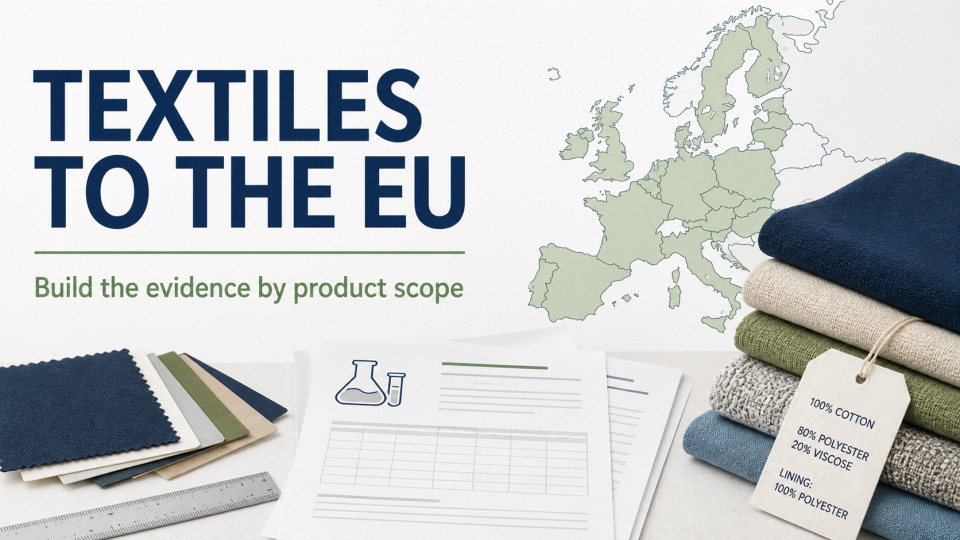
There is no single “EU textile certification” that covers every product. The evidence you need depends on the product, materials, sales channel, destination Member State and claims made on the label or product page. This page is a documentation guide, not a product-specific legal assessment.
1. Define the product and sales scope first
Build a SKU register covering the finished-product use, fibre composition, dyes, finishes and coatings, skin or food contact, child-oriented use, destination Member States, manufacturer and importer details, packaging, and online claims. Apparel, home textiles, footwear, decorative fabrics and technical textiles may have different regulatory paths. Products with electrical, medical or protective functions may also fall under more specific rules.
“Exporting to the EU” is not the name of a certificate. Map each requirement to its product scope, legal or commercial source, original supporting record and permitted wording. Do not buy a generic certificate before the product scope is clear.
2. Common mandatory evidence layers
Fibre-composition labelling: Regulation (EU) No 1007/2011 sets rules for textile-fibre names, fibre composition and related labels or commercial documents. Labels must be durable, legible, visible and securely attached. For consumer sales, fibre information must also be clear before purchase and handled in line with the language rules of the destination Member State. Keep composition or supplier records that connect the label to the exact SKU.
Chemical restrictions: REACH and Annex XVII restrict certain substances and uses. For textiles, assess dyes, finishes, coatings and prints against the actual formulation and intended use. A generic “textile report” is not automatic coverage for every style, colour or batch. Keep formulation or material statements, supplier records, sampling logic and tests matched to the product scope.
General product safety: For consumer products not covered by more specific product legislation, the General Product Safety Regulation (EU) 2023/988 has applied since 13 December 2024. Prepare product identification, risk analysis, traceability, manufacturer or importer information, warnings and online-sale information. Children’s products, items with electrical parts and special-purpose textiles require a separate scope check.
3. Place voluntary certifications and green claims in context
OEKO-TEX, GOTS, GRS, RCS and FSC have different certified objects, scopes and document types. They should not be presented as interchangeable EU market-entry certificates. If a page uses “organic”, “recycled”, “free from harmful substances” or a named certification, verify the certificate holder, scope, products or materials, facilities or transaction chain, certificate number and current status. Limit the claim to what the evidence actually covers.
The European Commission’s ESPR 2025–2030 Working Plan identifies textiles, with a focus on apparel, as a priority product group. Textile Digital Product Passport and ecodesign requirements still depend on product-specific delegated acts and supporting rules. A planning milestone should not be written as an already effective, uniform filing duty. For environmental claims, retain the calculation boundary, material records and supporting certificate or test evidence.
4. Build the file by SKU
Product and parties: SKU, style and version, fibre composition, colour and finish, manufacturer, importer or EU responsible person where applicable, packaging and online-page captures.
Regulatory basis: fibre-labelling basis, chemical-restriction screening, product risk analysis, warnings and traceability records. If a product falls under specific legislation, list its technical file and declaration separately.
Testing and supply chain: sample description, style or batch mapping, laboratory and method, report number and date, material and chemical-supplier statements, and purchasing or production records. Whether a report is sufficient depends on the applicable requirement and product scope; a fixed report-age rule is not a substitute for that assessment.
Claim evidence: index each page statement as “claim—evidence—covered object—limitation”. Recheck the mapping after a material, colour, factory, certification scope or page change.
5. Human review before submission or sale
Read the label, packaging and product page for each SKU. Confirm that fibre names and percentages match, party details are consistent, warnings fit the actual risk, environmental or certification claims stay within their evidence scope, and the sample and report trace back to the current style. Store legal duties separately from buyer or marketplace requirements so a commercial preference is not presented as an EU legal conclusion.
This guide is based on public European Commission material on product safety, textile Digital Product Passports and the ESPR Working Plan, together with the EUR-Lex text of Regulation (EU) No 1007/2011. Rules, delegated acts and Member State implementation details can change; check the latest official texts for the product and destination before placing it on the market.
Documentation and compliance-boundary note: 绿色方舟(深圳)认证有限公司.


