
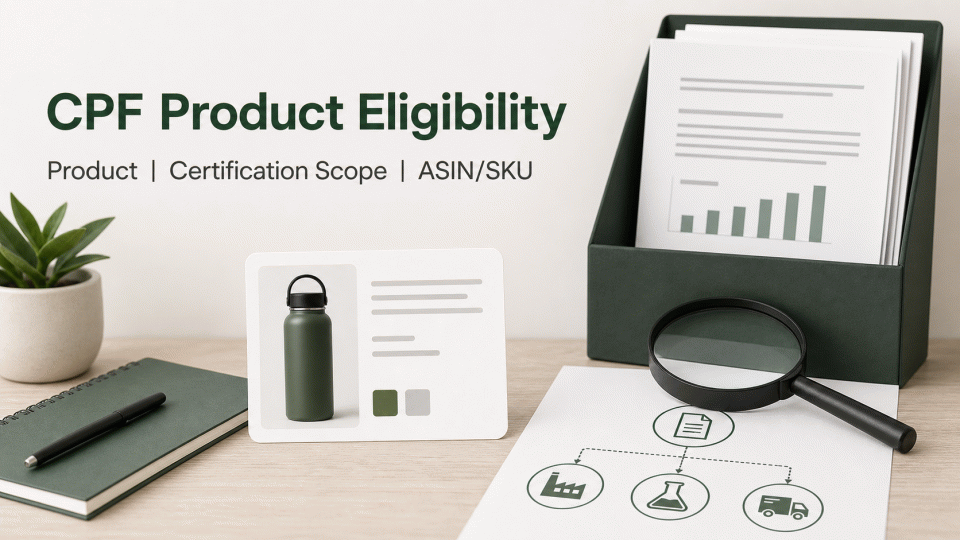
Climate Pledge Friendly (CPF) is an Amazon program that helps shoppers identify products with sustainability features. It is not a universal certification and does not replace mandatory product, chemical, labeling, packaging, import, or safety requirements. Start by confirming the product basis for eligibility, then organize evidence around each specific item.
1. Separate CPF from mandatory compliance
CPF highlights sustainability features for shoppers. The supporting basis may be an approved third-party certification or an Amazon-owned program. It does not replace the legal requirements of the destination market, and completing a mandatory requirement does not by itself create CPF eligibility.
Keep two linked records: one for CPF eligibility and supporting evidence, and another for mandatory requirements in each sales market. Do not treat an HS code, customs document, general test report, or private buyer audit template as a universal CPF application document.
2. Build a product–certification–evidence record
Create a separate record for each SKU and check:
Product identity: ASIN, SKU, brand, model or variation, category, and the exact products covered by the certification. If a certificate covers one model, material, formulation, or product family, do not extend it to uncovered SKUs.
Certification basis: program name, issuing or operating organization, certificate number, certificate holder, scope, applicable market, and current status. Keep the certificate and, where available, a public verification page or issuer-provided validation record.
Product evidence: specifications, BOM or material information, label and packaging artwork, product images, batch or supplier records, and a mapping that connects the certified object to the Amazon product record. Add testing or supply-chain documents only where the relevant program or Amazon guidance calls for them.
3. Four checks before submission
1. Is the basis currently recognized by CPF? Recognized programs, markets, and requirements can change. Use the current CPF guidance, product template, and help pages in Seller Central.
2. Does the certificate cover this product? Match the brand, model, category, material or formulation, certificate holder, and status. A supplier having “a certificate” does not prove that it covers your listing.
3. Do the records agree? Product name, model, ASIN/SKU, brand, and responsible entity should be explainable across the documents. Resolve discrepancies with the issuer or responsible party; do not conceal gaps by renaming or stitching together files.
4. Are the page claims within the evidence? Describe only the supported feature and program status. Do not turn “submitted” or “under review” into “approved,” or present a CPF badge as a conclusion that covers every product, market, or legal requirement.
4. Maintain the record and define responsibility
Recheck the certification scope and product mapping after a product change, material change, factory change, change of brand owner, or certificate update. Record the submission version, supporting files, relevant communications, and change date so that any follow-up from Amazon or the certification body can be traced to its basis.
绿色方舟(深圳)认证有限公司 can assist with product-scope review, evidence indexing, and page-claim boundaries. Certification decisions, program eligibility, and Amazon display status remain subject to the latest rules, records, and review outcomes of the relevant certification body and Amazon.
Sources and scope note
This reference is based on Amazon Seller Central’s public explanations of Climate Pledge Friendly and its product-submission guidance. Recognized certifications, product categories, templates, and workflows may change; recheck the current version in the relevant Seller Central marketplace before submitting.


