
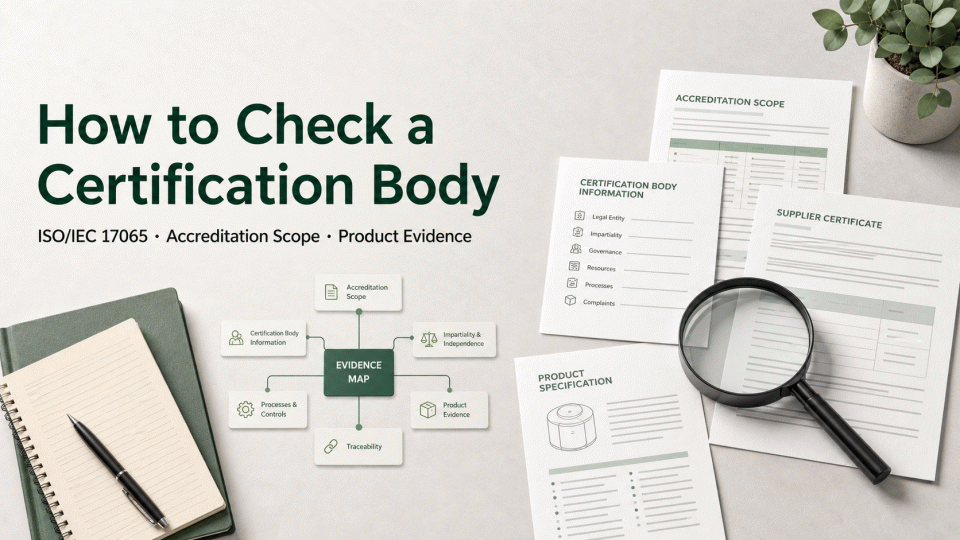
Bottom line: A statement that a certification body works to ISO/IEC 17065 is not proof that a product is certified, and it does not automatically establish eligibility for Amazon Climate Pledge Friendly (CPF). To assess a supplier certificate or environmental claim, connect the body’s identity, accreditation scope, certification scheme, certificate status and product evidence in one traceable record.
1. What ISO/IEC 17065 tells you
ISO/IEC 17065:2012 sets requirements for bodies that certify products, processes and services. ISO’s public page says the edition was confirmed as current in 2024, while a later revision project is being developed. The standard addresses impartiality, organizational structure, personnel and resources, evaluation processes, certification decisions, certificates, surveillance, changes, suspension or withdrawal, complaints and appeals.
The standard does not define the technical requirements for every product. Product certification has to be read together with a certification scheme, which should identify the object, specified requirements, sampling or evaluation methods, decision process, use of a conformity mark and any surveillance. Seeing “ISO/IEC 17065” on a document is not a substitute for checking the scheme and the product scope.
2. Six document checks
Check 1 — legal identity and roles
Record the certification body’s legal name, office or registration information, certificate issuer, accreditation body where relevant, and the roles of the supplier, brand owner and product-responsible entity. A sales agent, testing laboratory, consultant and certification body may be separate organizations. Do not treat them as one body because the same salesperson sent the files.
Check 2 — accreditation status and exact scope
When a body claims accreditation, check the accreditation body’s public directory or accreditation document for the name, status, standard, product or sector categories, activities and scope. Accreditation may cover only defined product categories or schemes. “Accredited” does not mean that the body is accredited for every green label, material or market.
Check 3 — certification scheme and version
Request the applicable scheme, standard or normative document, including its version and scope. Confirm whether it defines sampling, factory evaluation, product testing, supply-chain traceability, surveillance and change control. ISO/IEC 17065 is a requirement for the body, not a standalone green certification standard; management-system certificates such as ISO 9001 or ISO 14001 do not replace product-certification evidence.
Check 4 — certificate and product scope
Match the certificate number, holder, product name, model or SKU, material and production site, scheme, issue date, status and annexes. A supplier’s factory, raw-material or organization certificate does not automatically cover a brand owner’s finished product. If one certificate covers several products, verify that each product is actually within the stated scope.
Check 5 — evidence for the same product
Link the product specification, BOM or formula, testing or evaluation records, supplier documents, orders and batch records to the certificate scope. Keep written explanations and change assessments for translated names, model suffixes, formula changes, site changes or outsourced processing. Do not repair an evidence gap by cropping a screenshot, renaming a file or adding fields yourself.
Check 6 — claim and platform boundaries
Amazon’s public materials describe CPF as helping customers find products with at least one sustainability feature and say that the programme evaluates relevant certifications. The accepted paths, submission route and page wording still depend on current platform and scheme requirements. A page may accurately state the covered object and attribute; it should not turn a body’s accreditation into a CPF badge, sales outcome, approval or other platform guarantee.
3. What to do when evidence is unclear
- Pause use of certificates, accreditation claims or environmental claims that cannot be verified, and mark the affected SKUs.
- Request the complete certificate, scope annex, scheme, status record and relevant evaluation or surveillance documents.
- Check the public scope with the accreditation body or scheme owner; do not rely only on a sales representative’s screenshot or explanation.
- Keep product facts, certification facts, accreditation facts and platform-submission facts separate before deciding the page wording.
4. Minimum evidence index
Certification-body identity → accreditation status and scope → certification scheme and version → certificate and annexes → product/site/material scope → testing or evaluation records → order, batch and change records → page claims and platform submission records. Each arrow should lead to an underlying file, public lookup or dated review record.
Sources: ISO/IEC 17065:2012 official page; ISO/CASCO guidance on certification bodies and certification schemes; CNAS-CC02, Requirements for Bodies Certifying Products, Processes and Services; Amazon Sustainability, “Products and services.” Standards, accreditation scopes and platform rules may change, so record the page date and lookup result when reviewing a file.


