
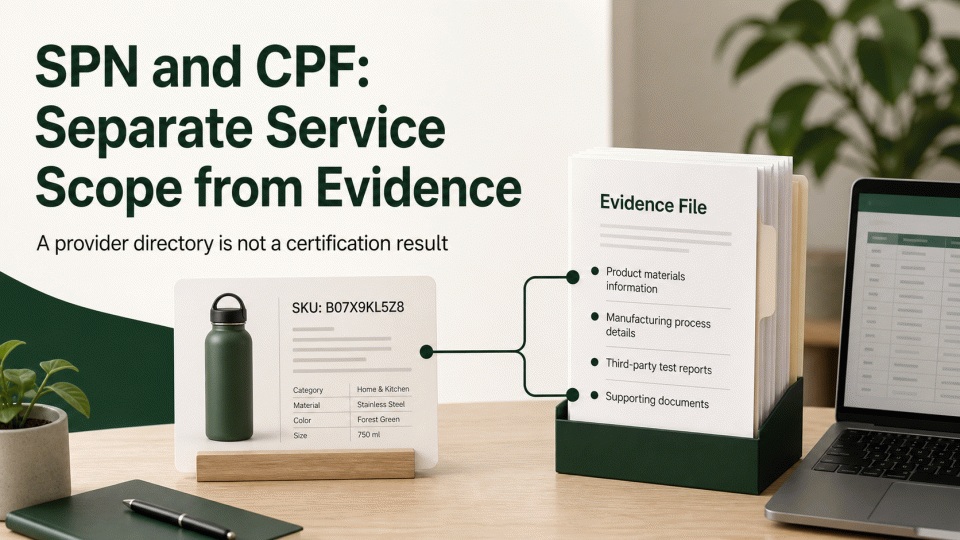
Sellers often treat finding a provider, obtaining support for a product claim, and seeing a Climate Pledge Friendly (CPF) label as one process. They are different layers with different owners and evidence. Separate them before choosing a service partner.
1. Separate SPN, CPF, and an external certification
Amazon describes the Service Provider Network as a directory of vetted third-party providers. Sellers can filter providers by service, location, language, and other information, then work directly with a selected provider. SPN connects a business need with a service provider; it does not issue a product certification decision. The provider’s scope, deliverables, and responsibilities should be documented separately.
Climate Pledge Friendly is described by Amazon as a way to help customers discover products with sustainability features. Amazon states that the program uses approved third-party certifications as well as Amazon-created certifications. Each certification has its own subject, criteria, and process. A product having supporting certification evidence, being recognized as CPF in a particular store, and receiving help from a provider are not interchangeable facts.
A useful page structure has three layers: identify the product and SKU; identify the specific certification or program basis; and record the relevant store, account, or submission evidence. Without supporting evidence, do not write that a product is certified, approved, guaranteed to receive a label, or compliant everywhere.
2. Build an evidence card for one SKU
Use the product as the working unit rather than treating a brand, factory, or supplier document as the complete scope. Record at least:
- ASIN, SKU, variation, model or version, and the target Amazon store;
- product name, materials or composition, key specifications, and packaging details;
- the named certification or program basis and its issuing or managing organization;
- the relationship among certificate holder, manufacturer, brand, seller, and importer where relevant;
- covered products, sites, models, current status, and the date of any registry check;
- the submitter, submission route, platform response or page record, and open evidence gaps.
Different models, materials, packaging formats, or production locations under one brand may require separate checks. A supplier document can be a lead, but its title, stamp, or a verbal statement that it “supports CPF” does not establish coverage. Check the original document, an official registry, or the program’s own scope explanation, and retain the mapping to the SKU.
3. Choose a provider by deliverables, not promises
If provider support is useful, define verifiable work packages: evidence inventory, SKU-to-certificate mapping, page-information preparation, platform-operation assistance, or a gap list. Each package should state its inputs, outputs, responsible party, and exclusions. Being listed in SPN is separate from having authority to speak for a certification body, Amazon, or a regulator.
- Does the provider clearly describe whether it offers consulting, document organization, testing coordination, or platform assistance?
- Does it ask for model, material, certificate-holder, and store details before proposing a path?
- Does it record platform handling, certification decisions, and its own deliverables separately?
- Are certification, testing, translation, and later-maintenance costs identified as included or excluded?
- Can the seller retain original reports, account records, and submission evidence?
4. Keep CPF page claims within the evidence
Amazon’s CPF materials describe the program as recognizing products with an improvement in at least one sustainability aspect and helping customers discover them through certification or program information. Page copy should name the supported attribute and its scope. Do not expand a narrow attribute into “fully compliant,” “risk-free,” or a claim that applies to every market.
If the relevant certification is incomplete, the target store has not recognized the product, or the seller lacks the supporting record, use bounded language such as “under review,” “planned for submission,” or “subject to the current requirements of the target store.” A provider directory, quotation, test booking, or internal checklist is not proof of a CPF outcome.
5. Four checks before publishing
- Scope: do the product, model, material, and store in the copy match the evidence?
- Sources: are the named program rules and platform requirements traceable to current official sources?
- Wording: are provider assistance, certification evidence, and platform recognition stated as separate facts?
- Records: are originals, query dates, submission records, and later changes retained?
Sources: Amazon Service Provider Network; Amazon Sustainability — Products and services. Platform entry points, eligible certifications, and display methods can change; check the current official page for the target store before submitting.


