
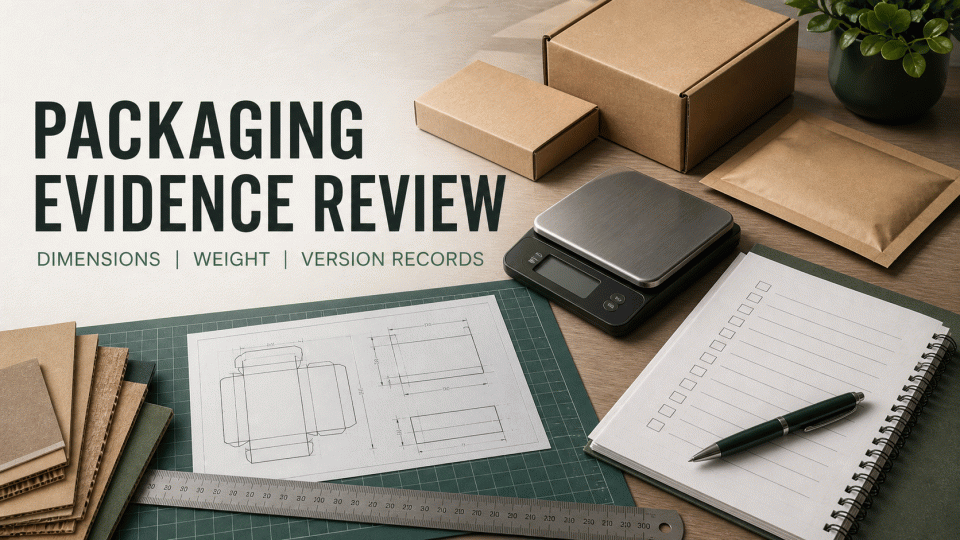
Use case: For brands, suppliers, and product teams organizing packaging data for Amazon listings, checking product-page wording, or deciding whether to learn more about Compact by Design.
Summary: Compact by Design is an Amazon-created sustainability program that uses “unit efficiency” to consider the volume, weight, uses, and packaging associated with a product. This article treats it as an evidence-mapping exercise: how to connect the product, packaging, quantity, and version records without inventing a universal score, threshold, review timeline, or outcome.
Scope first: Amazon’s public materials describe Compact by Design as an Amazon-created sustainability certification or recognition program, and explain that relevant products may be surfaced within the Climate Pledge Friendly system. It is not a general packaging regulation, a third-party certification, or a calculator that guarantees recognition merely because a box is smaller. Eligibility, markets, submission routes, and display status should be checked against Amazon’s current product workflow and records.
1. What the public sources support
Amazon sustainability materials connect Compact by Design with more efficient shapes and the removal of unnecessary air and materials. The SCS Global Services validation summary describes the framework in terms of unit efficiency and says that packaging volume, weight, and the amount of product delivered are considered. These points support a preparation direction, but they do not establish one public scoring formula for every category.
| Evidence area | Keep on file | Do not turn it into |
|---|---|---|
| Product and package dimensions | Model/version, measured dimensions, packaging layers, shipping-unit dimensions, measurement date and method | A universal “80% pass line” or self-calculated approval |
| Weight and quantity | Net product weight, layer-by-layer packaging weight, units per pack, and the stated use or purchase quantity | An unsupported reduction percentage, freight saving, or carbon result |
| Packaging structure | Drawings, photographs, materials, and the function of protective, securing, information, and outer-pack components | An assumption that protective or safety components can simply be removed |
| Product records | ASIN, SKU, model, market, change batch, and links between records, photographs, and measurements | Applying one version’s data to an entire product family |
2. Build a product–package–record evidence chain
Start by fixing the ASIN, SKU, model, and market, then preserve product photographs and the packaging version. Record the product itself, immediate packaging, transport packaging, and shipping unit separately; do not mix product volume with internal package space or outer-carton volume. Describe the function of each component and confirm that any material reduction does not compromise transport protection, product safety, labeling, or use. Index source records, calculation sheets, measurement photographs, drawings, and change approvals together.
For liquids, powders, concentrates, or multipacks, state the net content, nominal container capacity, selling unit, and the definition of “use.” These bases are not interchangeable. Keep different packaging, bundle, and market versions separate. Any transport testing, food-contact, children’s-product, electrical-safety, or other mandatory requirement must be assessed under its relevant law, standard, or product-safety record; Compact by Design does not replace those requirements.
3. Manual pre-submission checklist
- Confirm that the product, packaging version, ASIN/SKU, and market records match.
- Recheck the dimension, weight, quantity, and use bases, preserving source measurements and calculations.
- Review the protective, securing, labeling, and use functions of every packaging component.
- Cross-check photographs, drawings, material notes, and change records against the data sheet.
- Separate Amazon-program evidence from legal, product-safety, and third-party certification requirements.
- Before submission, verify the current Amazon route, scope, and display rules and retain the version date.
4. Sources and boundaries
This page is based on Amazon Business sustainability procurement information, an Amazon Sustainability report, and SCS Global Services’ validation summary for the Compact by Design framework, methodology, and criteria. The public sources support the program description and the unit-efficiency concept; they do not support the original article’s universal weights, fixed scores, category rankings, approval rates, named lab list, review timeline, or case outcomes.
This is a record-preparation reference, not an Amazon eligibility decision, product-safety conclusion, legal opinion, or certification result. 绿色方舟(深圳)认证有限公司 does not decide for Amazon. For a specific ASIN or SKU, use verifiable product records, applicable rules, and the current Amazon system information.


